


Jana Aranya: A cinematic take on the quiet commerce of conscience and compromise

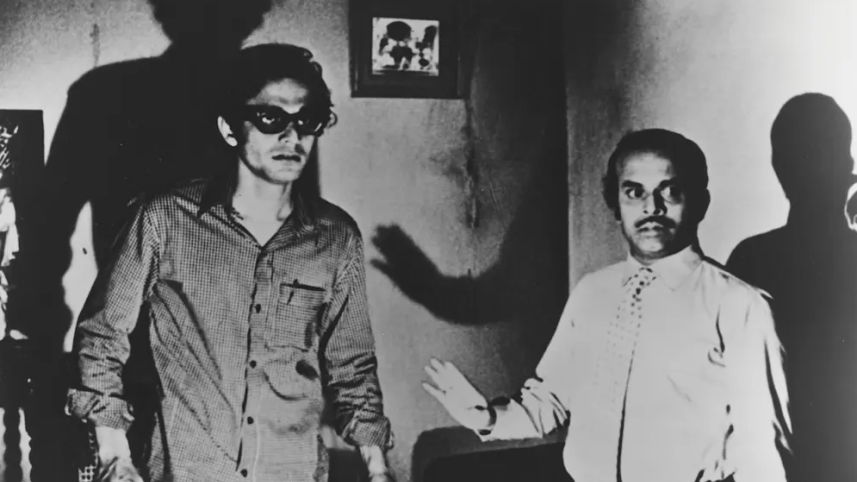
Some movies gain depth with time -- their questions echoing long after the era that produced them has receded into history. Half a century on, "Jana Aranya" stands firmly in that category.
Directed by Satyajit Ray and adapted from the eponymous novel by Mani Shankar Mukherjee, the movie was released on February 20, 1976.

Satyajit, always the most perceptive anatomist of the Bengali psyche, recognised that the tragedy of his time was not poverty alone but the corrosion of belief.
In "Jana Aranya", he turned his lens not on heroes or villains but on the ordinary young man standing at the threshold of adulthood, trembling before a future that demanded not his brilliance but his compromise.
The film did not arrive as a spectacle. It arrived as diagnosis.
Half a century later, its quiet opening still resonates with unsettling clarity, for "Jana Aranya" was never merely about one man’s fall. It was about the moment an entire generation realised that the world they had been prepared for no longer existed, and that to survive in its place, they would have to become something they never intended to be.
As the final instalment in Satyajit Ray’s Calcutta Trilogy, following "Pratidwandi"and "Seemabaddha", the film completes a triptych of urban disillusionment.
If "Pratidwandi"was about rebellion, and "Seemabaddha"about moral surrender masked as success, "Jana Aranya" is about capitulation. It chronicles the moment when resistance collapses, and compromise ceases to feel like a choice.
At its centre stands Somnath, played with haunting restraint by Pradip Mukherjee.
He is educated but unremarkable, earnest but unexceptional, hopeful but unequipped. He belongs to that vast, invisible demographic of the urban middle class, raised on the promise of meritocracy yet stranded in its failure.
The city around him, Calcutta, is no romantic metropolis. Satyajit strips it of nostalgia and reveals its mechanical indifference. The crowded alleys teem not with opportunity but with desperation -- human beings circulate like currency, their value fluctuating according to demand.
It is a city that does not nurture aspiration.
Somnath’s descent begins with banality. A missed opportunity here, a failed interview there.
Each rejection erodes not only his confidence but his sense of self.
Education, once revered as a ladder to dignity, reveals itself as little more than decorative ornamentation. The promise of social mobility becomes a cruel mirage.
When Somnath encounters Bishuda, played by the formidable Utpal Dutt, he is introduced to the logic of the marketplace. Business, he suggests, is not about producing value but about facilitating transactions. The middleman is not merely an occupation. He is a philosophy.
This is the film’s central metaphor. The middleman exists between need and fulfilment, between desire and its satisfaction. He produces nothing yet profits from everything. His currency is not goods but relationships, not skill but negotiation. He thrives in the interstices of dysfunction.
Somnath’s transformation into such a figure is gradual, almost imperceptible. He does not become corrupt overnight. He acclimatises. He rationalises. He learns the subtle grammar of compromise. Each small concession prepares him for the next.
Satyajit understood that moral collapse rarely arrives dramatically. It seeps in quietly, like damp through a wall.
 For all latest news, follow The Daily Star's Google News channel.
 The film’s most devastating sequence arrives when Somnath must procure a woman for a client in order to secure a lucrative contract.
What makes the moment unbearable is not merely the act itself but its emotional architecture.
The woman turns out to be the sister of his friend Sukumar, another casualty of systemic failure. She does not plead for rescue. She asserts her agency within her constrained circumstances. She is not a victim but a participant in the same brutal economy.
Satyajit dismantles the illusion of moral hierarchy.
Everyone is implicated. The system does not merely exploit individuals; it conscripts them into exploitation.
Somnath’s horror is not enough to prevent his compliance. He completes the transaction. He secures the order. He succeeds.
In that moment lies the film’s most chilling truth. Success, in such a system, is indistinguishable from surrender.
"Jana Aranya" is not simply about unemployment or economic hardship. It is about the commodification of human relationships.
Every interaction becomes transactional. Friendship becomes networking. Trust becomes leverage. Even intimacy becomes negotiable.
Satyajit presents capitalism not as an abstract ideology but as lived experience. Its violence is not spectacular but mundane. It manifests not in explosions but in conversations, in negotiations, in silences.
Stylistically, the film reflects this emotional austerity. Satyajit avoids melodrama. His camera observes rather than intrudes. He employs natural light, unadorned settings, and long takes that allow discomfort to linger.
Silence becomes a narrative device, conveying despair more eloquently than dialogue ever could.
The absence of a conventional musical score is particularly significant. It denies the audience emotional guidance. There is no orchestral cue to tell us how to feel. We must confront the reality unmediated.
The performances mirror this ethos.
And 50 years later, its relevance has only intensified. The middleman has not disappeared. He has proliferated. He exists in corporate intermediaries, freelance brokers, digital platforms.
The gig economy, often celebrated as liberation, frequently replicates the same precarity. The language has changed. The logic remains.
"Jana Aranya" is not confined to its historical moment. It is prophetic.
Its greatest impact lies in its emotional honesty. It refuses consolation. It offers no redemption arc, no moral restoration.
The protagonist does not reclaim his innocence. He adapts to its loss.
The film ends not with resolution but with acceptance. The middleman has found his place.
"Jana Aranya" remains less a film than a reckoning. It forces us to confront uncomfortable questions. What is the cost of success? What compromises have we normalised? What parts of ourselves have we quietly sold?
Satyajit offers no answers. He offers only a mirror.
And in that reflection, one may recognise not merely Somnath, but themselves.
Comments