


Living with graves: Loved ones buried inside houses
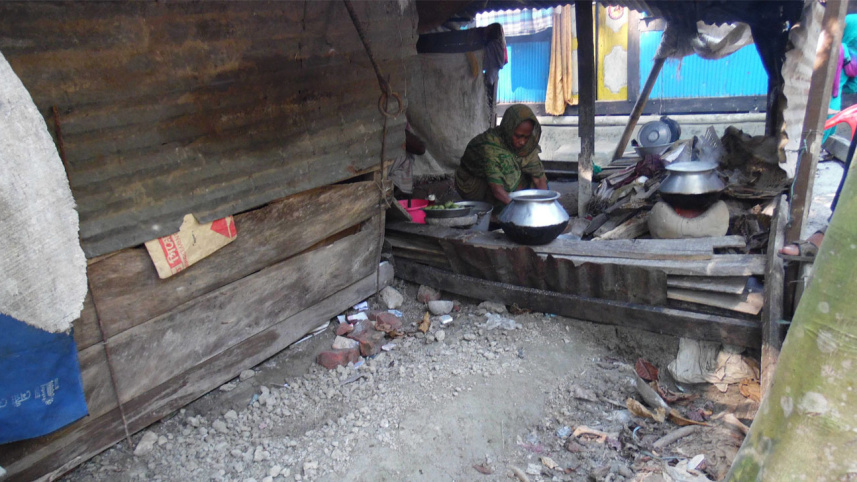
About 350 years ago some 20 families from Barguna district were made landless by various calamities. They resettled in Jalepara, in Amua union in Jhalakathi's Kathalia upazila, on an uninhabited quarter-square-kilometre island between the Bishkhali and Amua rivers. Jalepara's population has since grown to include around 300 families and while the land yet manages to tightly accommodate the living there's simply no ground for the dead.
"I buried my father under the bed where we sleep," says local Saleha Begum.

"We've been living on graves or with graves for a long time because there is no graveyard," says Khotojan Begum, an elderly woman.
All the local families have deceased relatives buried either inside or right beside their houses. "My mother is buried next to our bedroom," says neighbour Md. Abul Hossen Sarker. "My father is buried in our kitchen, which is a great tragedy since my wife has to cook there every day and she has to sit on the grave to do so."
In total Sarker's house includes four graves, including one under the toilet. In the past the situation was so dire, he explains, that at times corpses were given to the river. "But we really can't do that," he says, "It's not right."
According to Amua union chairman Akter Hossen Nijam, the problem stems from geography. "Their household land is surrounded by rivers," he says, "and with ten times as many people to house as there once were, there's no land for the deceased."
Poverty also creates the problem, says Sarker, as most Jalepara families rely on river fishing to sustain them and it's not a livelihood that leaves much profit for additional land purchase.
Yet, according to one local fisherman, the community did go as far as depositing money to buy cemetery land. "But the land owners won't sell to us because they think it's not prestigious to sell the land to us," he says.
The community has raised their concerns about lack of a cemetery to local and upazila authorities on many occasions, locals say, without any result.
Amua's chairman Nijam says meanwhile, that the situation troubles him too, and that he has contacted higher authorities to ask for an allotment of public land. He says he's yet to receive a response.
"I am informed of the problem," says Jhalakathi's deputy commissioner Mizanul Haque Choudhury, "I hope to allot a piece of land for a graveyard as soon as possible. Two plots have been selected, one of which will be their graveyard once official procedures are complete." It's quite upsetting, he adds, to think that some in the community don't have any land on which to bury their dead.
 For all latest news, follow The Daily Star's Google News channel.
Comments