


Without radical trade reforms, Bangladesh risks losing competitive edge: economist
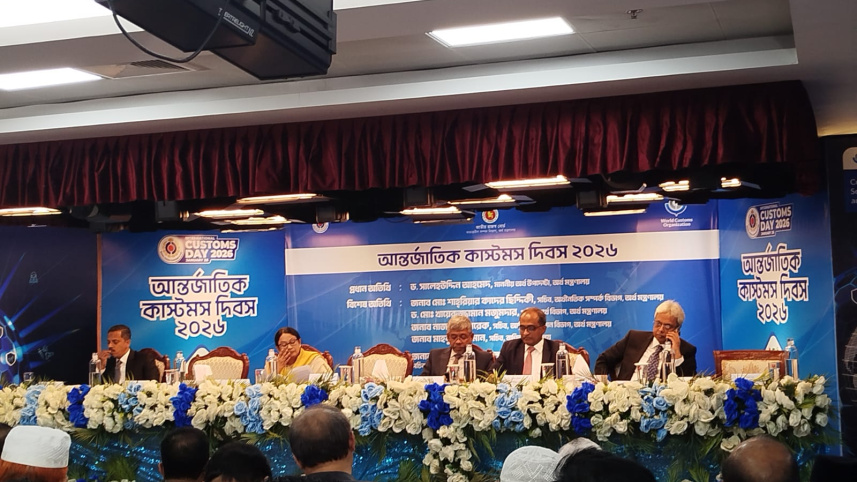
Bangladesh may fall behind peers and competing economies without radical reforms in tariffs and trade facilitation within five years, an economist warned today.
“Unfortunately, we have not undertaken significant trade policy reforms over the past 15 to 16 years, and all the reform work has now piled up,” said Zaidi Sattar, chairman of the Policy Research Institute of Bangladesh, at an event marking International Customs Day 2026 at the National Board of Revenue (NBR) headquarters in Agargaon.

“Compared to international standards, Bangladesh’s tariff regime is very high and extremely complex,” he said.
This makes customs procedures cumbersome, raises compliance costs and weakens the country’s competitiveness in global value chains, he added, stressing the need for extensive customs modernisation and radical liberalisation of the trade policy.
"If radical changes are not implemented within the next five years -- particularly in tariff rationalisation, tariff modernisation, and trade facilitation -- and if strong measures are not taken in these areas over the next three to five years, the country’s economy will fall behind many other competitive economies,” the economist said.
He expressed optimism that Bangladesh would move towards a modern customs administration that prioritises trade facilitation over revenue collection.
“At present, trade taxes account for around 2.5 percent of GDP. By 2035, this should decline to no more than 1 percent,” he said, adding that the reduction will ensure trade facilitation through a modern customs system.
At the event, Commerce Secretary Mahbubur Rahman urged NBR to prioritise process simplification to remove non-tariff barriers that continue to impede trade.
He noted that visiting European Commission officials recently raised a long list of concerns, many of which were linked to customs procedures.
“People are not really asking us to remove high tariffs. They are raising concerns over legitimate technical barriers to trade,” he said, adding that around 15 of the EU’s concerns related to customs processes and day-to-day operational practices rather than formal rules and regulations.
The commerce secretary said Bangladesh’s upcoming LDC graduation has made trade facilitation more urgent, as the country seeks to retain preferential market access through agreements with key partners.
“We have already initiated the second round of negotiations for a Comprehensive Economic Partnership Agreement with South Korea. We will soon begin negotiations with the European Union, and also with Australia and Canada,” he said.
NBR Chairman Md Abdur Rahman Khan chaired the event, where nine new firms received Authorised Economic Operator certificates and 15 customs and VAT officials from Bangladesh received the World Customs Organisation (WCO) Certificate of Merit in recognition of their professional excellence and contributions.
 For all latest news, follow The Daily Star's Google News channel.
Comments