


Regulator moves to rewrite IPO rules

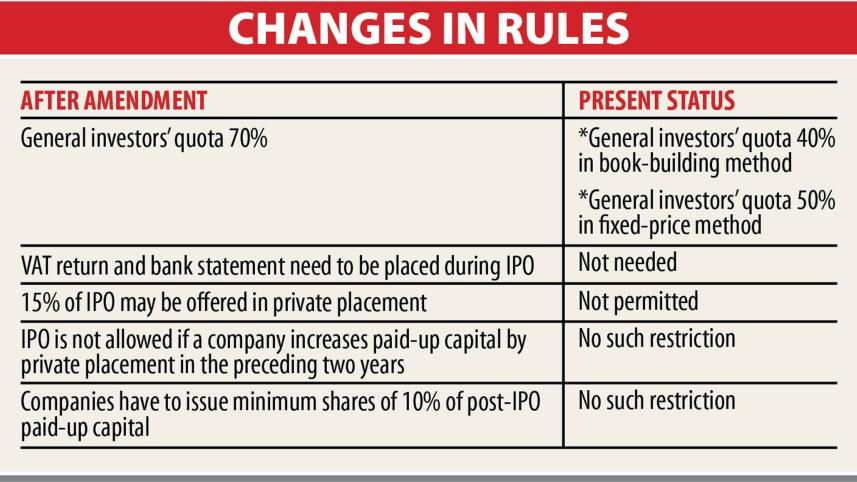
Retail investors may get a higher allocation of shares during initial public offerings (IPOs) as the regulator has moved to make the market an attractive investment destination for individuals.
The Bangladesh Securities and Exchange Commission (BSEC) has proposed to raise the general investors' portion in the IPO in the draft amendment of related rules.

The regulator has published the draft of the amended public issue rules on its website, seeking comments from the stakeholders by March 15.
The commission plans to award 70 per cent shares of an IPO to general investors. Now, it stands at 50 per cent for the fixed-price method and 40 per cent for the book-building method.
When a company enters the market at face-value, it goes through the fixed-price method. A firm follows the book-building method if it wants a higher price over the face-value.
Of the 70 per cent share, 5 per cent has been proposed to reserve for non-resident Bangladeshis, from 10 per cent now.
The proposal came at a time when the regulator is set to implement a new provision for IPOs that will distribute shares proportionately among the applicants, bringing an end to the lottery system.
From April 1, every IPO applicant will get shares if they have a minimum secondary market investment of Tk 20,000. They will have to make a subscription of at least Tk 10,000 in the IPOs.
Retail investors welcomed the proposal on the higher quota for individuals. Institutional investors expressed concerns that their portion will be lower because of the amendment.
"Our stock market has been bearish for almost all the time in the last decade. Many institutional investors did not make a good profit from IPOs. Now, we will have to fight in the secondary market as well to stay afloat," said an asset manager, preferring anonymity.
Other proposed amendments are good for the market, said the asset manager.
According to one of the amendments, foreign investors and placement shareholders of an IPO-seeking company would face a lock-in period for one year and two years, respectively.
In a first, the regulator has set a minimum share issuance. If the size of the post-IPO paid-up capital is up to Tk 75 crore, at least 30 per cent shares have to be issued.
At least 20 per cent of shares have to be offloaded if the post-IPO paid-up capital ranges from Tk 75 crore to Tk 150 crore. It will be at least 10 per cent when the post-IPO paid-up capital goes past Tk 150 crore.
"Most of the amendments proposed are positive," said Prof MA Baqui Khalily, a former chairman of the finance department at the University of Dhaka.
"Because of the steps, the supply side of the stock market has been strengthened. General investors will be happy as they will get more shares."
One thing has to be ensured so that mutual funds don't get a lower number of shares because the sector plays a vital role in the stock market, he said.
"Though they are getting many benefits now, the mutual fund sector should not be impacted."
IPO-seeking companies will have to submit the certified copies of VAT returns from the National Board of Revenue and the certified copies of bank statements, according to the draft amendment.
The commission may verify the authenticity of the documents.
 For all latest news, follow The Daily Star's Google News channel.
 "Bank statements and VAT return certificates will add greater transparency to IPO-seeking companies' financials," said Prof Khalily.
The provision of setting aside a 15 per cent share of IPO for IPO-seeking companies was not welcomed.
An issuer company may offer private placement for up to 15 per cent of the size of the IPO at par value under the fixed-price method or at a cut-off price under the book-building method. It will be treated as a part of the IPO, the draft rule said.
A company will not get permission to go public if it has had any private placement in the preceding two years before the IPO.
A merchant banker said the provision to allocate 15 per cent of the IPO shares as private placement would not be a good one.
"Neither general investors nor institutional investors will benefit from it. It may work for the betterment of a company's owners."
Comments