


Policy support vital for API industry growth: experts

- Experts urge policy support, remove barriers
- Stakeholders propose permanent API taskforce formation
- Local API production vital post-LDC graduation
- Energy, pricing hurdles threaten industry growth
Health experts and pharmaceutical industry leaders yesterday called for policy support and the removal of tariff and non-tariff barriers to boost local production of raw materials for drugs, aiming to reduce import dependency and keep medicine prices stable.
They also proposed forming a permanent taskforce involving all stakeholders to advance the active pharmaceutical ingredient (API) industry.
Experts said competition in the pharmaceutical sector would intensify once Bangladesh graduates from the least developed country (LDC) category and loses exemptions under the Agreement on Trade-Related Aspects of Intellectual Property Rights (TRIPS).
In such a scenario, increasing local API production will be crucial for sustaining growth.
They noted that with long-term planning and effective public-private partnerships, Bangladesh could become self-reliant in API production within a short time.
The views were shared at a discussion titled "Policies and Implementation Strategies for the Development of the API Industry" at the Super Specialised Hospital of Bangladesh Medical University (BMU) yesterday.
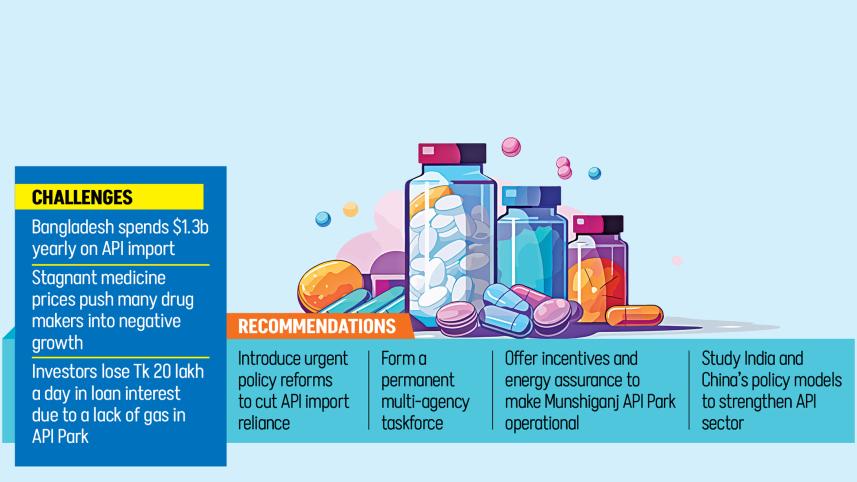
The Alliance for Health Reforms, Bangladesh (AHRB), a platform for healthcare reforms and the event's organiser, offered three proposals — giving production linkage incentives, forming a permanent taskforce, and ensuring an uninterrupted gas supply at the API Industry Park in Munshiganj.
Bangladesh's pharmaceutical sector now meets almost the entire domestic demand for medicines and exports to over 150 countries.
However, most of the raw materials, or APIs, still have to be imported, which increases pressure on foreign currency reserves and makes local production vulnerable to international market volatility.
In a keynote presentation, Prof Syed Abdul Hamid, convenor of the AHRB, said Bangladesh spends $1.3 billion annually to import APIs, so the industry must be developed to save hard-earned foreign currency.
The industry needs to flourish to address the post-LDC graduation challenges of the pharma sector and generate thousands of jobs, he said.
He recommended providing both financial support, including a 20 percent incentive following in the footsteps of India, and policy support, including streamlining regulatory requirements, to develop the sector.
Zakir Hossain, secretary general of the Bangladesh Association of Pharmaceutical Industries (BAPI), said practical policy support was needed to advance the API industry, as merely forming committees would not be enough.
He said that despite several committees being formed by the government over the past 15 months, none included any representatives from BAPI.
Yet, he added, the opinions of relevant stakeholders are essential for the development of this sector.
SM Saifur Rahman, president of the Bangladesh API and Intermediaries Manufacturers Association (BAIMA), said that to compete with India and China, Bangladesh needs to properly understand their strategies for expanding the API industry.
He said India has formed a permanent taskforce to support the growth of its API sector, and Bangladesh should also establish a similar body involving all relevant stakeholders.
 For all latest news, follow The Daily Star's Google News channel.
 Muhammad Halimuzzaman, treasurer of BAPI, said that encouraged by the government, they had set up a factory in the API Park in Munshiganj with a loan of Tk 490 crore two years ago.
But the government's relevant agency is now saying that it will not be able to provide gas supplies, he said.
"Now, we are paying Tk 20 lakh in interest every day… In this situation, no one else would be foolish enough to invest in the API Park," he added.
Ahmed Ehsanur Rahman, a scientist at the International Centre for Diarrhoeal Disease Research, Bangladesh (icddr,b), and a member of the government's Health Sector Reform Commission, said 90 percent of the problems faced by the API industry are well known.
"These issues have been discussed for over a decade, but no progress has been made. Before moving forward, the government and the companies must first clarify their vision for the API sector," he added.
Abdul Muktadir, president of BAPI, said around 70 percent of pharmaceutical companies are experiencing negative growth, as the government has not adjusted medicine prices since 2017.
He added that the API industry is facing two major obstacles — an inadequate supply of primary energy and a lengthy, time-consuming process to obtain approval from the Department of Narcotics Control for solvent intermediates.
He called for the authorities' intervention to ensure that alternative energy sources are managed efficiently and that approvals from the Department of Narcotics Control can be obtained within 15 days.
He said developing the API industry would not only benefit the pharmaceutical sector but also support the agrochemical and dye industries.
ATM Saiful Islam, additional secretary to the Health Services Division, said national health protection, economic growth, and employment are closely linked with the pharmaceutical sector.
He added that the development of the API industry is crucial to ensure an uninterrupted supply of raw materials for pharmaceutical companies.
The programme was moderated by Prof Syed Md Akram Hussain, a member of the Health Reform Commission and chairman of the Clinical Oncology Department at BMU.
Teachers of the pharmacy department, doctors, and current and former government officials also attended the event.
Comments