


Machinery imports rebound


 For all latest news, follow The Daily Star's Google News channel.
 - Capital machinery imports rise 23 percent
- Private sector credit growth hits 22‑year low
- Economists caution recovery remains modest, fragile
- World Bank projects 4.8 percent GDP growth
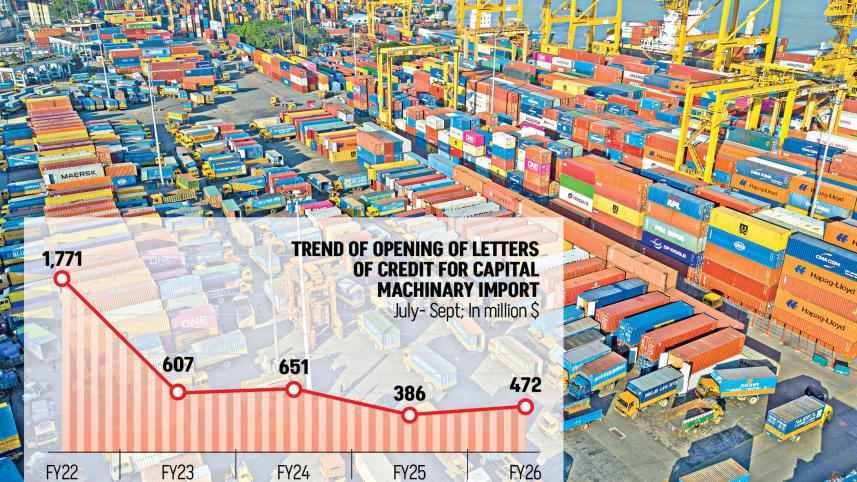
Bangladesh's investment is showing early signs of revival, with the opening of letters of credit (LC) for capital machinery imports increasing by over 20 percent year-on-year in the first quarter of the current fiscal year.
The growth comes amid a sluggish private sector credit growth, which stood at the lowest level in 22 years during the first two months of the fiscal year 2025-26 (FY26).
Bangladesh Bank data shows that the LC opening for capital machinery rose by 23 percent year-on-year to $472 million during July-September. In FY2024, the figure stood at $384 million, down by 41 percent year-on-year from $651 million a year ago.
In terms of intermediate goods, LC opening rose by 1.59 percent during the period, compared to a 7.22 percent decline in the previous fiscal year. Similarly, LC opening for industrial raw materials increased by 5.73 percent during the same period, up from 4.66 percent earlier.
Economists, however, cautioned that while this is a positive sign, it remains modest and far from indicating a full-fledged recovery.
"Investors might be feeling better, but they're not yet ready to put out their money from their own pocket into new investments," said Zahid Hussain, former lead economist of the World Bank's Dhaka office.
Meanwhile, Prof Mustafizur Rahman, distinguished fellow at the Centre for Policy Dialogue (CPD), said, "The situation was negative before, but now it has turned positive.
"Since last year was deeply negative, this shift indicates that things are returning to a more normal situation."
Rahman, however, noted that private sector credit growth still hasn't strengthened.
It remains below the central bank's target of an 11 percent credit growth for the private sector. In the first two months of the current fiscal year, credit to the private sector grew only 6.35 percent, the lowest in over two decades.
He said this rise in capital machinery imports is mainly for export-oriented sectors, while domestic market-oriented investments are not increasing. As a result, private sector credit growth remains very low.
After the government announced the national election timeline, businesspeople received positive signals, he said. "Although many businesspeople may still wait, some are likely already taking this as an investment opportunity."
Economist Hussain termed the development a low-base effect. "For raw materials and intermediate goods, the indicators are not showing much change; it's mostly business as usual," he said.
Although there's a bit of recovery where things were negative before, the numbers aren't big enough to suggest a strong turnaround, he added.
"The 22 percent growth is in capital machinery imports. But in absolute terms, it's only about $400–$500 million. For a $400-billion economy with 180 million people, that's not much; it's mostly machinery replacement," Hussain said.
He said that the first quarter of the last fiscal year was abnormal, as trade was disrupted by the mass uprising against the Sheikh Hasina-led government.
"Now, the situation looks somewhat normal. But I wouldn't call it a recovery yet. From this data, we don't see a clear sign of a turnaround," he added.
Hussain suggested replicating the model of the recent university students' representative elections in the upcoming national election.
After witnessing the lower growth in Bangladesh, at least three multilateral development partners projected that growth may increase moderately, which aligns with central bank data.
The World Bank, in a recent report, projected Bangladesh's real GDP growth to be 4.8 percent in FY26, which would be an improvement from FY25 but still below its past 10-year average of 6.3 percent.
The increase is anticipated to be supported by a gradual recovery in private consumption as inflationary pressures ease. Private investment growth is expected to recover only marginally to 1.9 percent in FY26, remaining well below its last decade's average of 7.4 percent.
The multilateral lender stated that persistent policy uncertainty surrounding the national election and fragilities in the banking sector are likely to weigh on private sector activity.
Similarly, public investment growth is expected to remain subdued ahead of the election and in light of the authorities' intent to implement development projects more prudently.
Export growth is expected to remain robust, as the new tariff schedule announced by the US is not likely to hurt. Import growth is expected to pick up as domestic demand improves and external pressures that constrained imports in the prior year ease.


Comments