


Top business leaders welcome trade in rupee with India

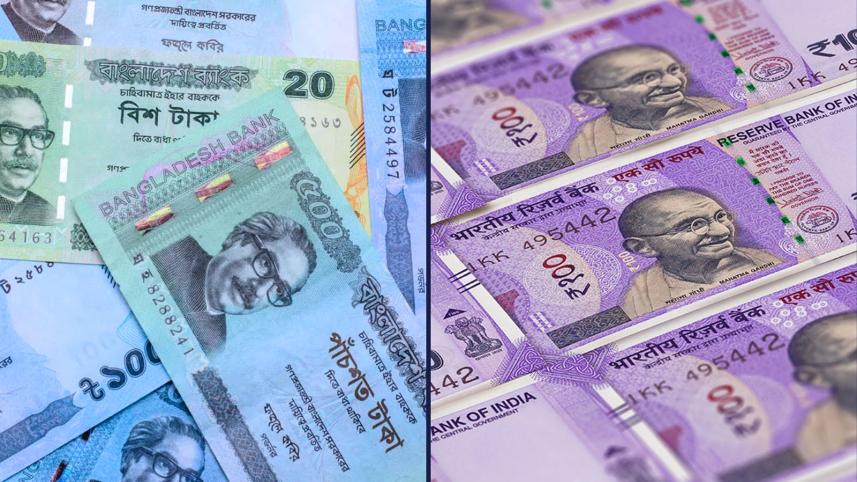
The settlement of trade with India in the rupee will offer some benefit to exporters as this is expected to protect them from currency conversion loss and save time, according to a number of business people.
However, the inclusion of the Bangladesh taka in making settlements for trades and services will give a boost to the growing bilateral commerce between the two nations, they said.

Several exporters and business people shared the view yesterday after Bangladesh and India launched trade settlement in the Indian rupee (INR) in order to cut over-dependence on the US dollar.
"The trade settlement in rupee is an option that will ultimately bring benefits to local exporters," said Faruque Hassan, president of the BGMEA
"The trade settlement in the rupee is an option that will ultimately bring benefits to local exporters although it will be applicable for $2 billion worth of imports initially. In the future, it is expected to be more," said Faruque Hassan, president of the Bangladesh Garment Manufacturers and Exporters Association.
He said the launching of a dual-currency debit card in September will also ease pressure on the dollar in both countries.
The BGMEA chief said the government has allocated Tk 10,000 crore to import raw materials. In this case, garment exporters can easily buy raw materials from India in the rupee.
He said the hassle of a multiple conversion of the currency will ease and the taka should also be included in the two-way trade in the future.
Md Fazlul Hoque, managing director of Plummy Fashions Ltd, a knitwear exporter, said India is a growing and prospective market for Bangladesh.
He said the settlement of trade in the INR will bring benefits if it could save Tk 1 per dollar by avoiding multiple conversions.
Plummy Fashions also exports products to India, alongside other countries.
Hoque raises some questions.
"What will be the effective dollar rate in Bangladesh to determine the exchange rate of the Indian rupee and the taka? The question comes as we have different rates for exporters, importers and remitters. This needs clarification," he said.
He said importers have to pay in dollars even when they buy raw materials from local sources.
"Will we be able to buy the raw materials in the rupee or taka?" he asked.
"A lot of things have remained unclear."
Overall, he said, the settlement of trade in the INR may not bring significant benefits to exporters.
Ahsan Khan Chowdhury, chairman of Pran-RFL Group, describes the beginning of trade settlements in the rupee as a great initiative.
"This is a step in the right direction."
"This will give more comfort to my customers and take us closer to our customers and eliminate wastage and currency conversion loss. India is a big market and it is a big opportunity for us."
 For all latest news, follow The Daily Star's Google News channel.
 The group ships products to India.
Chowdhury said Pran-RFL group will try to settle import bills in the INR equal to the amount of its export earnings from the country.
"Let's try. If it is not beneficial, we can always come back," he said.
MA Jabbar, managing director of DBL Group, a garment exporter to India, says the new initiative will benefit both exporters and importers of Bangladesh and India as the process will be simplified and the cost of currency conversion will reduce to some extent.
He also thinks trade settlements should also be carried out in the taka.
Mohammad Hatem, executive president of the Bangladesh Knitwear Manufacturers and Exporters Association, said the move will deepen bilateral ties.
"The over-reliance on the US dollar will reduce to some extent. This will cut the cost of doing business as well."
Mohammad Ali Khokon, president of the Bangladesh Textile Mills Association, said trade volumes worth $2 billion might be settled in the rupee initially.
The balance of trade heavily tilts towards India, with the neighbouring country exporting goods worth more than $12 billion to Bangladesh.
Bangladesh ships goods worth $2 billion to India annually.
"So, Bangladesh's benefit will be low," Khokon said.
Abdul Matlub Ahmad, president of the India-Bangladesh Chamber of Commerce & Industry, said the dual-currency card to be introduced in September will reduce the exchange rate loss stemming from the conversion of US dollars.
"The taka-rupee card would be useful for travellers of both countries."
Comments