


Panchagarh’s tourism potential remains untapped


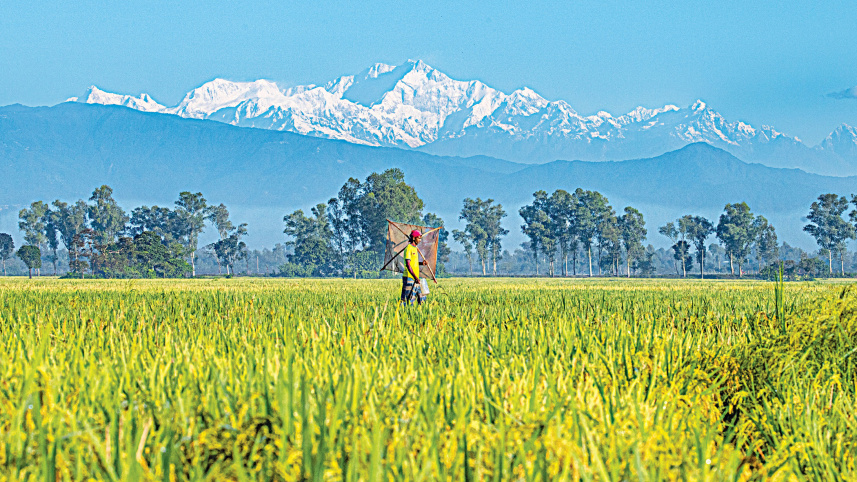
Raju Ahmed, a businessman from Lalbagh, Dhaka, came to Panchagarh for sightseeing with his family in November 2025. His primary aim was to enjoy the iconic sight of Mount Kanchenjunga.
Bordered by India on three sides, Panchagarh sits at the base of the Himalayan foothills, a setting that gifts the district with distinctive weather and striking natural scenery. Panchagarh has long been known for an abundance of gravel beds. Thousands of acres of land were devoted to digging for the resource, bolstering the regional economy.

But over the years, quite a few tourist attractions in the region -- other than the breathtaking mountain view -- have started to draw attention. Locals trace this change back to the establishment of Banglabandha Land Port in 1997.
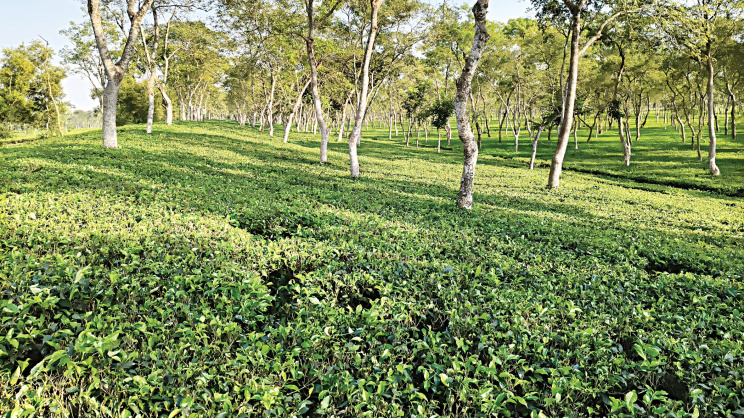
Tourist spots include the country’s only rock museum, Banglabandha Zero Point and Banglabandha Land Port, sprawling green tea estates, Debiganj Karatoya Bridge, Tetulia Dak Bungalow, and the Mahananda River.
Maharaja Dighi, Mirza Shah Mosque, Golokdham Temple, Bodeshwari Temple in Boda upazila, and Imambara Mosque in Atwari upazila also receive attention. The tulip garden in Tetulia’s Darjipara village and the ruins of Bhitargarh, an ancient fort city built around the 5th century, are also notable destinations.
Ahmed mentions that he has visited several tourist destinations in the country, but this is his first time in Panchagarh. The district is tourist-friendly, he observed, offering satisfactory lodging, food, and transportation at a significantly lower cost than other tourist attractions in the country.
Despite the inviting prospects, Panchagarh’s potential as a tourism hub remains lacklustre, years after it started to draw in curious tourists.
Mehedi Hasan Khan Babla, president of the District Residential Hotel Owners’ Association, reminisces about the year 2000 when a handful of tourists started visiting the area. As the infrastructure in the area improved, so did the number of visits. Tourism started picking up significantly in 2016. However, in the years since, the tourism sector’s growth in the area has not met expectations, the businessman said.
Banglabandha Land Port was established in the district in 1997. In 2011, an agreement was signed with neighbouring India to facilitate import and export activities. Subsequently, in 2017, trade with Bhutan began through this port. Since the establishment of immigration services at this land port in 2016, travel to India has become more convenient for Bangladeshi citizens.
Consequently, travelling to Panchagarh was also made easier as many new roads and bridges were constructed. Rail connectivity was enhanced, and inter-district travel also improved.
“Communication with Dhaka used to be very limited,” said Shafiqul Islam, former principal of Bhajanpur Degree College in Panchagarh. After the Jamuna Bridge opened, it prompted many changes, he mentioned.
While travel has been made easy, lodging has not seen improvements proportional to the tourist influx.
THOUSANDS OF TOURISTS, NOT ENOUGH HOTELS
According to local businesspeople, Panchagarh district has approximately 25 hotels in total; of these, 13 are located in Panchagarh Sadar, while the remaining are in Tetulia upazila. Meanwhile, Tetulia boasts 3 resorts and 10 to 12 homestays.
Mehedi Hasan Khan Babla, also a former president of the Panchagarh Chamber of Commerce and Industry, said most hotels are of moderate quality, with two 2-star hotels located in Panchagarh town.
Overall, he said, the tourism sector in Panchagarh collectively employs around 250 people and generates business worth approximately Tk 10 to Tk 12 crore annually.
Robiul Islam, the manager of Himalaya Residential Hotel in Tetulia upazila, said that many tourists used to be unable to find lodging after visiting the local attractions. In some cases, the lodging options they found were substandard.
This prompted the opening of the hotel in February 2024.
From October to December, around 20 tourists stay at the hotel over the weekend, from Thursday to Saturday, he added.
Afroz Shahin Khasru, the Upazila Nirbahi Officer (UNO) of Tetulia, said that during the tourism season, when Kanchenjunga becomes visible, nearly 10,000 tourists visit Tetulia each day.
 For all latest news, follow The Daily Star's Google News channel.
 However, the number of accommodation facilities compared to the number of tourists has remained disproportionately low, he said.
Consequently, the tourism sector has not grown as much as expected. The UNO stated that the private sector needs to come forward in this regard. Recently, construction work for several new resorts in the upazila has begun, he added.
Echoing his statement, Babla pointed out that if loans were made available under easier conditions for establishing tourism-centred businesses, the district’s potential could be better utilised.
He further noted that the district administration is attempting to brand Panchagarh in various ways, but these efforts need to be made more dynamic.
BYPASSING THE LODGING CHALLENGE
The lack of accommodation is a detriment not only for tourists but also for tour operators.
“When we organised our first tour in 2016, with a total of 36 tourists, Panchagarh was largely unknown as a tourist destination,” said Shafiqul Islam Polash, chief executive officer at Banglar Pothe, a tour operator.
He added that, at that point, accommodation options were extremely limited, with only a few basic hotels primarily catering to local businessmen.
Even now, the number of tourists outweighs the capacity of hotels in Panchagarh. The solution to this problem has been elusive for years, until some tour operators came up with the idea of “day-trips.”
Mostafa Hossain Munna, founder and CEO of the tour operator Panchagarh Tourist Management Centre, said the company has been organising tours to Panchagarh since 2021. After facing the difficulties of finding accommodation for all the tourists under his charge a few times, he started taking groups on “day-trips.”
This type of trip requires booking a bus for a group of tourists. The bus leaves Dhaka at around 7pm and reaches Panchagarh right around daybreak, perfectly on time for them to experience the magnificent sight of the first rays of the sun shining upon the peak of Mount Kanchenjunga.
The tour group then visits around ten other attractions scattered across the district, Munna said. At the end of the day, the group again boards a bus and returns to Dhaka by the next morning.
No hotel or resort booking is required for the entire trip, and therefore, the lack of accommodation in Panchagarh does not affect the tourists at all.
“This type of trip costs around Tk 2,000 to Tk 3,500 per person,” Munna told the Daily Star.
In case the tourists want to stay overnight despite the lack of vacancy in the hotels and resorts, there is another way to accommodate them, Munna said, referring to homestays.
Sensing that accommodation facilities were inadequate considering the rush of visitors, the district’s administration in 2021 took the initiative to develop “community tourism” with help from the Bangladesh Tourism Board. The concept refers to locals renting out one or two rooms of their houses, alongside providing food. Over time, this concept has evolved into the idea of “homestays” in the region.
TOURISM CONTINUES TO PROP UP LOCAL BUSINESSES
Hafizul Islam runs a tea stall next to a small pond in the border area of Magura union in Panchagarh Sadar upazila. The border between Bangladesh and India lies right beyond the pond. Tourists curious to peek at the border frequent his shop, and that’s how the tea seller earns his livelihood.
Tourists started coming to this area in 2020, and Islam decided to open the tea shop. The first year, nearly 2,000 cups of tea were sold daily, he recalls. Now, that number has risen to around 3,000 cups per day. The profit is not spectacular, he says, but he is comfortable.
The Jannat Hotel and Restaurant was opened at the beginning of 2022. The eatery, located at the Chaurasta Bazar in Tetulia upazila, also enjoys steady business.
At first, there were around 350 to 400 tourists eating there daily in peak season, and daily sales were around Tk 25,000. The number of customers increased to nearly 700 per day during the same period in 2025, and daily sales were around Tk 40,000.
Comments