


Telenor shrinks Asian footprint, puts GP in spotlight
Over the past month, two major developments have stood out in the Asian telecommunications market. Telenor, the Norwegian telecom company, has finalised the sale of its Pakistan operations, nearly two years after announcing its exit, and reached an agreement to sell its stake in Thailand, further shrinking its presence in Asia.
With these moves, Telenor has exited most of its Asian markets through a series of divestments, leaving only Malaysia and Bangladesh -- where the company began its Asian journey nearly three decades ago -- as its remaining major presence in the region.

These developments raise an obvious question: what lies ahead for Telenor’s operations in Bangladesh, particularly Grameenphone, as the company continues to reassess its exposure to Asia?
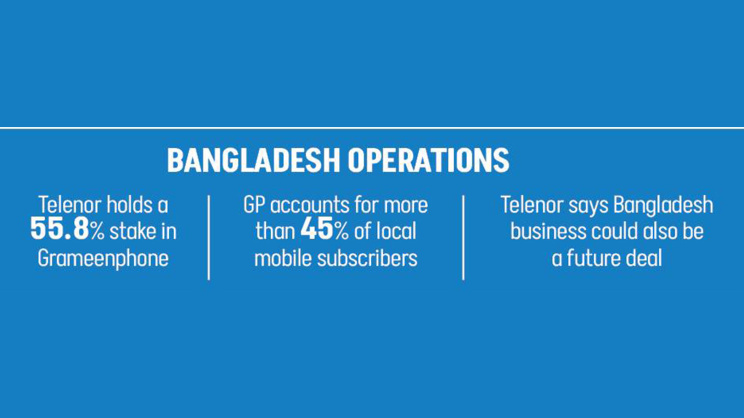
Last week, Telenor signalled that even its remaining Asian assets could be involved in future transactions. According to Reuters, the company said its assets in Asia, including Grameenphone, where it holds a 55.8 percent stake, “could also become subject to deals.”
“It’s business as usual until such time that any opportunities present themselves,” Torbjorn Wist, chief financial officer of Telenor Group, told Reuters in a telephone interview.
Asked specifically about Bangladesh, Jon Omund Revhaug, head of Telenor Asia, expressed the same view. “I would reiterate what Torbjorn, our Group CFO, has said. We continue business as usual with full focus and commitment in Bangladesh until such time that any opportunities present themselves,” Revhaug told The Daily Star.
This marks the first time senior Telenor officials have publicly floated the possibility, however cautiously, that Grameenphone could be part of a future deal if circumstances align.
As recently as a year and a half ago, Telenor took a much firmer stance. In an interview with The Daily Star on April 3, 2024, Sigve Brekke, former president and CEO of Telenor Group, stressed the company’s long-term commitment to Bangladesh.
“…we’re very committed (towards Bangladesh),” Brekke said at the time.
His statement came as Telenor was restructuring its Asian operations in Thailand and Malaysia through local mergers, after which it emerged as a minority shareholder. At the time, the strategy appeared to be to remain in Asia while reducing direct operational exposure.
TELENOR’S JOURNEY IN ASIA
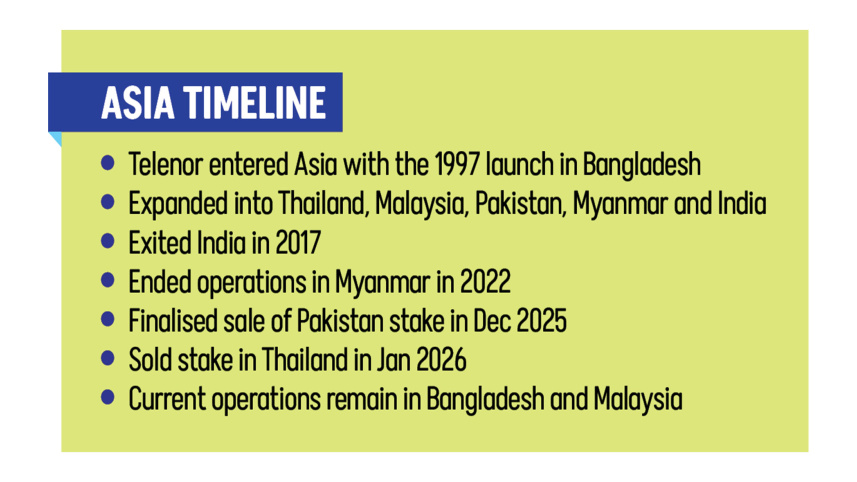
Telenor’s expansion in Asia began with the launch of Grameenphone in 1997. Its success in Bangladesh became the foundation of the company’s regional growth, paving the way for entries into Thailand, Malaysia, Pakistan, Myanmar, and India.
However, Telenor’s journey in Asia has also involved several exits. Nearly eight years after entering India, it withdrew in 2017. In Myanmar, it entered in 2014 but left in 2022 following the military coup and new junta-imposed regulations.
After these departures, Telenor now remains in only two Asian markets: Bangladesh and Malaysia, where its role differs sharply. In Malaysia, Telenor holds a 33.1 percent stake in CelcomDigi Berhad, the country’s largest mobile operator, after a merger completed in late 2022. It is a minority shareholder with limited operational control.
In Bangladesh, Telenor has a much stronger presence. Through Grameenphone, the telecom market leader, it owns a 55.8 percent majority stake. Grameenphone serves 45.46 percent of the country’s total subscribers, generates nearly half of industry revenue, and accounts for 88 percent of sector profits. It is also the most valuable company on the country’s stock market.
“Telenor has been a growth partner in Bangladesh for 28 years. We remain committed to bringing global expertise to support the country’s connectivity and digital development goals,” said Revhaug.
When asked about Bangladesh’s long-term growth potential and regulatory environment, as Telenor refocuses on the Nordic region following its exits from Pakistan and Thailand, Revhaug said the country must prioritise a sustainable investment climate. “Investors need long-term predictability and forward-looking regulations to boost market growth and confidence,” he added.
Revhaug further said, “This depends on a strong, objective regulatory framework with fair dispute resolution mechanisms based on international best practices, and streamlined consultations that rely on evidence-based input from industry stakeholders. Such rigour builds trust, ensures technical feasibility, and produces balanced outcomes that reward competition and innovation rather than narrow interests.”
The Daily Star spoke with half a dozen senior executives from various telecom companies to understand industry sentiment, which was divided.
Several executives said Bangladesh remains Telenor’s “golden goose” in Asia, consistently generating strong returns over the years.
 For all latest news, follow The Daily Star's Google News channel.
 “Grameenphone is not only profitable, Telenor also holds a majority stake, giving it control and strategic comfort. That makes Bangladesh fundamentally different from its other Asian markets,” said one senior executive.
Others, however, see a changing scenario. “Telenor’s overall strategy has shifted. We are seeing a gradual withdrawal of capital from non-core markets, except the Nordic region,” said another top executive. “Growth in Bangladesh’s telecom market has slowed, making it less attractive for foreign investors.”
The telecom market should ideally see at least 5 percent annual growth, but Grameenphone is currently facing stagnation and, in some cases, a decline. Its revenue has fallen by around 1 percent in 2024 and first three quarters of 2025, though its profit in 2024 rose, largely due to a sharp drop in finance expenses.
“Within the next two to three years, there could be a drastic shift. If Telenor makes a major decision regarding Bangladesh, it will not come as a surprise,” the executive added.
Comments