


Stock market reforms stuck in red tape

Masudur Rahman, who has been investing in stock for nearly 20 years, was hopeful that at least a few state-run firms would be listed on the stock market soon, as the interim government directed authorities to do so. To his dismay, no new state-run companies were listed.
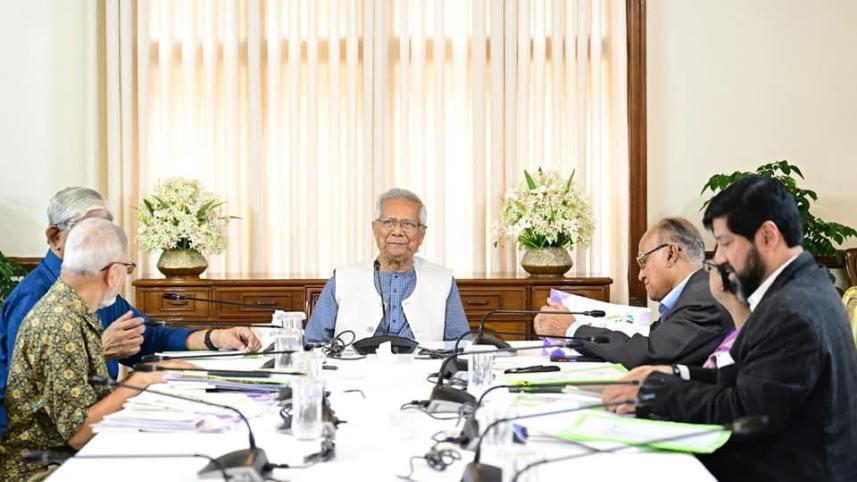
On May 11 last year, Chief Adviser Prof Muhammad Yunus gave five directives to revitalise the capital market. His directives included offloading shares of well-performing state-owned companies and listing them on the stock market, offering shares in multinational firms to the public, and offering incentives to non-listed companies that perform well, encouraging them to go public.

Around nine months have lapsed, yet the directive to list well-performing state-owned companies was not fulfilled.
Similar attempts to list state-run companies were taken by finance ministers working for the previous government, but they also could not make much headway.
“I thought the interim government would keep the bureaucrats under pressure this time, and they would be compelled to follow the directives,” Rahman said.
As per the Dhaka Stock Exchange (DSE) data, Bangladesh Submarine Cables PLC (BSCPLC) was listed on the stock market back in 2012. Since then, no other state-owned companies entered the capital market.
During the last decade, many junk or low-performing companies entered, causing the share market to become highly volatile. The chief adviser at a meeting gave the five directives to officials, including the finance adviser, the finance secretary and the Bangladesh Securities and Exchange Commission (BSEC) chairman, to bring dynamism into the stock market.
Attempts were made by the authorities to complete the directives, but progress was stalled at some point, and none of the five goals were reached.
Shortly after the May meeting, the finance ministry ordered all relevant ministries to prepare their state-owned enterprises for listing.
Abul Kalam, spokesperson of the BSEC, said that to ensure offloading shares of state-run companies and multinational companies, a potential list has been made, and the Financial Institutions Division (FID) ordered firmly that concerned ministries bring them to the market.
“The BSEC has done all they could. The next steps will have to be taken by the concerned ministries. But that’s where the progress stalled,” he said.
Another of the CA’s directives was to offer incentives to bring well-performing local companies into the market. No such incentive was also seen from the National Board of Revenue or any other authorities.
The BSEC has done its part in amending IPO rules so that good companies can get a fair price from investors.
Another order was to include foreign experts in the market reform activities. No such steps were taken.
Authorities were directed to take measures to encourage large borrowers to raise capital from the stock market by issuing equity and bonds. No progress was seen there either.
Following the CA’s directive, the BSEC has taken several strict punitive measures against those involved in corruption and market manipulation.
Saiful Islam, president of the Dhaka Stock Exchange (DSE) Brokers Association of Bangladesh, said that in realistic terms, no decision has been implemented in the last nine months despite the order coming from the head of the government, especially regarding the listing of state-run companies and multinational companies.
“It is extremely frustrating for us.”
He noted that the lack of implementation of those directives was a regulatory failure.
“The caretaker government’s tenure was a golden opportunity to implement these decisions on the listing of state-run firms for the betterment of the capital market. During any political government, such measures are difficult to implement, mainly due to non-cooperation from the bureaucracy,” he said.
 For all latest news, follow The Daily Star's Google News channel.
 “Adding at least 4-5 state-run companies within this period would have been a boost for the market,” he added.
Abul Kalam said the BSEC, Financial Institution Division and Anisuzzaman Chowdhury, a special assistant to the chief adviser, tried their best to implement the directives. A joint committee was formed, and it submitted a report to the government, outlining the necessary measures to be taken to incentivise the well-performing local companies. The Bangladesh Bank (BB) governor has said in a meeting that the government will push forward those measures.
The BB and BSEC are taking steps to make the bond market vibrant, the BSEC spokesperson added. However, such measures cannot be completed overnight, and a guideline to implement the measures was made.
Regarding the matter of appointing a foreign expert, he said, “A directive came from the higher-ups that the inclusion of a foreign expert would be time-consuming.”
In light of the situation, the responsibility was given to an academician who has foreign expertise as well as local experience.
“What else can the BSEC do?” the spokesperson said, stressing that the BSEC and the FID have taken all possible necessary steps.
While the BSEC has been diligent in following its part of the directives, the completion of the measures halted due to bureaucracy in the concerned ministries, causing stock investors to lose hope in any further progress.
Comments