


South Asia least integrated region worldwide: ICCB
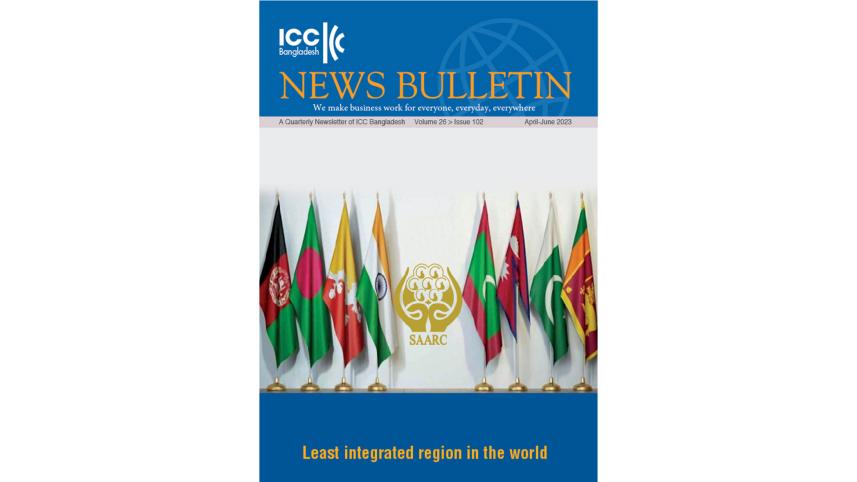
South Asia is one of the least integrated regions in the world in terms of trade and people-to-people contact, according to the International Chamber of Commerce (ICC) Bangladesh.
The world business organisation recently published its news bulletin, where ICC Bangladesh wrote about the matter in an editorial.

Quoting World Bank, ICC Bangladesh said that regional cooperation has the potential to produce significant gains across all countries of South Asia, where intraregional trade now stands at just one-fifth of its potential.
An electricity market of the BBIN countries -- Bangladesh, Bhutan, India, and Nepal -- would save an estimated $17 billion in capital costs. Besides, improvements in transport and logistics can reduce the 50 per cent higher cost for container shipments in South Asia compared to OECD nations.
With the aim of promoting intraregional trade and economic cooperation within the Saarc region, Saarc countries signed the Saarc Preferential Trading Arrangement (Sapta) in April 1993. The agreement came into force in December 1995.
ICC Bangladesh said that regional cooperation has the potential to produce significant gains across all countries of South Asia, where intraregional trade now stands at just one-fifth of its potential
Later, the Sapta was replaced by the South Asian Free Trade Area (Safta) in January 2006.
Besides Safta, there are three bilateral free trade agreements (FTAs) in South Asia, which are India-Sri Lanka, India-Bhutan and Pakistan-Sri Lanka.
Furthermore, the Bangladesh-Bhutan-India-Nepal (BBIN) Agreement signed in June 2015, is another initiative for this sub-regional cooperation.
The deepening relationship among BBIN countries on regional trade and transport is reflected by the increasing number of connectivity agreements even though opportunities for growth through regional trade remain largely untapped, according to ICC Bangladesh.
Despite all these initiatives, intraregional trade in South Asia remains much below the actual potential of trade cooperation.
Currently, regional trade in South Asia accounts for only 5 per cent of the estimated $23 billion in trade flow, which is well below the potential trade of $67 billion.
The ratio of trade in other regions are East Asia: 50 per cent, Asean: 26 per cent, EU: 67 per cent, Nafta: 62 per cent, LAC and COMESA: 22 per cent.
Among the countries with a population exceeding 2 billion and robust $4.1 trillion economy, India has firmly established itself among the booming economies of the 21st century, with 1.4 billion people and a $3.4 trillion economy.
By 2035, India will be the third-largest economy. Bangladesh is well placed to play a key role in the regional trade and logistics networks and act as a transit country in South Asia.
Despite huge potential, bilateral trade between India and Bangladesh was only $11 billion in FY22, out of which exports from Bangladesh to India was only $1.27 billion.
Minimising various trade barriers, Bangladesh's export to India can grow by 300 per cent if it can just fetch just 1 per cent of the total Indian imports.
Estimates by the World Bank suggest that Bangladesh's exports to India could increase by 182 per cent from the current levels if the countries implement an FTA.
Improving transport connectivity between the two countries could increase exports even further, yielding a 297 per cent increase in Bangladesh's exports to India.
Bangladesh and other countries in the region trade on better terms with distant economies than with their neighbours.
 For all latest news, follow The Daily Star's Google News channel.
 For example, the World Bank's Connecting to Thrive Report found that it is less expensive for a company in Bangladesh to trade with a company in Germany than with a company next door in India.
Comments