


Green growth needs to be cost-effective
Lack of policy support and awareness, huge capital requirements, lack of incentives, and a lack of expertise regarding green technologies are the main barriers to implementing a green value chain in Bangladesh, experts said at an event yesterday.
In order to combat such issues, the government can give various incentives to green companies, including monetary and tax incentives alongside social incentives, said Abul Kalam Azad, a co-chair of Smart Bangladesh Network.

"Green growth must be cost-effective, otherwise, it is impossible (to implement)," Azad said.
"People do business to make money, if green activities are more costly, how they will make money?"
Azad made these comments while speaking as chief guest during a discussion on green value chain.
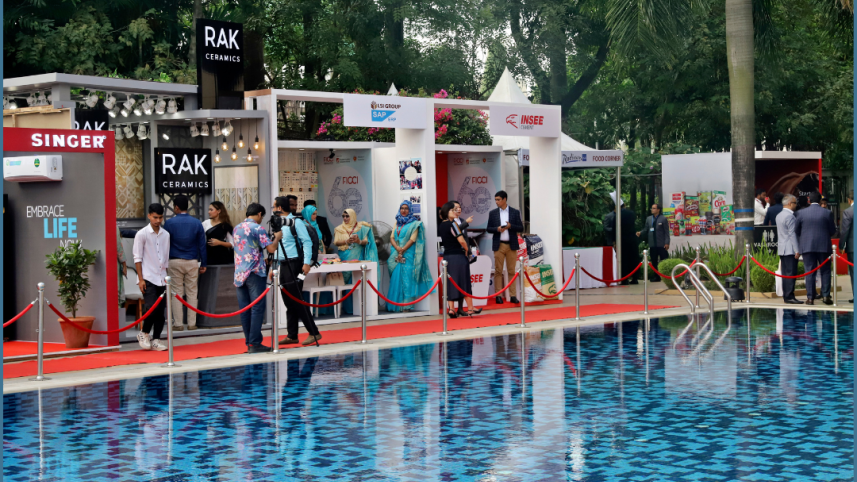
The event was organised by the Foreign Investors' Chamber of Commerce and Industry (FICCI) at its "Investment Expo 2023", designed to celebrate 60 years since its founding anniversary at the Radisson Blu Dhaka Water Garden.
Zaved Akhtar, chairman and managing director of Unilever Bangladesh, moderated the session while Yasir Azman, CEO of Grameenphone, Stefal Liller, UNDP Resident Representative, and Mohsina Yasmin, executive member of Bangladesh Investment Development Authority, also spoke.
Green value chains involve responsible and environmentally-friendly sourcing, operations, and distribution, which has environmental, economic and social benefits, said Prof Imran Rahman, vice-chancellor of University of Liberal Arts Bangladesh while presenting the main presentation.
Responsible sourcing is sourcing of raw materials, packaging materials and agricultural inputs from sustainable producers while responsible operations include the use of renewable energy, waste reduction and water-saving measures, and introducing effluence treatment plants.
He said the main barriers to greening were a lack of harmonisation, awareness, access to finance, coordination between government agencies and expertise on green technologies alongside unaddressed energy security concerns, weak monitoring system and no set environmental goals.
The government can take fiscal measures by providing tax incentives and addressing anomalies in the tax system. For instance, at present, recycled paper has a higher duty than non-recycled paper, he said.
There should be some platforms where all business leaders can sit together with policymakers and carry on conversations, said Nihad Kabir, chairperson of Business Initiative Leading Development, a private sector think-tank.
The new generation also needs to be included in the dialogue, she said.
Greening should be built into business processes because providing incentives from the top will not have a significant effect in the current context.
Meanwhile, market demand for green products is growing and consumers are reluctant to buy products if the production process is not sustainable.
"We should not allow greening to be the next non-tariff barrier for us," added Kabir.
Greening in SMEs is still at a nascent stage in the nation as access to finance remains a major issue alongside a lack of awareness, knowledge, and skills, said Md Sameer Sattar, president of Dhaka Chamber of Commerce and Industry (DCCI).
He also questioned whether the extra funds that are needed to adopt sustainable measures should be treated as a cost or an investment.
"At this stage, it seems to be a cost. It will only be an investment when buyers pay a higher price for adopting sustainable processes," he said.
"We have a large number of green RMG factories, so the right intention is being shown. However, they are not getting higher prices for that," he added.
 For all latest news, follow The Daily Star's Google News channel.
 Azad, a co-chair of Smart Bangladesh Network, recommended that firms try to reduce the use of plastic, produce power through rooftop solar panels, conduct research, and build a skills base.
The private sector can form a policy guideline to make a green value chain easier to achieve and then go for proper advocacy, he added.
Comments