


Bangladesh sees sharp decline in quality rawhides: CPD study
The availability of good quality rawhides has fallen sharply in Bangladesh over the years, although overall supply has increased, according to a research report.
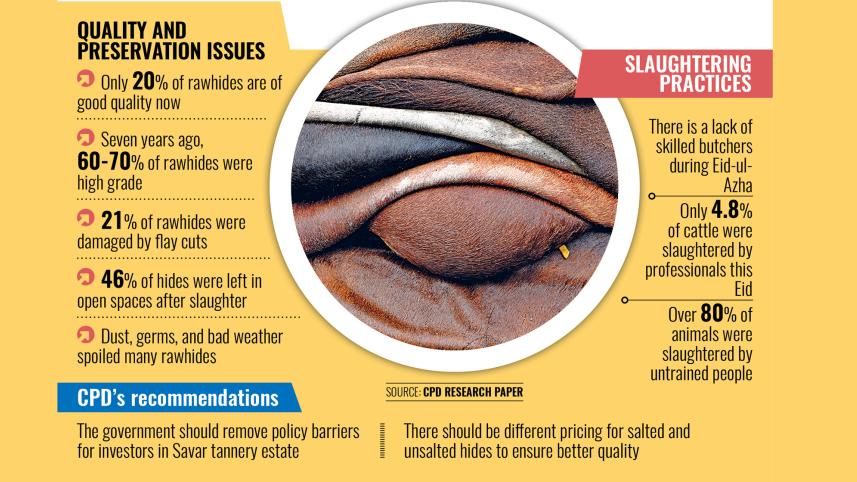
Some 60 percent to 70 percent of rawhides were of good quality seven to eight years ago, but now less than 20 percent meet the standard, it said.
 For all latest news, follow The Daily Star's Google News channel.
 The Centre for Policy Dialogue (CPD) conducted the research under an initiative jointly undertaken by the Bangladesh Tanners Association (BTA) and the Leather Sector Business Promotion Council under the Ministry of Commerce.
Khondaker Golam Moazzem, research director at the CPD, led a three-member team in conducting the study. The other two are Tamim Ahmed, a senior research associate, and Atikuzzaman Shazeed, a programme associate.
Ahmed presented the research paper titled "Bangladesh's Leather Supply Chain: Ensuring Quality and Price of Raw Hides" at a workshop in Dhaka Club yesterday.
Ahmed said ensuring the quality of rawhides was important because high-quality hides not only guarantee better prices but also reduce waste and help produce high-value exportable leather products.
He said if animals are not slaughtered and skinned properly, cuts, tears, or structural damage may occur on the hides. As a result, high-quality hides often end up becoming low-grade or unusable, he mentioned.
In Bangladesh, there is a shortage of skilled butchers during the Eid-ul-Azha period for slaughtering and skinning cattle, he said.
While it is estimated that over 20 lakh animals are sacrificed in Dhaka alone during this time, the city has only about 11,600 trained butchers, he added.
The report also revealed that during Eid-ul-Azha in 2025, only 4.8 percent of cattle were slaughtered by professional butchers.
In 13.3 percent of cases, the animal owners themselves carried out the slaughter, while in most cases (81.9 percent), the task was performed by representatives from madrasas or mosques, many of whom are not trained butchers, it said.
Due to inexperience and a lack of skills in skinning, a significant portion of rawhides was damaged, especially through flay cuts, it added.
Flay cuts refer to incisions or marks on the hide caused by excessive pressure or improper use of sharp tools while removing the skin.
According to the report, 21 percent of rawhides were affected by flay cuts during this year's Eid-ul-Azha.
The survey also found that 46 percent of sacrificial animal owners left the hides in open spaces after the slaughter, while in 36 percent of cases, madrasa authorities and seasonal traders kept the hides in the open.
In 14 percent of cases, wholesalers kept the hides in open areas, it said.
This unhygienic and unplanned storage method likely exposed the rawhides to adverse weather conditions, dust, and germs, causing deterioration in their quality, it added.
Tamim Ahmed also said the government needs to remove policy barriers related to land purchase and plot allocation for both foreign and local investors within the Savar Tannery Industrial Estate (STIE).
The leather associations, the government, and plot owners should sit together to decide how the vacant spaces can be utilised by other potential investors, he said.
Associations should also offer foreign investors the benefits that their members get, he added. Khondaker Golam Moazzem said in determining the price of rawhides, there should be separate rates for salted and unsalted hides.
The price for salted rawhides should be set high enough to encourage proper salting. Price variations should also reflect some basic quality standards, he added.
Shaheen Ahamed, chairman of the BTA, said if the STIE's central effluent treatment plant (CETP) can be made fully functional, it would be possible to increase exports by Tk 50,000 to Tk 60,000 crore within the next four to five years.
He said this would also create opportunities for foreign investment in the country's leather sector.
Md Shakawat Ullah, senior vice-chairman of the BTA, also urged for the CETP to be made fully functional. "After that, we will see how to increase the price of leather," he said.
Mahbubur Rahman, secretary to the Ministry of Commerce, said next year, instead of distributing free salt for preserving rawhides, the possibility of offering incentives for selling salted rawhides would be considered.
He believes that this would encourage faster and better preservation of rawhides.


Comments