


A dream rewritten: Rokeya’s radical vision and its cinematic afterlife
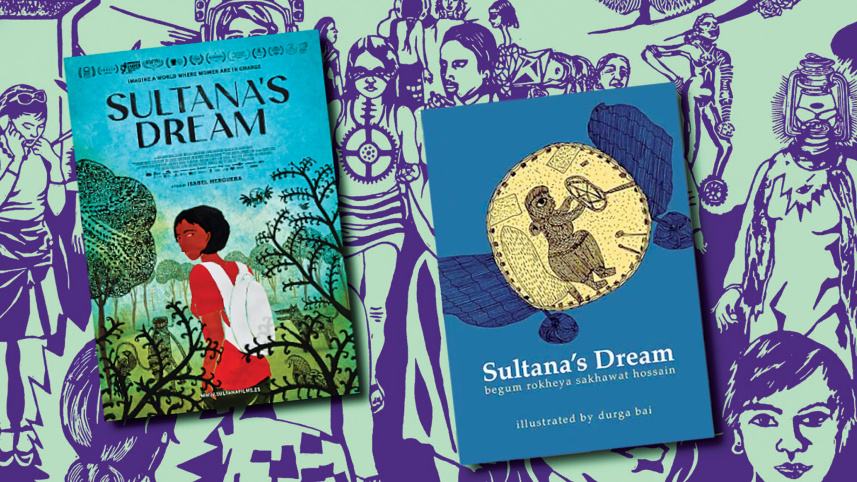
“There is no place on earth where women are safe,” declares Inés, the protagonist of Isabel Herguera’s animated film Sultana’s Dream (2023). Loosely inspired by Begum Rokeya’s seminal short story of the same name, the film follows Inés’s journey of self-discovery after she encounters a copy of Sultana’s Dream (1905) and is profoundly affected by its vision. As the narrative moves through the bustling streets and intimate encounters she experiences along the way, the film weaves Inés’s personal search for a safe space for women with fragments of Rokeya’s life and legacy. Yet, as the story unfolds and the adaptation increasingly departs from its literary source, an unavoidable question emerges: does the film ultimately do justice to the radical imagination and historical significance of the work it invokes?

Ladyland’s environmental futurism is thus inseparable from its postcolonial critique: sustainability, self-sufficiency, and nonviolent technological defense function as rejections of imperial science and its hierarchies of knowledge.
This film has emerged from an unconventional method of production that shaped both its aesthetic and its narrative form. Developed through a series of drawing workshops conducted across India between 2013 and 2014—with widows rooted in tradition, self-employed women, and art and design students—it adopts a collective, open-ended approach in which participants reinterpreted Begum Rokeya’s text through their own social and cultural experiences. These responses influenced the script and visual language of the film, resulting in a mixed-media structure: hand-drawn ink and watercolor animation depicts Inés’s contemporary journey, Begum Rokeya’s life appears in shadow-silhouette cutouts evoking pre-cinematic shadow theatre, and Ladyland is rendered through intricate mehendi-inspired patterns. Unified by monochromatic palettes in muted browns and pastels, the film privileges atmosphere and symbolism over material specificity. While this methodology reflects a feminist commitment to participatory authorship, it also helps explain the film’s diffuse focus, positioning Sultana’s Dream less as a direct book-to-screen adaptation than as a collage of reflections that prioritises multiplicity over fidelity to Rokeya’s speculative vision.
Any adaptation necessarily involves interpretation, compression, and creative liberty, particularly when translating a century-old literary text across cultures and media. Artistic license is not, in itself, a failure. However, Sultana’s Dream—the movie—positions itself less as a direct adaptation and more as a meditative response to Rokeya’s legacy, increasingly privileging Inés’s personal journey and contemporary side-plots over the structural and ideological core of the original text. It is within this shift—from adaptation to abstraction—that many of the film’s representational shortcomings begin to surface.
While the animated film is rich in evocative imagery, its storytelling remains thin and uneven, with characters that often feel underdeveloped and one dimensional. The film does thoughtfully attempt to demonstrate the many shared experiences and struggles faced by women across the globe, yet the storytelling did not translate well into a cohesive narrative. One such instance is when Inés travels to Vrindavan in India, she encounters widowed women who are portrayed as guarded and unwelcoming—an interaction that is framed without sufficient context or nuance. Rather than interrogating the social and historical conditions that shape their lives, the film presents their resistance through a lens that risks stereotyping, reinforcing a flattening and categorical depiction of South Asian women. This tendency to gesture toward complexity without fully engaging it—substituting atmosphere and symbolism for depth—emerges not only in the film’s characterisations, but also in its approach to Rokeya’s speculative world.
Nowhere is this more evident than in the film’s treatment of Ladyland itself. Gone are the sustainable, renewable innovations that form the backbone of Begum Rokeya’s Ladyland: the solar- and wind-powered technologies devised by women to till fields, cook food, regulate indoor climates, enable travel, and even defend the nation without bloodshed. In Herguera’s adaptation, this carefully articulated solarpunk infrastructure is replaced by a single speculative device—a “frequency amplifier” that repels enemies by amplifying sonar energy. This substitution does more than streamline Rokeya’s worldbuilding; it fundamentally alters the political and epistemic force of her science fiction. Writing in English under British colonial rule, at a time when women in Bengal were systematically denied access to higher education and scientific authorship, Rokeya’s vision positioned women as scientists and engineers whose renewable technologies directly challenged both patriarchal authority and colonial models of extractive, militarised modernity. Ladyland’s environmental futurism is thus inseparable from its postcolonial critique: sustainability, self-sufficiency, and nonviolent technological defense function as rejections of imperial science and its hierarchies of knowledge. By erasing these elements, the adaptation reframes Sultana’s Dream as a symbolic feminist fable rather than the pioneering work of science fiction it was, obscuring Rokeya’s most radical claim—that women from the colonised world could imagine, design, and sustain technologically advanced futures on their own terms, decades before such ideas entered Western speculative discourse.
Throughout the narrative, the film weaves in different languages. Spoken by different characters, the incorporation of Spanish, Bangla, English, Hindi, Basque, Italian signifies Inès’ journey throughout the globe in search of safe spaces for women. While this attempt at showcasing different languages and dialects from around the world is commendable, the transition between the languages feels ornamental and devoid of meaning. An instance of which is seen in the inclusion of the folk song in Bangla that Inès experiences during her visit to Pairaband, Bangladesh, the birth place of Begum Rokeya. While the song is beautifully sung with its tune, the lyrics feel inorganic and have a rather conversational tone. Instead of capturing the typical nuance of folk songs, the song opts for direct exposition in recounting Begum Rokeya’s story. In doing so, the film oversimplifies the very cultural aspects rooted in Begum Rokeya’s abode and disregards the unique flairs of Bangladeshi folk songs.
In addition to failing to engage the complexities of South Asian cultures and womanhood, the adaptation reproduces subtle but telling cultural misrepresentations—most notably in its costuming of the characters. Begum Rokeya is depicted in a salwar kameez, while Sakhawat Hossain appears in a tupi and panjabi, visual choices that read less as historical accuracy than as a generalised, western-facing shorthand for Muslim identity. Historical photographic evidence available online, however, shows Rokeya wearing sarees and Sakhawat Hossain dressed in a suit and tie, reflecting the cosmopolitan, reformist milieu in which they lived. More broadly, Bangali men in the film appear visually indistinguishable from one another, uniformly rendered in tupi-panjabi and long beards, as though regional, class, and ideological differences did not exist. Such aesthetic homogenisation raises an unavoidable question: does the film reflect a European tendency to view the cultures of the Indian subcontinent as a monolith, stripped of internal diversity? Whether born of indifference or unconscious bias, these choices echo the same logic of simplification that undermines the film’s engagement with Rokeya’s radical, historically grounded vision.
The film’s ambition is evident in the sheer number of intellectual, political, and autobiographical threads it attempts to hold at once. Inés’s journey toward self-understanding is repeatedly interrupted by new ideas, encounters, and references that are introduced only to be quickly abandoned, creating the sense of a film reaching toward depth but rarely lingering long enough to explore it fully. This tendency becomes particularly apparent in the film’s contemporary European sequences, where conferences and conversations substitute sustained inquiry with aphoristic exchanges. Intellectual figures and family members alike communicate through polished declarations about truth, silence and liberation, lending the film an air of theoretical seriousness while often reducing complex feminist debates to easily digestible statements. While this approach may resonate with younger audiences encountering these debates for the first time, it also contributes to the film’s reliance on exposition and citation over narrative or speculative development.
Ultimately, the animated Sultana’s Dream reveals both the possibilities and the limitations of adaptation. While the film approaches Begum Rokeya’s work with evident aesthetic care and feminist intent, its emphasis on symbolism and universality comes at the cost of the historical, ecological, and postcolonial specificity that made the original text so radical. Rokeya did not simply imagine a world governed by women; she envisioned women as scientists, engineers, and producers of knowledge within a colonised society that denied them access to such authority. By flattening cultural difference, minimising solarpunk infrastructures, and translating structural struggles into allegory, the adaptation narrows the scope of Rokeya’s intervention and fails to incorporate the historical and contemporary significance of Rokeya's original story. Yet the film’s very existence also gestures toward the enduring relevance of the original Sultana’s Dream, inviting renewed engagement with the text itself. In this sense, the adaptation may be less a definitive reimagining than a reminder of the urgency—and the unfinished work—of reclaiming the futures Rokeya so boldly imagined.
Sara Kabir is a dreamer, writer, and literature lover who’s constantly juggling academia and her many creative hobbies. She currently teaches English at North South University. Find her musings on Instagram @scarletfangirl.
Sabrina Sazzad is a contributor to Star Books and Literature. Reach her at sabrinasazzad07@gmail.com.
Kashfia Nahreen is a passionate reader and an aspiring writer who spends her days cuddling with her cats.
 For all latest news, follow The Daily Star's Google News channel.
Comments