


Don’t lift curbs prematurely
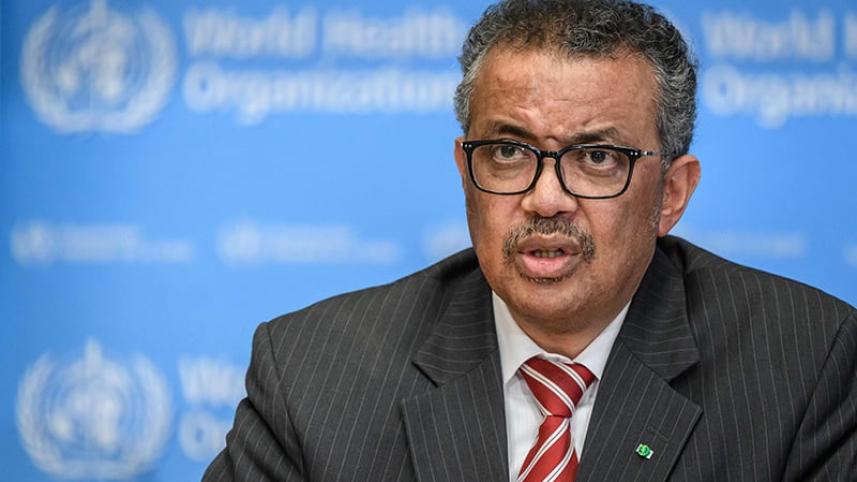
The World Health Organization (WHO) has warned countries to be cautious about lifting restrictions introduced to curb the spread of the new coronavirus as global death toll from the pandemic soar passed 100,000.
The United Nations agency would like to see an easing, but at the same time "lifting restrictions could lead to a deadly resurgence," WHO Director General Tedros Adhanom Ghebreyesus told a press conference.

Extraordinary measures from New York to Naples to New Delhi have seen businesses and schools closed in a desperate bid to halt the virus's spread, and the IMF has warned that the world now faces the worst economic downturn since the Great Depression.
More than 103,536 people have died of COVID-19 with 1.7 million infections detected globally, according to a Johns Hopkins University tracker, with nearly 70 percent of the fatalities in Europe.
The United States, now the pandemic's epicentre, became the first country to record more than 2,000 virus deaths in one day and is closing in on Italy's 18,849 fatalities -- currently the highest national figure.
With more than half a million reported infections, the United States already has more coronavirus cases than anywhere else in the world.
President Donald Trump, however, said that with the US infection trajectory "near the peak" and social distancing working well, he was considering ways to re-open the world's biggest economy as soon as possible.
He acknowledged the risk of higher death tolls if businesses restart too soon.
"But you know what? Staying at home leads to death also," Trump added, pointing to the massive economic suffering for millions of Americans.
It is unclear when that will be possible, with New York Governor Andrew Cuomo saying millions in the state -- the hardest hit in the country -- will have to be tested before it can reopen.
More than four billion people are confined to their homes as governments worldwide have imposed never-before-seen measures to halt the virus, which first emerged late last year in central China.
Like Trump, governments in Europe are under pressure to strike a balance between keeping people safe and keeping already battered economies stable.
WHO chief said Friday said there had been a "welcome slowing" of epidemics in some European countries - Italy, Germany, Spain and France - but there had been an "alarming acceleration" elsewhere including community transmission in 16 countries of Africa.
Yemen reported its first case of the novel coronavirus on Friday as aid groups braced for an outbreak in a country where war has shattered health systems and spread hunger and disease.
Tedros said he was particularly concerned by the large number of infections reported among health workers.
"In some countries reports of up to 10 percent of health workers being infected, this is an alarming trend," he said.
A new UN supply task force will coordinate and scale up the procurement and distribution of protective gear, lab diagnostics and oxygen to the countries that need it most.
"Every month we will need to ship at least 100 million medical masks and gloves, up to 25 million N-95 respirators, gowns and face shields, up to 2.5 million diagnostic tests and large quantities of oxygen concentrators and other equipment for clinical care," he said.
The World Food Programme - the UN agency that handles logistics - will deploy eight 747 aircraft, 8 medium-sized cargo aircraft and several smaller passenger planes to transport the goods and aid workers needed in the operation which will have 8 hubs, he added.
Tedros urged donors to contribute to WFP's operation which will cost an estimated $280 million, while the cost of procuring supplies will be "much greater".
 For all latest news, follow The Daily Star's Google News channel.
 He said no country was immune from the pandemic, urged countries find the loopholes in their health care systems and fix them.
Amid this gloom, glimmers of hope may be emerging in some countries.
Spain, the third-hardest-hit country, saw its lowest 24-hour toll in 18 days, after Prime Minister Pedro Sanchez said the "fire started by the pandemic is starting to come under control". It reported 510 deaths yesterday.
And the daily rises in new infections in hardest-hit Italy have slowed dramatically. Still, the Italian government said it would extend lockdown orders until May 3.
Comments