


Referendum: One question, 47 consequences

The upcoming referendum is unique in the sense that voters will not be the final stop in the process. Instead, if the referendum carries -- meaning the “yes” vote prevails -- it will set in motion a sequence of further steps. Ordinarily, however, a referendum comes at the end of a process, after an issue has been discussed and debated publicly and secured a supermajority in parliament. At that stage, sovereign citizens have the final word, accepting or rejecting the proposal.
That is not the case with this referendum. Voters will be asked whether they approve the July charter implementation order and a set of proposals presented as a summary of the 47 measures requiring constitutional amendment.

The implementation order outlines a series of steps, including the issuance of another order detailing the referendum, the formation of a constitutional reform council -- effectively another form of the entire parliament -- its deadline, its dissolution, and the formation of an upper chamber, among other measures. The ordinance outlining the referendum has already been issued and provides the Election Commission with the legal framework to hold the vote, a step deemed necessary because the prevailing constitution does not contain any provision for referendums.
Under the order, the constitutional reform council will be able to pass July charter recommendations, which in effect amend the constitution, with a simple majority of the entire council -- 151 votes in a 300-member body. The council has a deadline of 180 working days to complete all reforms. However, there is no contingency. The order makes no provision for what happens if the council fails to meet the deadline or does not address all the July charter issues.
Once the council is dissolved, its decisions will be incorporated into the constitution and published as a gazette. There is no way to predict what the final language of the constitution will look like, and voters will have no control over that outcome if they vote yes.
On the other hand, a “no” vote would effectively shut the door on the reform process, which has been described as a core mandate of the interim government.
The ballot itself briefly mentions a selection of proposals and presents them as a done deal. The government’s campaign, which is openly in favour of a “yes” vote, claims that a “yes” victory would defeat fascism and asserts that those who want reforms must vote yes, without clearly explaining the full process or all the measures contained in the July charter.
Saying yes or no is inherently difficult because so many issues are bundled together. The first paragraph on the ballot states: “The election-time caretaker government, the Election Commission, and other constitutional institutions will be formed in line with the process outlined in the July charter.”
It is followed by another paragraph that reads: “The next parliament will be bicameral. A 100-member upper house will be formed in proportion to the votes received by parties in the national parliamentary election. Approval from a majority of the upper house will be required to amend the constitution.”
It is evident that these paragraphs address distinct and diverse issues, some of which may enjoy wide support and others little or none. Certain proposals evoke strong feelings both for and against, while others may not. A single proposal may appear necessary to some and sacrosanct to others. Yet the ballot offers no way to reflect these differences.
As such, the referendum forces citizens into a compromise, either by making them grudgingly accept a number of proposals they oppose or by compelling them to reject an entire raft of measures, even though some are acceptable. Yet the spirit of this republic, particularly the one aspired to after the July uprising, must have been to accommodate minorities rather than simply ensure the rule of the majority. It must have been to recognise every citizen’s right to dissent, not secure a wholesale acceptance. And yet, the referendum makes it difficult for citizens to choose because of how reforms have been packaged.
A LOOK BACK AT REFERENDUMS
More than three decades after the last referendum, Bangladesh is again facing one, this time on the constitutional issue of the July National Charter. Each of the three previous referendums took place during periods of political upheaval, when rulers sought legitimacy for their regimes or for a new system of governance. The referendums of 1977 and 1985 were widely viewed as attempts to legitimise the military governments of Ziaur Rahman and Hussain Muhammad Ershad, while the third, held in 1991, was a constitutional exercise that paved the way for Bangladesh’s return to parliamentary democracy.
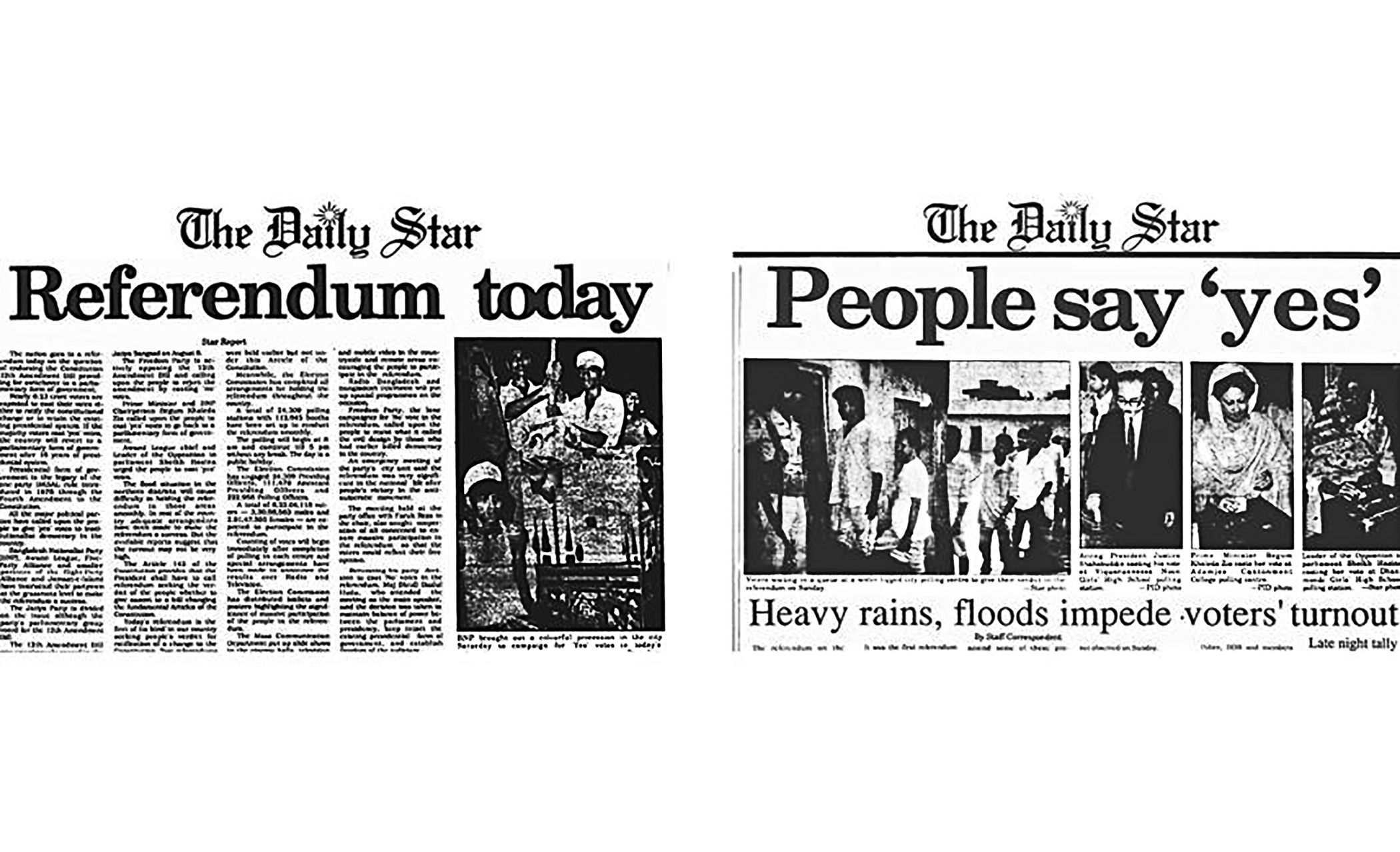
Media coverage of 1991 referendum.
MAY 30, 1977
Question: “Do you have confidence in President Major General Ziaur Rahman, BU [Bir Uttam] and the policies and actions he pursued?”
Total voters 3,83,63,858
Turn out 88.05%
Yes 98.88%
No 1.12%
MARCH 21, 1985
Question: Do you have confidence in the policies and programmes pursued by President Lieutenant General Hussain Muhammad Ershad, and do you support his continued tenure as president until elections are held in accordance with the suspended constitution?
Total voters 4,79,10,964
Turn out 72.44%
Yes 94.11%
No 5.50%
SEPTEMBER 15, 1991
Question: Should the Constitution of the People’s Republic of Bangladesh (Twelfth Amendment) Bill, 1991, receive the assent of the president?
Total voters 6,22,04,118
Turn out 35.19%
Yes 84.38%
No 15.64%
Data sources: Election Commission reports on national polls, Electoral Reform Commission report, and Bangladesher Nirbachoni Bebostha O Folafol, edited by Nasar Amin.
 For all latest news, follow The Daily Star's Google News channel.
Comments