


How the Omnicom–IPG merger crowned the world’s largest media empire - and ended WPP’s reign
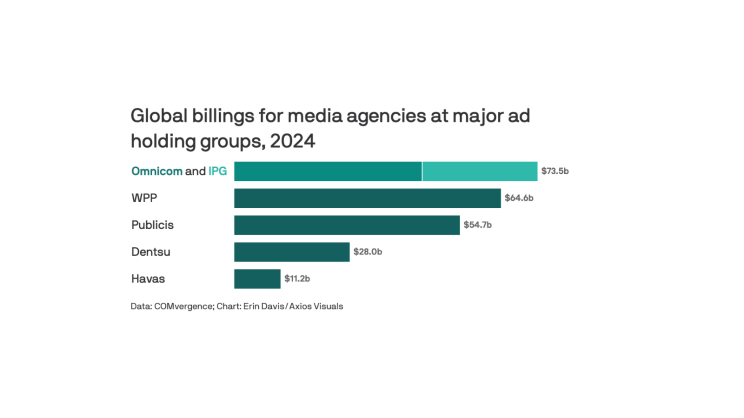
On November 26, 2025, John Wren formally executed the $30 billion merger of Omnicom Group and Interpublic Group (IPG). With a single stroke, the combined entity vaulted past every rival to become the world’s largest advertising and media holding company—overtaking WPP, Publicis Groupe, Dentsu, and Havas.
The throne was seized.

But the story of how it was won cannot be separated from the story of the empire that collapsed to make it possible.
The Ghost of 2013
This was not Wren’s first attempt at building a super-holding company.
In 2013, he and Publicis CEO Maurice Lévy unveiled a much-publicized “merger of equals” in Paris—a $35 billion deal that promised to reshape the global advertising industry. Within nine months, it had disintegrated. Clashes of ego, disputes over tax domicile in the Netherlands, and an irreconcilable governance stalemate killed the transaction in full public view.
The industry moved on.
Wren did not.
Twelve years later, the deal he completed proved far more consequential than the one he lost.
The Uninvited Guest: Accenture Song
While Omnicom and IPG were quietly engineering their combination, the most disruptive force in the market was not another holding company at all. It was Accenture Song.
Accenture’s rebranded marketing arm generated approximately $20 billion in revenue in FY2025, growing around 8% year-on-year. In the 2025 Ad Age Agency Report, it edged past WPP to become the world’s largest agency organization by revenue.
Its advantage is structural. Accenture Song does not merely sell advertising—it designs how enterprises buy it. By operating upstream of the traditional holding-company model, it embeds itself directly into clients’ technology, data, and operating systems.
Ten acquisitions in 2024 alone—including Work & Co. and ConcentricLife—strengthened its capabilities across digital commerce, experience design, and data strategy.
We are not going to market talking only about marketing. We are here to change how enterprises think about growth.
The Fall of WPP: From Sovereign to FTSE Exile
For three decades, WPP—under the leadership of Sir Martin Sorrell—was advertising’s undisputed sovereign.
That era ended abruptly.
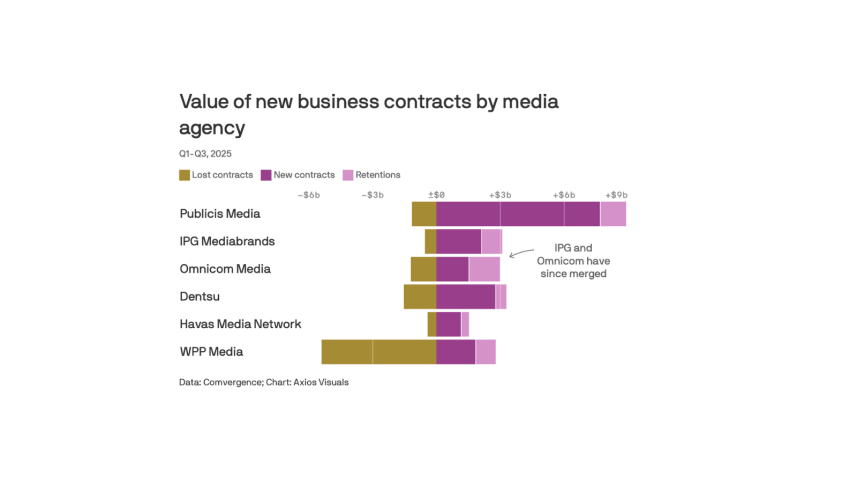
Following Sorrell’s departure in 2018, the organization entered a prolonged decline. By December 2025, WPP’s market capitalization had collapsed from $24 billion in 2017 to just $3.2 billion—less than one-seventh of its peak. After 27 consecutive years, the company was ejected from the FTSE 100.
Publicis, by contrast, stood at $26.3 billion—roughly four times WPP’s size.
Client losses accelerated the unraveling. Coca-Cola North America (over $700 million) moved to Publicis in March 2025. Mars ($1.7 billion in global media spend) followed just one day after CEO Mark Read announced his retirement. Paramount Pictures, Johnson & Johnson, and The Trade Desk all exited. Mindshare, WPP’s flagship media agency, came under sustained pressure on its Unilever APAC mandate—one of the most scrutinized accounts in the region. Malaysia, Philippines, Singapore, Vietnam and Thailand market Unilever moved to Publicis Media from WPP. Alternatively, LATAM, most of the MENA, majority of Chianese and Turkey market Unilever moved Omnicom Group-IPG.
Financial performance reflected the strain. Revenue fell 5.9% in Q3 2025, prompting a full-year guidance downgrade to a 5.5–6% decline.
WPP Crisis Timeline
- Shanghai (October 2023): GroupM China CIO and two senior executives detained on bribery charges allegedly totaling $110 million. Prosecutors sought life imprisonment. (News link - https://tinyurl.com/bdh3pmmp)
- India (March 2025): Competition authorities raided GroupM offices in Mumbai, Delhi, and Gurugram over alleged market collusion. (News link- https://tinyurl.com/5apsup39)
- United States: WPP paid $19 million to settle SEC charges related to FCPA violations across China, Brazil, and India. (News link - https://tinyurl.com/3b9w3ze9)
 For all latest news, follow The Daily Star's Google News channel.
 If six goes to five, I think five will go to four. I don’t think WPP is going to survive.
The Deal and the Empire
Announced in December 2024 and cleared by U.S. and EU regulators by November 2025, the Omnicom–IPG merger united some of the most powerful brands in advertising history.
Creative networks including BBDO, DDB, TBWA, McCann Worldgroup, FCB, and MullenLowe were combined with IPG Mediabrands and Omnicom Media Group, forming one of the largest independent media buying operations on the planet.
Projected annual cost synergies reached $750 million—equivalent to roughly 7,500 roles.
But the real prize was data.
IPG’s Acxiom—a $2 billion consumer identity and data platform—now sits at the core of Omnicom’s AI strategy. Integrated with Flywheel Digital’s retail commerce intelligence, it forms one of the most powerful first-party data ecosystems in global advertising.
Omnicom + IPG: 5,000+ Clients — Select Accounts
- Technology: Apple, Google, Microsoft, Amazon, Uber, Netflix, Meta, IBM, Airbnb, Dell, PlayStation, LEGO
- Consumer & FMCG: P&G, Kraft Heinz, PepsiCo, Unilever, Mars, Mondelēz, L’Oréal, Colgate-Palmolive
- Financial Services: American Express, HSBC, Mastercard, Visa, Citibank
- Media & Entertainment: Warner Bros., NBCUniversal, Disney
- QSR & Retail: McDonald’s, KFC, Adidas
- Healthcare: Pfizer, GSK, AstraZeneca, Abbott — the world’s largest healthcare advertising group
- Automotive & Energy: Ford, Volkswagen, BMW, Hyundai, Nissan, Castrol
The AI Arms Race
Omnicom’s Acxiom-powered Omni platform now faces Publicis’s Epsilon—still widely regarded as the most advanced consumer identity solution among the major holding groups. Publicis has invested more than $12 billion in data and AI, anchored by Epsilon and the Marcel AI platform.
Both companies are racing to demonstrate AI-driven ROI at global scale. Omnicom manages 30% of the Procter & Gamble $7 Billion global media business through Ai driven platforms, cutting media costs by approximately 10%. As fully autonomous AI marketing systems mature, every holding company will be forced to justify its role.
WPP also could not achieve its anticipated returns in a faster growing AI era from a partnership with OpenAI to build an AI-driven platform for Coca-Cola’s media business, underscoring the difficulty of converting AI ambition into tangible results.
A New Order
By early 2026, the old Big Six had been replaced by a Big Two:
- Omnicom — $26.2B market cap, 5,000+ clients, operations in 70+ markets
- Publicis — $21.5B market cap, Epsilon, Marcel AI
WPP fights for survival under new CEO Cindy Rose, while its founder openly questions whether the business can still be saved. Dentsu retreats. Havas treads water. Accenture Song continues its march upstream.
The industry’s next great disruption—the fully autonomous, AI-driven marketing era—is no longer theoretical.
It has already begun.
And the race for that throne has only just started.
Reference Links –
- https://tinyurl.com/5yn8ax2j
- https://tinyurl.com/msjrfyp7
- https://tinyurl.com/msprx2mx
- https://tinyurl.com/mvw3c3tz
- https://tinyurl.com/59cwccrm
- https://tinyurl.com/msprx2mx
- https://tinyurl.com/3x75js2m
Arifur Rahman is an author & advertising professional. He can be reached at Shakkhor@gmail.com.
Comments