


GOFFREDO ALESSANDRINI
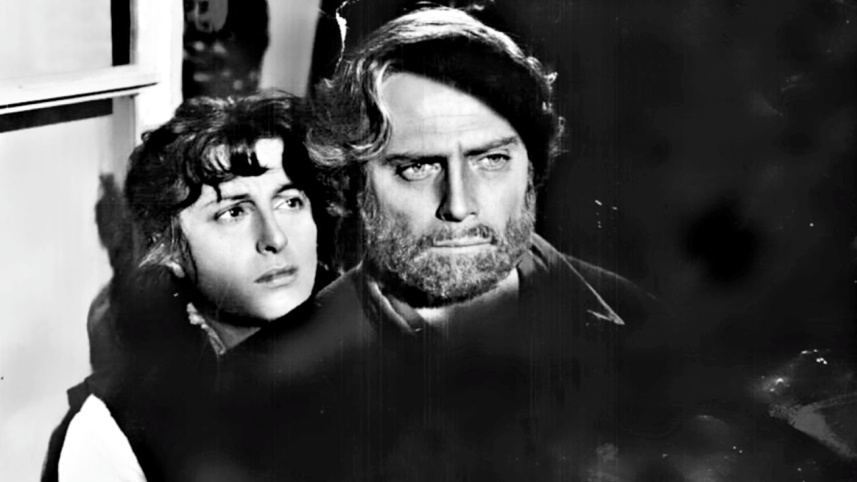
Son of a building contractor who worked in Egypt, Alessandrini was born in September 1904 in Cairo and studied in London to be one of Italy's most prolific screen writers and film directors. In 1928, at only the age of twenty-four, he began his film career as an assistant to Alessandro Blasetti, and even though Blasetti was four years older than him, Alessandrini made his directorial debut first with the film “Sole e terra madre”. The following year, Alessandrini faced his first experience with a documentary, “Diga di Maghmod”, and soon after he moved to Hollywood for about two years. It was there, at one of the most prestigious studios, Metro Goldwyn Mayer, Alessandrini acquired his knowledge of English which allowed him to be entrusted with the direction of Italian versions of successful American films.
Following his eye learning experience in the US, Alessandrini returned to Italy in 1931, and in that same year, he made the film “The Private Secretary,” remade from a German film. It brought him great success thanks to the interpretation of the protagonist by Elsa Merlini, a brilliant actress with great communication skills. In 1935, Alessandrini married actress Anna Magnani, a talented Italian whose prowess was present from magazine covers to the theater and to films. She was gifted with the great quality to portray roles in dramatic comedies, and even though she had won the Academy Award for Best Actress and other international awards later on, her marriage to Alessandrini failed after only four years, in 1940.

During the fascist regime, Alessandrini's career, like that of other directors such as Blasetti, Camerini and Genina, experienced its most brilliant period. Between 1936 and 1942, he was able to draw, fascinating film with interesting stories and characters which had a great hold over the audience. He was widely praised by critics and was awarded multiple times; for instance, he received several awards at the Venice Film Festival during the Fascist era: the Mussolini Cup for Best Italian film in 1938 for “Luciano Serra pilota”, and in 1939 for “Abuna Messias”. He also received the Biennale Award in 1942 for “Noi Vivi and Addio Kira!” He collaborated frequently with one of the stars of the time, Amedeo Nazzari and also with a son of Mussolini, Vittorio. As it can easily be deduced from the titles, him being regarded as one of the most important directors in Italian fascism was not an understatement, and the success of his works was, at least in part, due to his blatant membership in the policy of the regime, an attitude that, however, later revealed to be a double edged sword. In fact, after the war, Alessandrini's activities were reduced very much, because he was unable to fit in constructively with the very different expressive climate created by the neo-realists. This current, which would renew decisively the entire Italian cultural climate, developed between 1945 and the early fifties; antagonizing absolutely every aspect of fascist ideology, faithful to realistic perspective to the rawness, he drew inspiration for his painful and profound films from the episodic descriptions of the Resistance and painful condition of the immediate post-war Italy.
As a result of this profound change of ideology and taste, Alessandrini remained, though still young, on the edge of film production. On the contrary, he triumphed by perfectly adapting to the new aesthetic and moral demands and the dramatic talent of his ex-wife Anna Magnani, the beautiful star of the iconic production of neo realism films in Rome, “Open City”. After some interest in discreet films, like “The Wandering Jew” (1948) and “Red Shirts” (1952), Alessandrini worked in making a few appearances as an actor, but always in minor roles through 1964 to 1967. Before disappearing in 1978, now forgotten, he ended his career with a television work, writing a script with Biancoli and Levi for an episode of Italian Histories.
by Mohaiminul Islam
 For all latest news, follow The Daily Star's Google News channel.
Comments