


V for Victory, V for Valentine: A mandate is not a licence

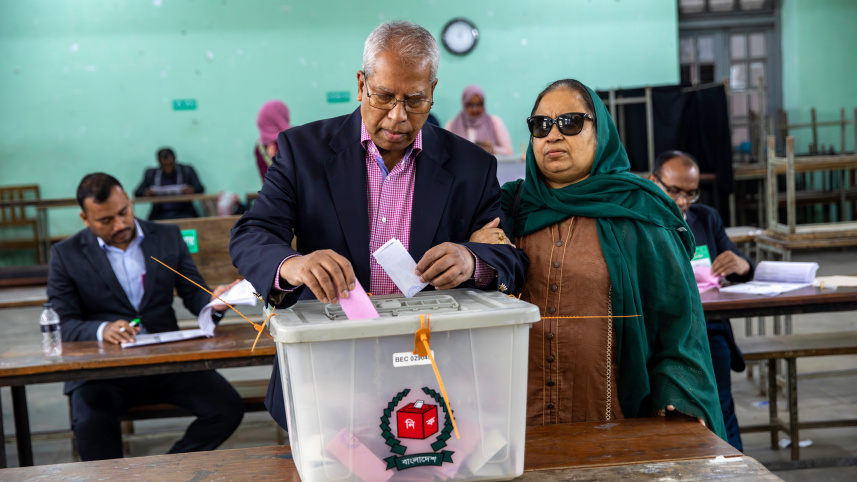
It’s perhaps divine timing that V-Day falls just after the confirmation of election results, marked by the public’s overwhelming support for the party at the top and the strengthening of support bases for the parties in second place. So, it’s a day of victory for BNP, which has been out of power for 20 years, and a day of vindication for Jamaat and its ancillary organisations, which strategically survived the previous regime and emerged as a formidable force. It’s also a valiant day for first-time voters, who felt compelled to choose a progressive vision without succumbing to conservatism. There is much to celebrate for a nation that has shown maturity in exercising its voting rights without any violence.
The interim government and the security forces deserve all the credit for delivering a fair, credible election to pave the way for democratic renewal. If we look at the parties, during the last 18 months, grassroots BNP often succumbed to the old political ways of extortion, vendetta, and aggression, but the centre appeared restrained and future-focused, and it worked at the ballot box. The agents of change, the new generation of National Citizen Party (NCP), stirred hope but only to have a late reckoning that they do not have the nationwide support structure to become a formidable force. They aligned with Jamaat-e-Islami, which proved to be the most strategic of the lot. But their combined strategies have still fallen short. Although the BNP’s “landslide” victory might not show it, this electoral race has been a wake-up call for both the winners and the wider political class.

These issues move this Valentine’s Day away from its typical paraphernalia, like cards, flowers and velvet hearts. A day that celebrates hearts to attain harmony and hope appears before us as a rupture, in the coinage of Slavoj Žižek. For the Slovene political thinker, love is violent because it denies accepting the world as it is. The logic of love is irrational. You have to believe that you are in love. Love is a dangerous commitment; it chooses and moves beyond inertia and cynicism, resulting in transformation.
So, today, we can wave two powerful symbols in one gesture: “V for Victory” and “V for Valentine.” “Victory” refers to the decisive mandate delivered by the public; “Valentine” because it celebrates love in a unique way that has interrupted the logic of choosing someone. The influence that BNP currently holds is not just based on sentiment. It is also a choice under uncertainty. To many, by publicly questioning women’s leadership or suggesting curtailing work hours for women, Jamaat displayed the “risk” of its version of democracy. The interviews given by the Jamaat chief and several others probably came as a shock even for the NCP, their electoral ally.
NCP’s female candidates, who defected from the party and ran the election independently, exposed the rift within. The tally of votes suggests that some of these candidates would have won the election if they had competed from a single platform. BNP became a beneficiary, but it knows that the public mood is volatile. A generation that has not spared Awami League for its transgressions will carefully monitor its actions, too. So, the love shown for BNP is not unconditional. It must perform to retain and solidify this love and be wary of post-uprising voters whose political consciousness was shaped in a climate of protest, social media activism, and distrust of institutional continuity. This is a cohort of voters who expect novelty and were willing to give a chance to youth parties, ideological outsiders, and anti-dynastic formations. They are not blindly enchanted by the word “change;” they will examine its substance.
NCP’s underperformance is also a warning sign that moral symbolism alone does not secure or retain trust. The scandals of some leaders from the interim government dented the moral high ground they claimed as the authentic voice of generational politics. However, once these leaders aligned themselves with Jamaat, they ventured into an area of ideological ambiguity, a move that voters rejected. By tethering itself tactically to actors whose ideological legacies provoke anxiety among liberal and centrist youth, NCP diluted its reformist clarity. It tried to expand its support base by aligning with Jamaat only to confuse voters. BNP, while it prepares to form the next government, must learn from this mistake: that authenticity cannot be subcontracted; it must be earned and retained through consistent democratic practice beyond the moment of electoral triumph.
It is critical to note that younger voters are not monolithically secular. Many value religious identity, but there is a qualitative difference between religious identity and restrictive governance. For a country that had more than three decades of female leadership, the lived reality of our politics can be contained neither within ideological nor secular camps. For a developing country that has its economic cushion tied to women workers, the issue became existential across the gender divide. Voting, then, can be read as a refusal of extremes. The V for verdict is not for revolutionary rupture or doctrinal rigidity, but governability. Most voters have rejected ambiguity and chosen to support an established order that can be held accountable. Hints of jurisprudential reservation towards women’s top leadership triggered anxiety, not because voters were anti-religion, but because the suggestion disrupted an established symbolic order. The new breed of educated, digitally literate, economically aspirational voters view professional and political advancement as intertwined with gender equality. They have given a verdict for fidelity to the future, not nostalgia for orthodoxy.
Let us address the other V word: violence. This election has demonstrated that even in a polarised landscape, electoral competition need not descend into violence and chaos. That alone is a civic milestone. Maybe the absence of Awami League eased the tension or caused restraint within the participants who were united against the former regime. The heavy presence of the armed forces also acted as a deterrent. But if BNP treats this peaceful tide as entitlement rather than responsibility, it will only invite ruptures. The same goes for the opposition parties. They must recognise that the electorate’s support or restraint is conditional. It will endure only if politics and governance in the coming days remain anchored in accountability and a collective refusal to return to the old ways.
Voters have demonstrated relative maturity in their voting behaviours. So, while our leaders show “V for Victory” on this Valentine’s Day, they need to be equally alert to the electorate’s commitment to a democratic relationship that refuses both violence and regression. This day is not one to romanticise politics but to discipline it. And perhaps that is the most radical form of love available to a democracy emerging from turbulence: not passion, but responsibility.
Dr Shamsad Mortuza is professor of English at Dhaka University.
Views expressed in this article are the author's own.
Follow The Daily Star Opinion on Facebook for the latest opinions, commentaries, and analyses by experts and professionals. To contribute your article or letter to The Daily Star Opinion, see our guidelines for submission.
 For all latest news, follow The Daily Star's Google News channel.
Comments