


No, woman, no cry

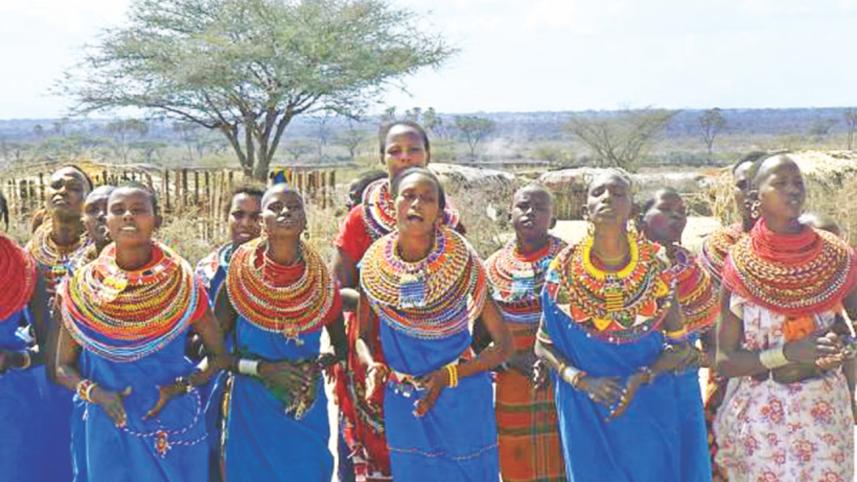
Few women have dared to do what Rebecca Lolosoli, a Kenyan, has done. Rejecting the patriarchal Samburu tribe she came from, she has created the ideal village for women where chauvinism, gender violence, and discrimination just do not exist. In fact, men are not allowed to enter the village unless they get permission from the women. After experiencing violence and abuse herself and that inflicted on others, Rebecca decided that enough was enough. Braving the threats, insults and ostracism, she formed Umoja village 25 years ago, giving shelter to women and girls who had been victims of various kinds of violence such as rape, female genital mutilation and forced marriage.
The women of the village are self-reliant, making jewellery or handicrafts for a living. Many of them suffered physical torture from their husbands; almost all had to go through genital circumcision as part of the Samburu tradition. Others had been abandoned by their husbands or families for the stigma attached to the abuse they had gone through.
 For all latest news, follow The Daily Star's Google News channel.
 Now, however, there is no shame, only pride that they can raise their children by themselves without the help or charity of any man. They have even set up their own school and community centre. Rebecca says in an interview (by Broadly, an online site), that the women of Umoja want their children, especially their daughters, to be educated.
This may be the ultimate feminist fantasy – in fact it echoes the ethos of Begum Rokeya's Sultana's Dream that describes a matriarchal society where women are in charge of everything from law and order to scientific research. But Rebecca's story is also one of great tragedy – it was because these women were subject to the worst kinds of torture and humiliation by men of their own community and outside it, that they were pushed to form their own little oasis. Undoubtedly the Samburu community, apart from the loss of face at this humiliating exodus, has also lost out economically and socially, in terms of the labour, skills, not to mention wisdom and nurturing, of these women.
Although it is plain common sense that when all members of the community are happy and productive, the economic returns will be huge, women are constantly being subject to violence and discrimination, thus depriving the community of its full economic potential. A recent World Bank research has found that countries that have discriminatory laws against women or do not promote gender parity also fare poorly in economic terms. The World Bank Group's Women, Business and the Law 2016 report has identified legal barriers to economic empowerment that keep women out of certain jobs, reduce access to credit and make them more vulnerable to violence.
Women for instance, says the report, are barred from working in certain factory jobs in 41 economies; in 29 economies, they are prohibited from working at night; and in 18 economies, they cannot get a job without permission from their husband. Only half of the economies covered have paternity leave, limiting men's ability to share childcare responsibilities. In 30 economies, married women cannot choose where to live and in 19 they are legally obligated to obey their husbands.
The result of this deliberate exclusion from economic activities, the research concludes, adversely affects not only the women but also their children, their communities and hence their countries.
In Bangladesh, as in most of South Asia, women are disempowered not so much by discriminatory laws but more because of the discrimination they face in getting justice through the legal system. We have anti-dowry laws, the Child Marriage Act, Prevention of Women and Child Repression Act 2000 and other laws that on paper cover most forms of violence and offer redress for the crimes. But in a society where cultural practices dominate, these laws can prove ineffectual for the victims. Money and influence are used by perpetrators - all male - to dupe the system and go scot free. Society, by and large, is unsympathetic to female victims. The low number of convictions of cases of violence against women results in an increase in the number of such incidents.
Statistics from Ain O Shalish Kendra (ASK) gleaned mainly from newspaper reports depict a horrifying scenario. Between January and June this year, there were reports of 378 rapes with 29 deaths as a result of rape; 63 of the victims were children between 7 and 12. ASK's report has also found 87 cases of sexual harassment with 6 suicides as a result of this. 112 women were tortured and murdered by their husbands in that short period.
True, there are more women in the work force in Bangladesh than ever before, which is a sure parameter of progress. But women are still not paid equally as their male counterparts, especially in blue collar jobs, and their productivity is significantly impeded physically and mentally by violence.
The lack of security at home and outside it, therefore, is a huge impediment to women's empowerment and the empowerment of the nation as a whole.
Rebecca Lolosoli was sick and tired of seeing her fellow women folk being regularly abused by men in her tribe and the brutal traditions it imposed, making them weak and powerless. She chose to make a change – leading the women out of their prison into a sanctuary of peace and economic freedom. Meanwhile, other women, inspired by Rebecca, have left their repressive communities to form similar matriarchal villages where women and girls can work, study and live a life without humiliation. For the men of the Samburu tribe, the abandonment is an insult to their masculinity and their traditional role as the protectors of women. For the world, Rebecca's initiative is a form of protest against the injustice half of its population suffers as a result of debilitating patriarchal domination.
The writer is Deputy Editor, Editorial and Op-ed, The Daily Star.
Comments