


Managing disasters scientifically
The discourse on disaster management has undergone significant changes in recent decades and the effects have been profoundly felt in the developing world, particularly in terms of reduction in the loss of human lives. The practices in dealing with disaster events in the 1970-80s were fundamentally response oriented, which didn't involve the use of scientific data and information. The prediction of disaster was fundamentally based on reading changes in natural phenomena, which were not very effective in projecting the extent of devastation a disaster could bring.
The traditional approach to disaster management has been in the aftermath of the events. Relief and response drove the earlier phase of disaster management.
 For all latest news, follow The Daily Star's Google News channel.
 The concept of disaster management has undergone significant changes, partly as a result of scientific study. The common view of disasters as simply hazards or events is now challenged by the view that disaster risk is the outcome of both natural and human influenced factors, with risk expressed in terms of potential losses of life, livelihoods and property. This has shaped up new approaches to science and practice in reducing the risks of disaster, being more resilient and more adaptable to climate change.
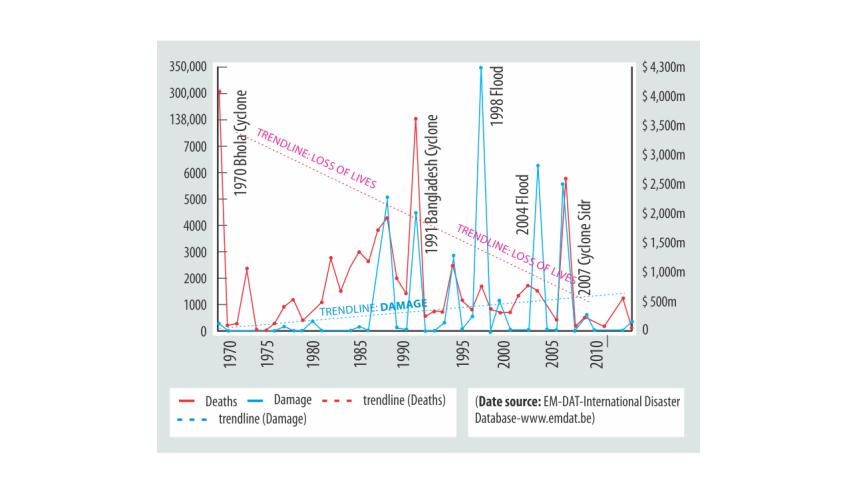
Bangladesh, being one of the most disaster‐prone countries in the world, has made remarkable progresses in reducing disaster-related deaths, thanks to the introduction of modern science and technologies. The progress has been achieved in the face of considerable vulnerability and exposure to natural and human-induced hazards. Between 1990 and 2008 Bangladesh incurred an average annual loss equal to 1.8% of the GDP due to disasters which threatened the hard earned development. Damage and loss due to disasters is still on the rise.
The key to reduction of disaster is adoption of both natural and social science, be it in the form of strengthening technologies and capacities for an effective early warning system, or dissemination of the warning to the last mile. But there are miles to go before we take a breath of satisfaction.
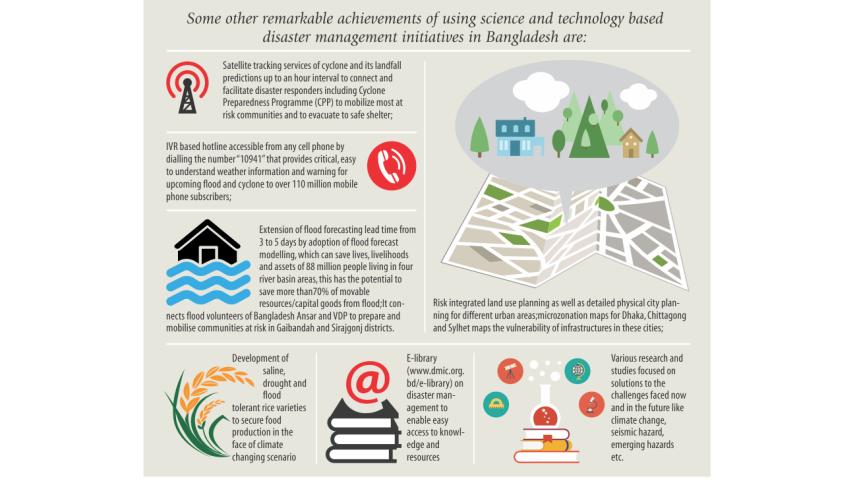
The rapid development of science and technology and its application over the last decade has shaped the conceptual basis for the paradigm shift of disaster management in Bangladesh. For example, the country's high growth mobile phone sector is buying into disaster risk reduction, as the government and other agencies teamed up with mobile phone operators to provide early warnings for cyclones and floods.
The Bangladesh government has adopted a national ICT Policy in 2009 which includes the following actions to address disaster management:
* Protect citizens from natural disasters through ICT-based disaster warning and management technologies;
* Utilise remote sensing technologies for disaster management and mitigation;
* Web-based environmental clearance certification system;
* Promote cell phone/SMS-based disaster warning systems targeted to the population likely to be affected;
* Utilise Geographic Information System (GIS)-based systems to monitor flood and cyclone shelters (including equitable distribution in vulnerable areas);
* Promote efficient relief management and post-disaster activities monitoring;
* Utilise GIS-based systems to ensure equitable distribution of relief goods with special focus on the hard-to-reach areas.
The Comprehensive Disaster Management Programme (CDMP), a flagship collaborative initiative of the Bangladesh Ministry of Disaster Management and Relief (MoDMR) and UNDP, is leading the charge on these initiatives.
Science has played an essential role in uncovering new ways to prevent, prepare for and respond to disasters and determining which technologies to adopt in the country context, but it all will go in vain if targeted users do not use or demand benefit from these applications.
It was seen that when scientific knowledge is blended with localised indigenous knowledge they yield outstanding results in reducing disaster loss. In August 2014, continuous rainfall in north and north-eastern Bangladesh, together with the onrush of water from upstream, caused flooding in low-lying and densely populated areas in nine districts. Small and medium scale local rural risk reduction interventions such as plinth raising, road cum embankment, construction of flood shelters among other structural interventions have been found to be very effective in reducing loss and sufferings of the people as these were designed considering scenario based flood .
In the next few decades, scientific advancements in understanding of natural hazards are expected to rise. It will further strengthen the approach to risk assessment, risk management, preparing communities, rebuilding and rehabilitating communities. The use of satellite and remote sensing data and information will be more effective, accurate and all-encompassing to allow disaster managers and policy makers to take decisions that are timely and more effective in building resilient communities, cities and nation.
Realising the context, the government has decided to focus on using scientific knowledge in reducing future disasters induced loss and damage hence ready to celebrate the National Disaster Preparedness Day (NDPD) 2015 with the theme "Know the Scientific Facts: Reduce the Disaster Loss" on March 31, 2015. Bangladesh has been observing National Disaster Preparedness Day every year since 1997 to raise awareness of people and motivate them to manage disasters successfully.
The writer is National Project Director, Comprehensive Disaster Management Programme, and Additional Secretary, Ministry of Disaster Management & Relief, Bangladesh
Email: abdul.qayyum@cdmp.org.bd
Comments