


The Tangail saree’s global fame and the weavers we forget

The Tangail saree has travelled far. Once woven quietly in riverside villages, it now appears in fashion catalogues, festival exhibitions, and heritage headlines. With UNESCO recognising the Tangail saree as an Intangible Cultural Heritage of Humanity, it has entered the global imagination as a symbol of Bengal’s fine craftsmanship. Yet behind this recognition lies an uncomfortable truth: while the saree’s reputation has soared, the lives of the weavers who make it remain precarious, undervalued, and increasingly uncertain.
In Tangail—Pathrail, Nagarpur, Kalihati, Basail, Balla, and Sontosh—the day begins with the clack of looms. Inside modest homes, wooden frames creak rhythmically as yarn is drawn, tightened, and released. Bowls of river water sit nearby, ready for the mar process that prepares the thread. This is not factory labour measured only by output; it is a craft shaped by memory, patience, and bodily skill. But for many weavers, this skill no longer guarantees dignity or security.
The Tangail saree’s uniqueness is inseparable from its geography. The region’s rivers—the Dhaleshwari and the Louhajang—have long provided the iron-free water that supports traditional weaving practices, especially the mar process, when yarn is treated before weaving to achieve softness and strength. Even when Tangail-style sarees are woven elsewhere with similar designs, the finishing often fails to feel the same. The cloth may look identical from a distance, but it does not carry the same softness, drape, and lasting comfort.
Nilkamal Basak, managing director of Nilkamaler Saree and a member of the Basak weaver community, points directly to the ecological foundation of the craft: “The Dhaleshwari and Louhajang rivers flow through our Tangail. When our ancestors came here, the water of these rivers was so clear and iron-free. This type of clear water is ideal for making any kind of weaving.”
Historically, the craft was sustained by the Basak community, master weavers whose migration across Bengal was shaped by both survival and ecology. From the Indus Basin to Murshidabad, then through Dhamrai and finally to Tangail, they moved where fine weaving could be produced.
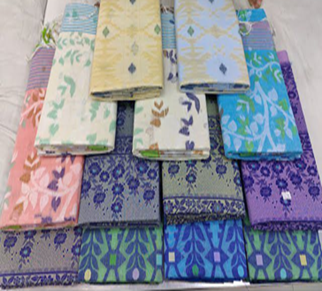
Over time, Tangail weavers developed distinctive techniques and designs. While most cotton fabrics tighten and lose softness over time, Tangail sarees behave differently, becoming softer with use. This durability is rooted in the traditional mar process practised by Tangail’s weavers. Elsewhere, yarn is typically treated with ordinary rice starch (bhater mar). In Tangail, however, master weavers use khoi-er-mar—a starch made from puffed rice—which coats the fibres more gently. The result is yarn that remains smooth, stable, and resistant to shrinkage, even after repeated washing. Nilkamal Basak describes the discipline behind it: “After applying mar, the yarn is wrung thoroughly so that the fibres are stabilised. This prevents them from absorbing excess water. As a result, the yarn becomes shiny and does not shrink. This method has been practised in our Tangail for a long time, which is not found anywhere else.”
The distinctive borders of the Tangail saree, known as paar, with their buti, floral, and geometric designs, are the result of a long process of refinement. With the spread of Jacquard weaving, the craft also became an exercise in mathematical precision: punch cards, locally called mala, allowed complex patterns to be encoded and reproduced with near-perfect consistency. The saree became not just beautiful, but technically sophisticated.
Yet the custodians of this knowledge find themselves increasingly sidelined. What once functioned as a household-based economy of skill is now compressed into a fragile system defined by thin margins and chronic insecurity. The spread of power and semi-power looms has boosted output and reduced costs, but it has also altered how labour is valued. Supply chains are controlled by intermediaries, while weavers are paid by the piece at rates that rarely account for the time, expertise, or physical toll of the work. Social protection remains minimal, health insurance largely absent, and the prospect of old age deeply uncertain.
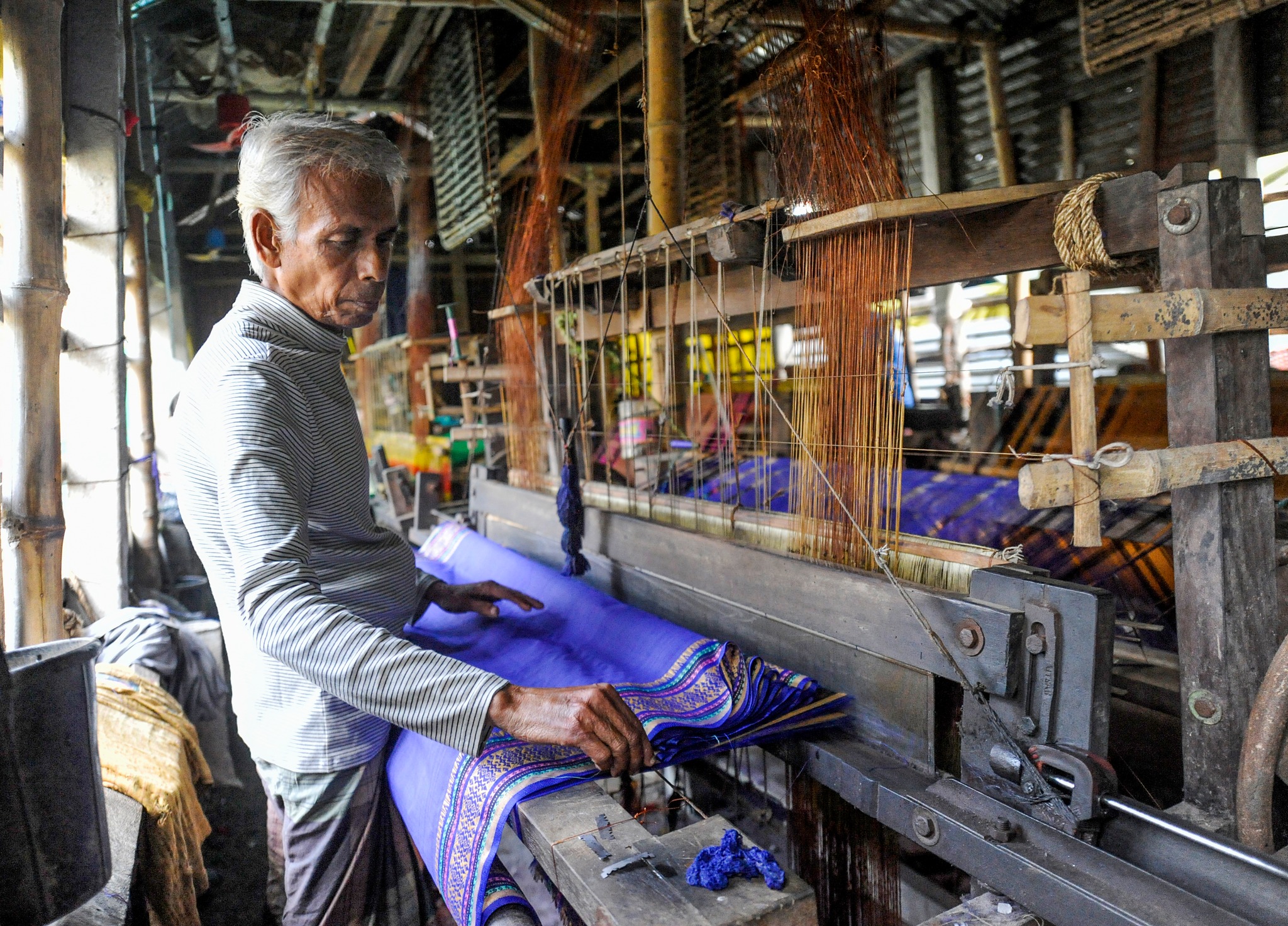
For women weavers, this precarity is even more pronounced. Their labour is routinely absorbed into domestic life and dismissed as assistance rather than acknowledged as skilled work. After long hours at the loom, they return to unpaid household duties. Their contribution, although essential, remains persistently overlooked.
Against this background, UNESCO recognition is a significant milestone, but prestige does not automatically translate into fair wages, safe working conditions, or stable livelihoods. Without deliberate policy and market interventions, recognition can even deepen inequality: the saree’s brand value rises, prices climb, and profits accumulate elsewhere, while the weavers remain stuck at the bottom of the chain.
This is why the crucial question is not only what makes the Tangail saree unique, but what kind of future it will have. A living craft survives only when people can afford to practise it. If the next generation sees weaving as a path to poverty, the tradition will not continue—no matter how many exhibitions celebrate it.
Recognition must be matched by concrete measures: fair pricing mechanisms, direct market access for weavers, stronger co-operatives, and public support through healthcare, pensions, and training programmes that protect skill transmission. Otherwise, the Tangail saree will become a paradox—globally admired, yet locally abandoned.
S. Disha is an undergraduate student of Applied Linguistics at BRAC University, exploring the intersections of culture and community.
Send your articles for Slow Reads to slowreads@thedailystar.net. Check out our submission guidelines for details.