


On a village veranda, one woman fights to save a fading script

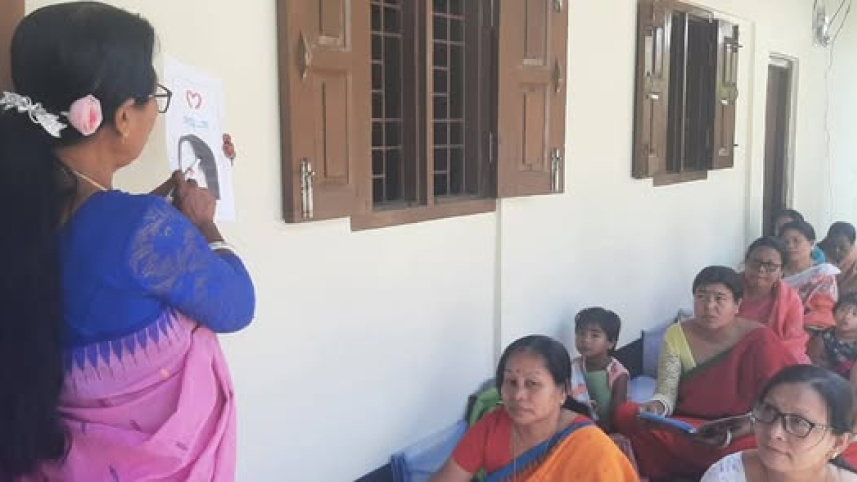
Every Friday morning, the quiet veranda of a house at Haktiarkhola village becomes a classroom.
Children sit cross-legged on plastic mats, their eyes fixed on a blackboard. Chalk in hand, retired schoolteacher and poet Brinda Rani Sinha carefully writes the curved letters of the Manipuri script, Meitei Mayek.

The children repeat after her, learning the letters, words and sentence structures of a language many of their parents can speak but cannot read or write.
For generations, the Manipuri community in Kamalganj upazila of Moulvibazar has spoken its mother tongue at home -- during festivals, family gatherings and daily conversations. Yet literacy in the language has steadily declined. While the language survives orally, the script has largely disappeared from everyday use.
In 2019, determined to reverse that decline, Brinda founded the Manipuri Language Training Centre, also known as the Meetai Moyek Tambibagi School, on the balcony of her home in Adampur union.
“I felt the language was on the verge of extinction,” she said.
“There was no opportunity to learn how to read and write it. I thought, at least let me try to help it survive and grow.”
Every Friday from 10:00am to 11:30am, between 25 and 30 children attend classes. On one or two Friday afternoons each month, homemakers gather after completing their household chores.
The modest veranda, with space for around 30 people, has been transformed into a small but lively classroom. Even during the Covid-19 pandemic, classes continued with fewer students and social distancing measures.
Brinda retired as an assistant teacher from a primary school in July 2023. Before launching the initiative, she consulted village guardians and sought her family’s support.
“When I started, I had only one Manipuri book,” she recalled.
“Later, poet AK Sheram gave me 15 books. My husband bought a blackboard and duster. Others donated money for a sound system (that she uses for classes). Many people came forward to help.”
Lakshmikanta Singh of the Ethnic Community Development Organization supported the centrewith books and other educational materials, she added.
Brinda provides notebooks and pens for her students.
Local cultural organiser Sanatan Hamom said the community’s mother tongue is Manipuri, also known as Mitilon. It is the state language of Manipur in India. Manipuris settled in the Kamalganj area some 350 to 400 years ago. The population now stands at an estimated 24,000 to 25,000.
“At home we speak Manipuri, but outside we mostly use Bangla,” he said.
“Many people are now more comfortable in Bangla, even with family members. As a result, our mother tongue is gradually being pushed aside.”
Although ethnic minority students are, in theory, allowed to study in their own languages at primary level, community members say the policy is not effectively implemented. Without institutional backing, efforts to preserve the language often struggle.
Yet Manipuri has a rich literary and cultural heritage and its own alphabet, Meitei Mayek, Sanatan said.
Since the centre’s inception, more than 100 Meitei (Hindu Manipuri) and Panghal (Muslim Manipuri) students from Kewalighat, Katabil and Haktiarkhola villages have learned to read and write their mother tongue, he said, adding that some have gone on to study at medical colleges and universities.
 For all latest news, follow The Daily Star's Google News channel.
 Homemaker Bimala Sinha, one of the learners, said the classes have transformed her relationship with her language.
“Before, I could speak but I could not read... Now I can read books in Manipuri. Our children are learning too. This will help our language survive,” she said.
Brinda began teaching homemakers in February 2022. Although their attendance can be irregular due to domestic responsibilities, their enthusiasm remains strong.
A mother of two -- one a doctor, the other a banker -- Brinda has published two poetry collections, including Aigi Khongchat (My Walk) in Manipuri. Yet she considers the veranda classroom her most meaningful work.
“As long as I am physically able, I will continue the language training centre,” she said.
Sajjadul Haque, president of the Panghal Research and Publication Organisation and a teacher-poet, said the centre has created a rare space for Meitei and Panghal students to practise their mother tongue and script.
“In the absence of institutional opportunities for language practice at the state level, there is no alternative to this centre,” he said.
On a simple village balcony, amid chalk dust and plastic mats, a quiet struggle continues — not for recognition or reward, but for the survival of a script and the identity it carries.
Comments