


Language debate in Pak era went beyond religion
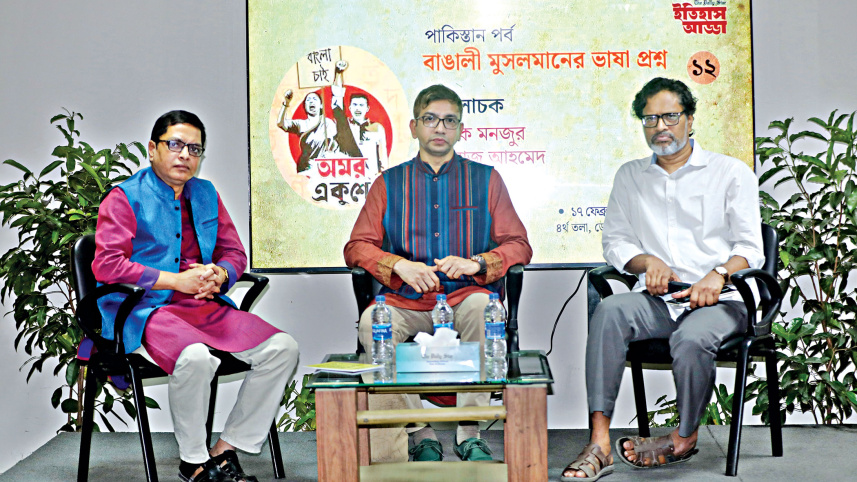
The debate over the language of Bangalee Muslims during the Pakistan period was shaped not only by religion but also by questions of power, region, economy, and democracy, speakers said yesterday.
They made the remarks at the 12th session of The Daily Star’s Itihas Adda, titled “The Language Question of Bangalee Muslims: Pakistan Period,” held at The Daily Star Centre in the capital.

Writer and thinker Firoz Ahmed said debates over Urdu and Sanskrit vocabulary are often reduced to Hindu–Muslim binaries, though the issue is more complex. “When we debate the use of Urdu or Sanskrit words, we assume it is only about a Hindu–Muslim division. But it is not simply a communal issue,” he said.
He referred to the historic East–West divide within Bengal. Citing an 1885–86 controversy, he said a Kolkata-based publication had described eastern Bengal’s language as “impure” and suggested that writings from the region be edited in western Bengal.
“Who gives them the authority to fix the standard of language?” he asked, adding that debates over linguistic purity were also contests over cultural authority.
He said words such as “Bondobosto” had long been part of Bangla and rejected the idea that vocabulary could be imposed from above. “No one can push a word into a language by force. A word survives only if people use it,” he said.
Firoz also cautioned against discarding either Arabic-Persian or Sanskrit vocabulary. Referring to Abul Mansur Ahmad’s idea of a “middle path”, he said language should not be driven to extremes.
Removing words from either tradition would weaken Bangla rather than strengthen it, he added.
“The best terminology often comes from the languages that historically shaped our intellectual and cultural formation. To discard them out of narrowness weakens the language,” he said.
Researcher Mamun Siddiqui of Bangla Academy said the language question during the Pakistan era was inseparable from land, democracy and economic rights.
He said discussions over Pakistan’s state language began even before the state was formed. “It was like speaking of the Ramayana before the birth of Ram,” he said.
Citing Abdul Haq, Mamun said, “If linguistic freedom is not secured, political freedom remains incomplete.”
“Besides, Enamul Haq had warned that imposing Urdu would bring ‘political, cultural and economic death’ to East Pakistan,” he added.
Referring to Abul Mansur Ahmad, Mamun said, “If the language of the people and the language of the state do not coincide, that state cannot be democratic.”
He said newspapers and magazines from Chattogram, Cumilla, Sylhet and Dinajpur carried arguments in favour of Bangla as the state language, showing that the demand extended beyond Dhaka-based elites.
“These writings prepared people’s minds,” he said, stressing that the 1952 Language Movement did not emerge suddenly.
He described the language struggle as linked to economic and political emancipation, arguing that without that connection, “no language movement can succeed.”
Prof Tariq Manzoor of the Bangla department at Dhaka University said, “If we think of ‘Bangalee Muslim’ as a combined identity, that is largely a post-1947 development,” he said, noting that before Partition the terms were often treated separately.
On language, he distinguished between spoken and written forms, saying linguistics prioritises speech while prescriptive grammar focuses on written norms.
He said attempts after 1947 to reshape Bangla through script reform, spelling changes and heavy insertion of Arabic-Persian vocabulary largely failed because language cannot be sustained through artificial imposition.
 For all latest news, follow The Daily Star's Google News channel.
 On the state language debate, he said from the perspective of a religion-based state, the push for Urdu as a lingua franca followed a certain logic. However, Bangla’s demographic majority and rich literary heritage made it impossible to sideline, he added.
“A language spoken by the majority and backed by a strong literary tradition cannot be denied state status,” he said.
Although Bangla received constitutional recognition in the 1950s, its administrative implementation remained limited during the Pakistan period. Recognition was granted, but practical application lagged far behind, he added.
Comments