


139 appeals over death penalty still pending
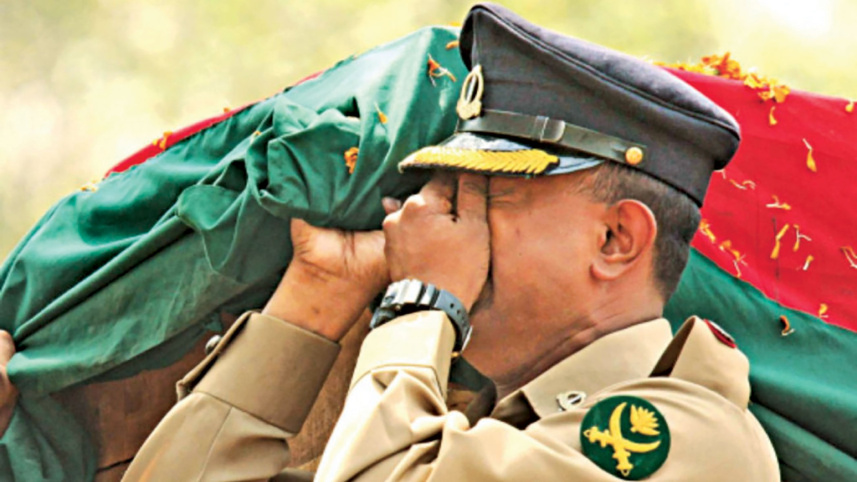
Seventeen long years have passed since the BDR carnage, but neither the Sheikh Hasina-led Awami League government nor Prof Muhammad Yunus-led interim government took any extensive steps to settle the appeals in the Appellate Division, leaving the death penalties of 139 convicts unexecuted.
Asked about the current BNP government’s plan on this issue, Law Minister Md Asaduzzaman refused to make any comment.

“I am not making any comment on anything. Let me settle down a bit first,” he told The Daily Star on February 20.
However, Attorney General (in charge) Md Arshadur Rouf told this correspondent on February 20 that the Appellate Division will start hearing the appeals in the BDR mutiny case when the chief justice orders to include the appeals in the list for their hearing and disposal.
The old cases are now being heard and settled in the Appellate Division, he added.
A total of 74 people, including 57 army officials, were killed in the mutiny that took place in the capital’s Pilkhana headquarters of the erstwhile Bangladesh Rifles (BDR) on February 25 and 26 in 2009.
The incident of mutiny had left the nation benumbed, as people stood aghast at the extent of the barbarity perpetrated at the headquarters of the paramilitary force, later renamed Border Guard Bangladesh (BGB).
A couple of days later, police filed a case with Lalbagh Police Station on various charges, including murder and use of explosives. The case was transferred to New Market Police Station on April 6 that year and then split into two cases -- one for murder and the other for the use of explosives.
On November 5, 2013, a Dhaka court sentenced 150 BDR members and two civilians to death and jailed 160 others in the murder case. Another 256 people, mostly BDR soldiers, were awarded varying jail terms, and 278 were acquitted.
While disposing of an appeal by the prosecution, the HC in November 2017 reduced the number of individuals sentenced to death to 139, awarded life imprisonment to 185, and sentenced 228 others to various prison terms ranging from one to 13 years.
It also acquitted 283 people and exempted 15 others from the case.
The 35 appeals filed challenging the High Court verdict that confirmed the death sentences of the 139 convicted accused in November 2017 are still pending with the Appellate Division of the Supreme Court.
It is still uncertain when the victims’ wait for justice will come to an end, since the Appellate Division has yet to start hearing the pending appeals.
Besides, the trial court could not even finish recording statements from witnesses in another case filed under the Explosive Substances Act, 1908, in connection with the same incident. Therefore, it cannot be said when the trial proceedings of this case will be finished.
The explosives case, however, has not seen much progress so far.
In July 2010, police submitted the charge sheet in the explosives case to a Dhaka court against 808 people, mostly BDR members. Later, another 26 were included in the charge sheet.
Though trial proceedings in both cases started in August 2011, the explosives case was put on hold so that the murder case could proceed uninterruptedly. The proceedings of the explosives case resumed after a Dhaka court pronounced the verdict in the murder case in November 2013.
Between January 19 and November 20 last year, 316 former BDR members, accused in the explosives case, were released from jail after securing bail from Dhaka Metropolitan Special Tribunal-2.
Of them, 259 had earlier been acquitted by the HC in the murder case, and 57 had already served jail terms ranging from one to 10 years, according to court staffers.
Advocate Md Aminul Islam, chief defence counsel in BDR cases, told The Daily Star that a separate bench of the Appellate Division, comprising at least four judges, is needed to hold hearings of the appeals in the BDR carnage case.
 For all latest news, follow The Daily Star's Google News channel.
 Currently there is a shortage of judges on the Appellate Division, and therefore, more time will be needed for disposal of the appeals, he said.
Aminul, who was appointed a chief prosecutor at the International Crimes Tribunal on February 22, also said the explosives case was used by the then Awami League government as a strategy to keep behind bars the accused who were acquitted or had already served their jail terms.
Another defence lawyer, Tasmiah Nuhiya Ahmed, recently told this correspondent the trial proceedings in the explosives case are going on slowly.
Comments