


Powering Villages, Empowering Lives
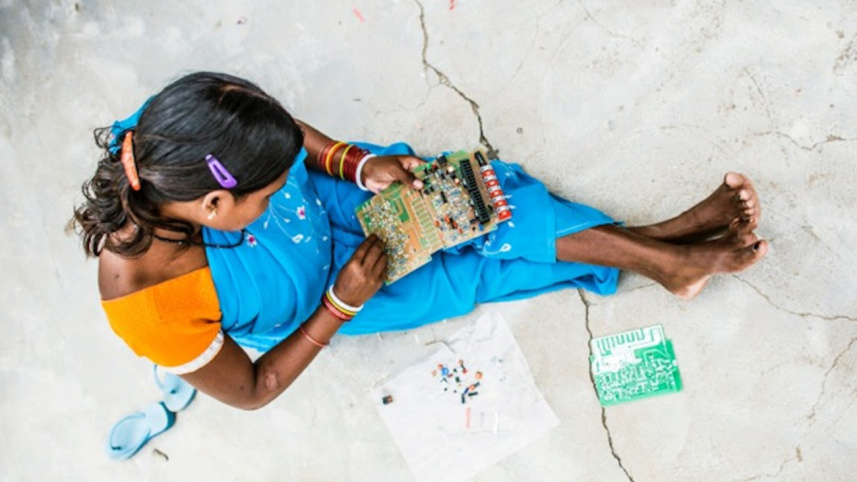
In India's Barefoot College, rural women learn to make and maintain solar panels, bringing clean power to their villages and creating employment for the previously unskilled
NilanjanaBhowmick

An unpaved, dusty road lined with bushes and shrubs leads to a sprawling campus and a large classroom filled with solar panels and equipment. Here, Geeta Devi, a 45-year-old woman in a red sequined sari and a silver nose ring, was recently explaining a complicated-looking circuit to a group of awestruck women standing around a worktable piled high with circuits and lanterns.
Devi is a solar engineer. Or, to be precise, a "barefoot" solar engineer, one of hundreds of women in their late thirties and forties (most of them grandmothers) from some of the most remote corners of India, trained by the Barefoot College to build solar panels and provide their off-grid villages with power.
Apart from lighting up villages, the program has also become an important tool for empowering rural women, many of whom are illiterate. Devi's life has undergone a sea change. From her formerly unremarkable existence, tending the fields, livestock and her family, she is now financially independent thanks to her role teaching at the college, where she earns a small monthly salary. She is respected in her community, a person whose opinions are sought after. "Today, I matter," she said.
Barefoot College was founded in the early 1970s by social activist Sanjit "Bunker" Roy, and it has been teaching solar electrification since 1989. It works out of Tilonia, a small, somnolent village of faded green fields and chocolate-box hillocks, in the desert state of Rajasthan, around 100 kilometres from the state capital, Jaipur. Starting with local women and panning out to the rest of India, today the Barefoot imprint reaches 64 other countries as well.
Every year, the college trains 100 women from India and 80 from Asia, Africa and Latin America, in two batches for six months each. The Indian government recognised the course in 2008 and covers the students' training and travel costs. The Ministry of External Affairs pays around 150,000 rupees (US$2,500) plus travel costs for each international grandmother, while the Ministry of New and Renewable Energy pays roughly 70,000 rupees for each domestic trainee. Funding from private individuals and foundations helps to pay for solar equipment and other costs.
Each grandmother learns how to make, assemble, maintain and repair solar panels. When time allows, they also learn to make sanitary napkins, mosquito nets and candles. Some of the domestic students stay longer and learn to build items such as solar cookers and water heaters.
Spread over two sprawling campuses—the newer one fully solar-powered—the Barefoot College started by teaching both men and women. But by 2005, Roy realised the model would work best if they trained women alone. "For a long-term, sustainable solution, training older women is a wise investment in human resources," he pointed out. "They just want to live closer to the land, their children and animals, and pass on their skills to the younger generation."
The international students study in the old campus, about a kilometre from the new one. Joselyn Mateo Diaz, a 41-year-old grandmother from the Dominican Republic, travelled all the way to India this spring to learn how to solar power her village. "The government forgot about us," said the ever-smiling Diaz. "My only wish is to study with my grandchild at night."
And soon she will. Diaz, who taught herself to read, has no problem following the lessons as they are carried out in basic English and through colour-coded circuits and sign language. Back home, the villagers will pay a nominal monthly stipend to coverher services as well as components and spare parts for the panels.
Globally, 1.3 billion people are off-grid. Of these, more than 300 million live in India, where the national electrification rate is 75 percent and rural electrification lags behind at 67 percent. More worryingly, around 800 million Indians are still dependent on carbon-emitting and polluting fuels. To date, there are close to 750 Barefoot solar grandmothers around the world, and they have powered some 1,160 villages. This translates to a reduction of nearly 13 metric tons of carbon emissions per day and an annual savings of 500,000 litres of kerosene.
What's more, by working longer hours in solar lighting, poor families can now increase their incomes. Indian villages electrified by the conventional grid cannot rely on power 24 hours a day. "In solar villages there are no power cuts," Roy said.
At the new campus, Devi gestured at the women around the table, some of whom were still looking dubiously at the various panels. "They always ask me, will I be able to do this?" she said. "I tell them I did it, you can too."
For more information
Website: http://www.barefootcollege.org/
Video: http://www.sparknews.com/en/video/barefoot-college-helps-women-become-solar-engineers
 For all latest news, follow The Daily Star's Google News channel.
Comments