


Five faiths sharing one roof
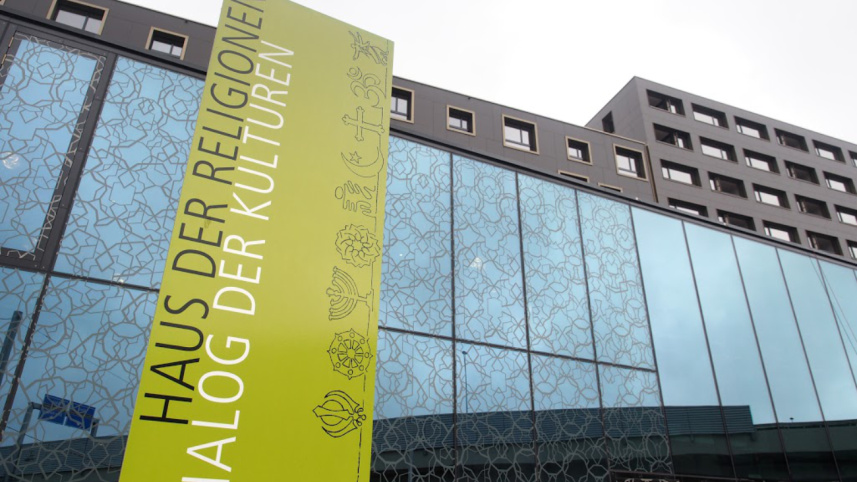
It is possible for very different rituals and beliefs about life and the afterlife to coexist: this miracle happens every day at the House of Religions, in the multicultural outskirts of Bern.
Five places of worship live together under the same roof: a mosque, a Hindu temple, an Alevi 'dergâh', a Buddhist centre and a church (used by eight different communities, including the local Ethiopian and Moravian communities).
 For all latest news, follow The Daily Star's Google News channel.
A new twostorey glassandconcrete complex hosts the five places of worship (funded and organised by the communities). The design also features a shared common area for all the communities, with conference rooms, a library and a restaurant.
Behind this miracle, three men of different religions stand out: a Moravian priest, an imam and a rabbi. More than ten years ago, when the world was shaken by 9/11 and the media focus turned to cultural differences, these men shared a dream: peaceful coexistence and dialogue among religions.
That seed has now bloomed, but the road has not been easy. The discouraging reaction of a public administrator in Bern, as he listened to the idea for the project for the first time, is just one telling example: "This project is unnecessary and destined to fail", he commented.
It took time, a lot of good will and determination, but the results finally came.
It has been a long, ten year journey. "We will not save the world, we are not missionaries, but we practice dialogue: not the abstract one among religions, but the concrete one among people of different faiths who built their temples under the same roof and share common spaces," explains Gerda Hauck, president of the association 'House of Religions Dialogue among Cultures'.
Different approaches to rituals could lead to conflict: a festive day of prayer for one religion could be considered impure by another.
"We prevent one community from restricting the activity of others. There have been frictions, but we have come up with a rule: we must discuss and find solutions in a limited time. And this has always worked," Hauck explains.
The Hindu minister confirms: "Our prayers are festive, explosive, musical, noisy. Nothing to do with Muslim rituals. We have had disagreements but we have learned that we have to discuss and find a solution". Sasikumar Tharmalingam, 38 years old, holds celebrations six times per day and follows 450 Hindu families, particularly Tamil, devoted to Shiva.
"The idea of living side by side, on the same doorstep with Muslims or Christians, was a strange one at the beginning, but this formula works. There are points of contact among religions and all of them, after all, say the same thing: God is love", the Hindu minister says.
The joyful explosion of colours in his temple clashes with the sober Alevi 'dergâh' upstairs: a creamcoloured room with no images, a table, a cauldron and 12 niches in the wall representing as many philosophers.
The mosque is elegant but sober, built on two floors: downstairs for men, upstairs for women. The walls are decorated with geometric designs on a black and purple background featuring the names of the 28 prophets; a huge crystal chandelier (brought disassembled from Turkey) dominates the centre.
"We are a model of interreligious coexistence. The mistrust towards Muslims exists in particular among those who don't know us. That's why it is important to promote knowledge of different faiths. Next generations will reap the benefits," explains Mustafa Memeti.
The Albanian imam has his own vision: "We promote dialogue, but not mixture. Each one of us maintains our own religious identity in their respective place of worship," he underlines.
The writer is a journalist of aRegioneTicino, Bellinzona – Switzerland
Translation by: Gloria Schiavi
PROJECT DETAILS
https://www.hausderreligionen.ch/
Comments