


Because you’re happy
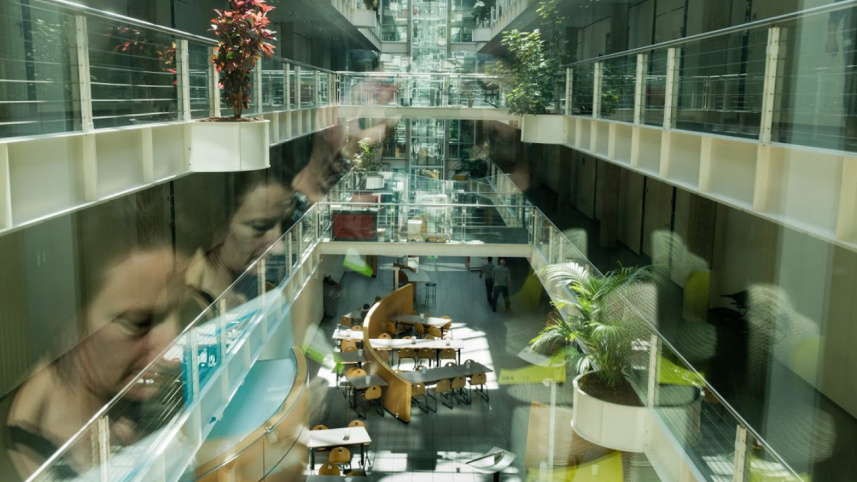
It seems that Switzerland is the happiest nation in the world...or at least if we are to believe the latest World Happiness Report published last month, overseen by the United Nations. Yet, not content with outdoing other countries when it comes to collective joy, Switzerland is now keen to make its citizens happy... at work. One Geneva-based company has made its employees' work-life balance its key issue. A major focus in the ruthless world of economic growth, its success could well give rise to a broader movement.
Geneva Industrial Services (SIG) – a self-governing State-owned company that provides the local population with services – came up with the EquiLibre project three years ago. The idea is an ambitious one: to rethink how the workplace and work itself is designed. The list of features includes working hours "taken on trust", desegregation of the hierarchy and a totally new space layout, none of which had ever been seen before in a country more closely associated with banking.
 For all latest news, follow The Daily Star's Google News channel.
 Conviction lies at the heart of the project or, to be specific, the conviction of a few executives, including Christian Brunier, now managing director of SIG. In 2011, he noticed with some concern that 54% of his company's 1,700 employees were over the age of 45. "So we asked ourselves the tough question: can we still be perceived by young people as efficient and attractive if we continue operating the way we are doing? The answer was clearly no."
As far as the Geneva-based company was concerned, simply giving the premises a facelift was not the answer. Change would be profound or not at all.
"Our research tells us that companies today are still holding onto this presenteeism culture, which goes against what employees are calling for," confirms Claudia Senik, an international specialist in welfare economics and behavioural economics, professor at Paris-Sorbonne University and at the Paris School of Economics. "Reconciling work and private life is becoming a real economic and social challenge. Beyond salary and the work itself, the issue of working conditions matters more and more."
Armed with these findings, Christian Brunier proposed that several internal departments should act as guinea pigs for the EquiLibre project. In total, 100 people volunteered to switch to happiness mode.
For these lucky few, the first revolution related to working hours. They were asked to stop clocking in and out. Their working hours are "taken on trust". In return, they are free to organise their time as they choose, with the option of working from home two days a week. The second big change was an end to designated workstations. Everyone is given a laptop, a smartphone and a named locker.
At the same time, it was decided to limit the use of paper as much as possible. The very height of independence, the employee now chooses the most appropriate workspace depending on the task he or she is about to perform. There are individual offices for working apart, a library for concentrating and interaction zones for discussions. The brand new designer furniture, which costs less than the conventional kind, can be adapted to any situation. A consequence of this is that the hierarchy has been fundamentally transformed: "Without an office to display their status, executives are forced to embrace their role as managers. This form of desegregation reveals 'casting' errors." Christian Brunier himself said goodbye to his comfortable 30 m2 office "without a backward glance".
Two years on, 80 percent of employees say that they are completely happy but, revealingly, the remaining 20 percent nevertheless want to continue with the trial. Most importantly, productivity rose by almost 15 percent in the sector in question within the space of a few months.
In short, EquiLibre is quietly introducing a new work paradigm, which other companies are also interested in. French company Botanic has already announced its intention to adapt EquiLibre to its branches in France. What's more, the State of Geneva has been eyeing up this style of working in recent months. As far as SIG is concerned, the effects have proved so positive that the trial is set to be extended to 600 of its 1,700 employees. The ultimate objective is to switch to full EquiLibre mode.
Comments