


Unfit yet in operation

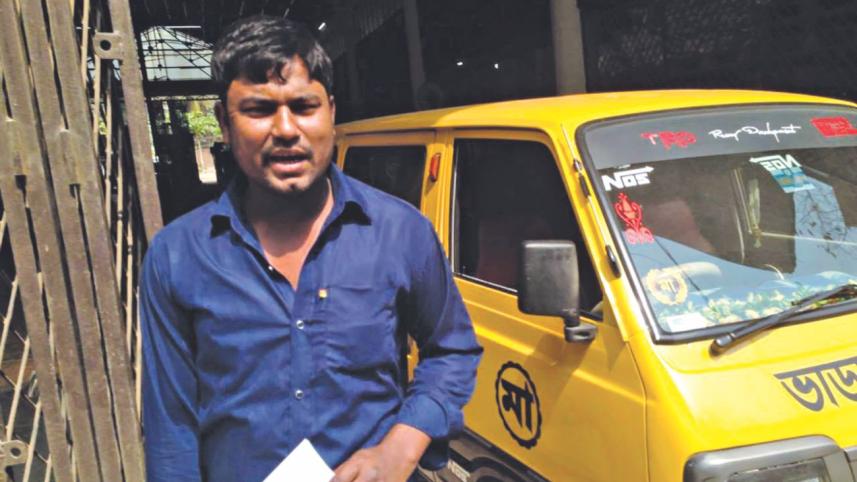
On March 1, Ranjan Das came to the BRTA in Mirpur from Comilla for a fitness test of his human haulier. The test, done at the automated Vehicle Inspection Centre (VIC) on the BRTA compound, found problem in the brake.
So denied the fitness certificate, Ranjan, who doesn't even has a professional driving licence, drove back to Comilla, about 90km from Dhaka.
 For all latest news, follow The Daily Star's Google News channel.
 “I don't find any problem while driving. But the machine has detected problem in the braking system…. I have to come again from Comilla for the test after fixing the problem,” said Ranjan, aged about 40, who only has a learner driving licence.
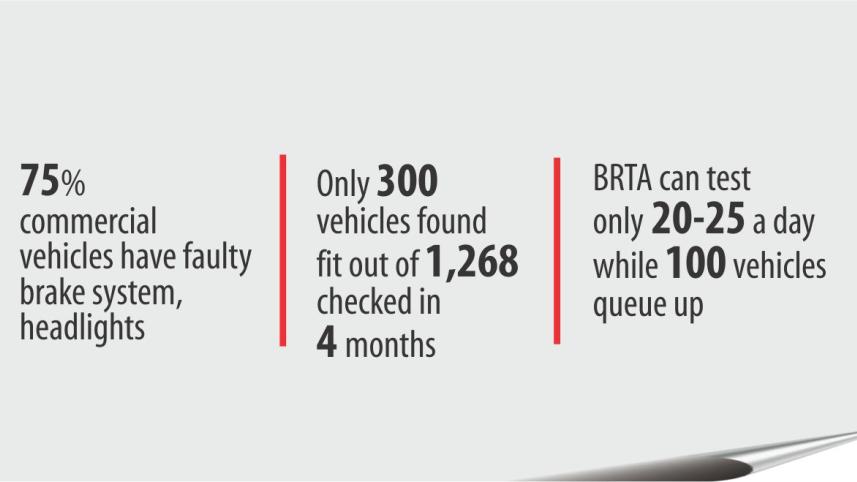
But it's not just about Ranjan's vehicle. Over the last four months, Bangladesh Road Transport Authority in Mirpur has tested 1,268 commercially-run vehicles at its VIC. Only 300 of them passed the test while the rest 968 have various fitness problems. At least 75 percent of them have problem in their brakes and headlights, BRTA data show.
Most of these vehicles are plying the streets, posing serious risk of accidents, said sources in the BRTA and transport sector.
But then again, this is only the tip of the iceberg. At least 11 lakh motorbikes, private cars and commercially-run vehicles are registered with the BRTA in the capital's Mirpur and Uttara, and Ekuria in Keraniganj.
Mirpur has the only VIC in the country, but only the commercially-run vehicles go through automated checking system. Other private vehicles are checked manually, which is not scientific and foolproof.
In other BRTA outlets across the country, all vehicles are tested through manual inspection. This means thousands, if not lakhs, of vehicles may have fitness problems that remain undetected.
A recent government-supervised study found at least 64 people get killed in road crashes nationwide. It is likely that many such accidents involve unfit vehicles.
Amid frequent deadly crashes, the government set up the digital checking system, costing about Tk 24 crore, for vehicles in Mirpur in October last year.
The centre can inspect only 20 to 25 vehicles -- buses, minibuses, trucks, covered vans, pickups and human hauliers -- a day.
Before issuing or renewing fitness certificates, five things are checked -- emission, headlight, wheel alignment, brake and speedometer.
The vehicles that fail the test are required to return upon fixing the problems after a certain time. While many come for a second or a third time, some do not and they continue to operate.
Motor vehicle inspector Ruhul Amin at the centre said over 75 percent of the vehicles tested so far had problems in their brakes and headlights. The rest has problems with their emission, alignment and speedometer.
Asked about the manual checking system, he said, “If you are ill, you usually go to a doctor and he gives you some pathological tests for accurate diagnosis. Similarly, fitness of vehicles should be checked with automated machines.”
There is only one automated machine in Mirpur, he said, adding that they needed at least two more.
On March 1, this correspondent spent more than an hour at the VIC, during which time four vehicles, including Ranjan's, underwent the test.
All the four failed the test on grounds of faulty braking system.
Every day, more than a 100 vehicles queue up at the centre, but it can inspect about 25, said Faruk Talukder Sohel, chairman of Bangladesh Bus-Truck Owners Association.
“As a result, many vehicle owners have to leave the centre without the test. So many vehicles hit the roads without fitness certificates. Police file cases against the owners and drivers in that case. Who is to blame for this?”
He declined to comment about the vehicles that are still in operation despite having faulty brakes and other problems. “I sent my vehicles for the test and they were found fit.”
Ali Ahsan Milon, assistant director (engineering) of BRTA, admitted that they could not check all the vehicles that go there for the test. “That's why vehicle owners face problem.”
Contacted, road safety activist Ilyas Kanchan demanded that all vehicles be tested digitally rather than manually.
In an urban setting, the problem of faulty brake and headlight is not that risky because the vehicles run slow. But they pose a greater risk on highway where vehicles run fast, said Dr Md Shamsul Haque of Buet.
“Overloading and over-speeding of commercial vehicles are among the major reasons for brake failure. So with vehicles with faulty brakes, the possibility of road crashes is high.”
He also said it was not possible to inspect vehicles manually. That's why the system is not in place anywhere else in the world anymore. “It is a corrupt system.”
Comments