


SKELETON trouble


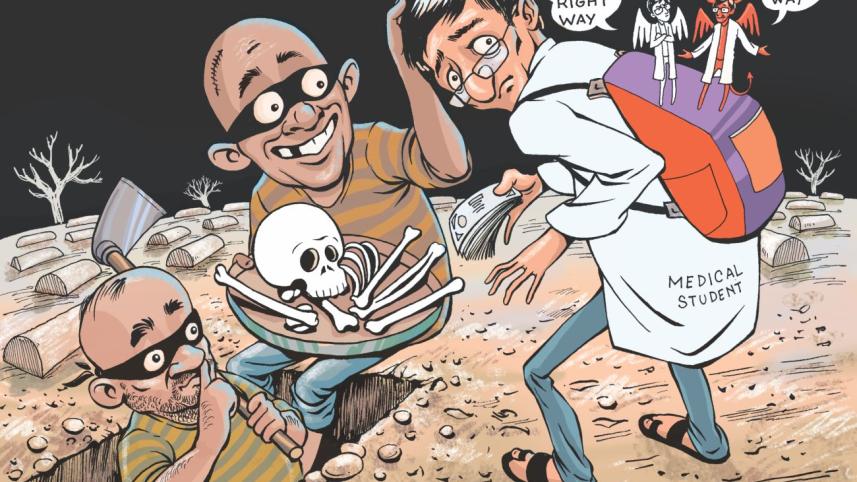
When Islam (full name withheld) signed up for MBBS studies three years ago, he faced an uphill task. For his anatomy course, he badly needed a human skeleton but he could not get one.
After months of frantic search, a few phone numbers written on the wall of his college building turned out to be the ultimate lead. One number belonged to a senior of his college who agreed to sell the skeleton he used in his early years as a medical student.
 For all latest news, follow The Daily Star's Google News channel.
 Islam, now in his third-year at Dhaka National Medical College, bought it for Tk 30,000 from the senior student, who had got it from a senior of his years ago.
“It's extremely difficult to get a human skeleton. There is no law that allows us getting skeletons for study purpose. That's why medical students often buy skeletons either from their seniors or from anatomy lab assistants who get those from underground sources,” he said.
The only legal source of human skeletons is those from donated bodies. But people donate their bodies to government hospitals only and these skeletons are used in the college classrooms and labs; they are not meant for personal use.
Doctors and students say making a law, change in the culture of body donation and updating the curriculum could solve this problem.
Knowledge of human anatomy is essential for medical students. It's an 18-month course, at the end of which students have to take 500 marks' exams.
Last year, 3,162 students enrolled in 29 public medical colleges for MBBS programme and 5,325 students in 64 private ones. In addition, nine public dental colleges have 532 seats for BDS course and 24 private dental colleges have another 1,280 seats, according to the Directorate General of Health Services (DGHS).
All medical students need to spend months to fathom the tiny details of the skeleton consisting of the 206 bones of the human body. But what is more difficult than mastering the course is getting their hands on a full set of human skeleton.
Most of the time, they buy those from senior students or lab assistants at their institutions or at the morgues of public medical colleges. The lab assistants buy those form illegal traders who steal those from graves.
Those that they get from their seniors are often very old, and therefore those no longer retain the delicate curves and contours that help specify or identify bones. In many cases, these older sets have some bones missing and so they hardly serve the purpose.
Normally, human skeletons remain in good shape for 30 years. After that they start to give way.
"In that case we try to get fresh sets from morgue or lab assistants at high prices," Islam said.
But many students cannot afford to buy alone. So they buy one in groups and then study together.
“Sometimes we have to spend nights on end in college hostels with our classmates so we can use the college labs to prepare for the exams,” said a female student of a public medical college.
WHAT ABOUT PRIVATE MEDICAL COLLEGES?
Although government medical colleges receive some donated bodies for use in classrooms and labs, private ones rarely get any directly from the government or donors. They have to rely on the goodwill gesture of state-run colleges. In other cases, they get those from illegal traders.
Professor Dr MA Bashar, principal of Dhaka National Medical College, said they usually borrowed human bodies or skeletons from various government medical colleges and hospitals.
“We need at least two bodies a year. But in the last few years, we didn't receive any from state-run hospitals. So whenever we need skeletons, we request our management and they get those for us [from underground sources],” he said.
Prof Dr Moazzem Hossain, chairman of East West Medical College Hospital, suggested that the government make a law, allowing public and private medical colleges to use some unidentified bodies and their skeletons for education purposes.
ILLEGAL AND UNETHICAL
Skeletons aren't easy to get. In the US, for example, most corpses are promptly buried, and bodies donated to science usually end up on the dissection table, their bones sawed to pieces and destined for cremation. So most skeletons used for medical study come from overseas, according a 2007 article published by American magazine WIRED.
India has long been the world's primary source of bones used in medical study, including in Bangladesh. In 1985, however, the Indian government banned the export of human remains, and the global supply of skeletons collapsed.
Over the years, while the number of medical students has risen manifold, the supply of skeleton both through legal and underground sources has dropped, said Prof Dr Rashid-e-Mahbub, chairman of the National Committee on Health Rights Movement.
Prof Shamim Ara, head of Anatomy Department at Dhaka Medical College, said that for the last several years they had been working on a draft of a law, which could solve the students' problem. The final draft might be ready in the middle of this year.
Islam, the student at Dhaka National Medical College, said they felt bad about the way they had to collect skeletons, as if they were committing an offence.
“We know these skeletons are stolen from graves and that is unethical, but we are helpless. There is no other way to get them,” he said.
Asked about the problem, Abdur Rashid, Director of Medical Education and Health Manpower Development of the DGHS, said, “We do not know how the public and private medical colleges collect human skeletons. We do not monitor the issue.”
DONATION CULTURE IN BANGLADESH
People in Bangladesh rarely donate their bodies for medical purposes, which is why skeletons are stolen from graves to meet the demand of the thriving public and private medical colleges.
Between 1990 and 2000, the DMCH received just eight bodies. Then from 2010 to 2016, it got another 26 donated bodies.
In recent years, the DMCH received the bodies of two notable personalities -- that of popular singer-songwriter Sanjeeb Choudhury in 2007 and that of Language Movement veteran Abdul Matin, popularly known as Bhasha Matin, in 2015, said Prof Shamim Ara.
DEVELOPED COUNTRIES VS BANGLADESH
In developed countries, the rate of donation of bodies is high, which is a good source of skeletons for the students and practitioners.
Also, they use artificial skeletons made of plastic and Gypsum plaster or “plaster of Paris” for their study. These skeletons are very hard and long lasting. (In Bangladesh, only plastic skeletons are available.)
Most importantly, many western countries have updated the curriculum. As a result, manual dissection of human bodies is no longer required there. Instead, they use computer simulation as part of virtual learning method.
In contrast, Bangladesh's curriculum is decades-old, said Prof Rashid. “The module for anatomy education in the country should be restructured.”
Charity organisation Anjuman Mufidul Islam buries about 1,500 unidentified bodies every year. This could be a legal source of human skeletons if the government makes a law in this regard, students and teachers said.
Comments