


Rainforest vanishing

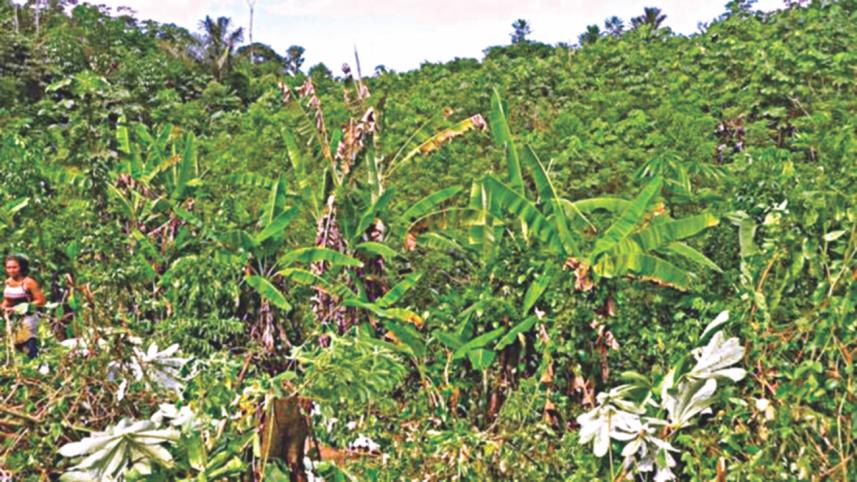
Bangladesh saw destruction or degradation of 66 square kilometres of tropical rainforest, roughly the size of Narayanganj city, over the last 17 years, according to a report by the Rainforest Foundation Norway (RFN).
Around four square kilometres of tropical rainforest in the country had been destroyed or degraded every year from 2002 to 2019, it says.
 For all latest news, follow The Daily Star's Google News channel.
 The report points out that the total area of tropical rainforest in Bangladesh was reduced to 900 square km in 2019 from 966 square km in 2001.
It also mentions that roughly 64 percent of the world's tropical rainforest has been destroyed or degraded since pre-industrial times. Between 2002 and 2019, areas of rainforest the size of France have been destroyed.
Experts say human settlement, agricultural expansion, and use of wood for various purposes are the main reasons for the degradation of tropical rainforest in Bangladesh.
They stressed the need for afforestation to cover the degraded areas or else the biodiversity will be hampered severely.
"Uncontrolled forest harvesting is the key reason behind the degradation of rainforest in the country. The degraded area is expanding day by day though afforestation is also going on. But it will take time to get results," said Ishtiaq Uddin Ahmad, former chief conservator of forests.
"The main danger of rainforest degradation is that it puts wildlife in peril. Loss of habitats hampers breeding of wild animals...
"This is a severe threat to wild animals and biodiversity," he told The Daily Star yesterday.
Contacted, Md Rakibul Hasan Mukul, deputy chief conservator of forests at the Department of Forest, said deforestation or degradation takes place mainly in the Sal forest and hilly areas.
"Every year, around 9,000 hectares of forest are degraded in the country, but at the same time, we afforest many areas... People's massive participation is needed to keep the forests intact."
Hasan said the government has already taken up a number of projects for afforestation and also to stop deforestation.
The RFN report said 3,024 square km of tropical forest were degraded in India, 99 square km in Sri Lanka, 67 square km in Bhutan and 36 square km in Nepal between 2002 and 2019.
According to it, just 36% of global rainforest -- from the Amazon to Sumatra to the Congo Basin -- remains fully intact.
The ongoing loss of rainforest and tropical ecosystem threatens the stability of the climate, food system, water supply and biodiversity, warns the report published on Tuesday.
"Humans are chopping these once vast and impenetrable forests into smaller and smaller pieces, undermining their ability to store carbon, cool the planet, produce rain and provide habitats," Anders Krogh, the author of the report and special adviser at the RFN, said in a statement.
"The world depends on tropical rainforests to provide these services."
The report said in this age of climate change and species loss, protecting rainforests is more than a matter of preserving beautiful landscapes.
"Rainforests provide food, water and medicine. They regulate the climate, act as a carbon sink and buffer communities from flooding and extreme storms."
It also noted that momentum is building for the protection of biodiversity worldwide. More than 50 countries have pledged to support the UN's call to protect 30% of land and marine spaces from exploitation by 2030.
Krogh said that while the world has lost a staggering area of rainforest, the remaining rainforest can be protected and allowed to grow.
"The good news is that we have an area half the size of Europe that is still completely intact," he added.
Comments