


One 'shootout' death a day in November

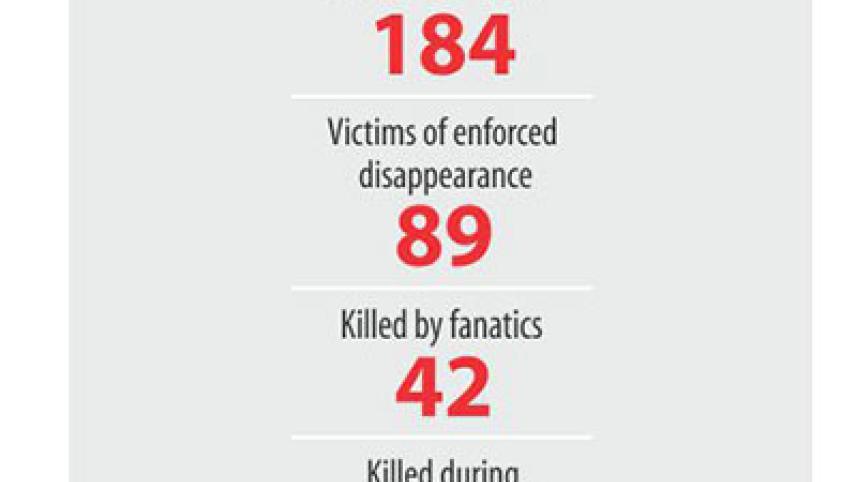
One person was killed a day in “shootouts” involving law enforcement agencies on an average last month, according to Ain o Salish Kendra (ASK).
And the “shootouts” claimed lives of 184 people in the last 11 months, showing a rise in this form of extrajudicial killings.
 For all latest news, follow The Daily Star's Google News channel.
 The number was 171 during the same period last year.
A total of 154 people were killed in “shootouts” throughout the entirety of 2014, said the rights body.
The incidents of enforced disappearance also increased this year with 89 people becoming victims in the last 11 months.
Of them, 22 were traced when they were shown arrested by law enforcers and three others returned to families.
The number of disappearance victims was 48 during the same period last year.
The rising incidents of “shootout” and enforced disappearance have created an atmosphere of panic in the society, rights activists say.
Against this backdrop, the country observes Human Rights Day today.
Nur Khan, acting executive director of ASK, said the number of deaths in “shootout” increased after the July 1 Gulshan terror attack that left 22 people, including 17 foreigners, dead.
A total of 105 people were killed in “shootouts” between July and November and 79 in the first six months of this year, according to ASK.
Besides, 33 people were killed during anti-militant drives between January and November this year.
Nur Khan also said the methods law enforcers apply in many cases to maintain law and order and contain political unrest have created fear among people.
He added militancy has become another threat to human rights as radical groups try to establish their opinion by force.
Some 42 people, including foreigners, police officials, Hindu priests, a Buddhist monk, Christians and gay rights activists, were killed in the last 11 months allegedly by Islamist militants.
“With religious militants on one side and activities of state agencies on the other, space for people's rights is shrinking. As a result, an environment of fear and a culture of impunity are being created in the society,” Nur said.
“Such an environment is a threat to democracy and human rights.”
He also expressed concern over the attacks on religious minorities, rising number of brutal assaults on women and children and the government's alleged bid to gag the media.
Jyotirmoy Barua, a Supreme Court lawyer who works on human rights issues, said the tendency of law enforcers to outright deny their involvement in offences is also on the rise. It was seen following the attack on Santals in Gaibandha.
He also observed, “People are not voicing any protest, rather they are accepting all this in fear of false persecution and the possibility of being victims of enforced disappearance.”
On the allegations over “shootouts”, National Human Rights Commission Chairman Kazi Reazul Hoque at a press conference on Thursday said, “We were concerned in the past. And we are still concerned.”
Law enforcers cannot kill people, he said talking to this newspaper later, adding, “They must be careful about their action.”
Kazi Reazul also said militants are violating human rights and curbing people's right to freedom of speech and expression. The government needs to handle radicalism but has to remain cautious so that no innocent people are victimised, he added.
Comments