


BSCIC estates in a shambles

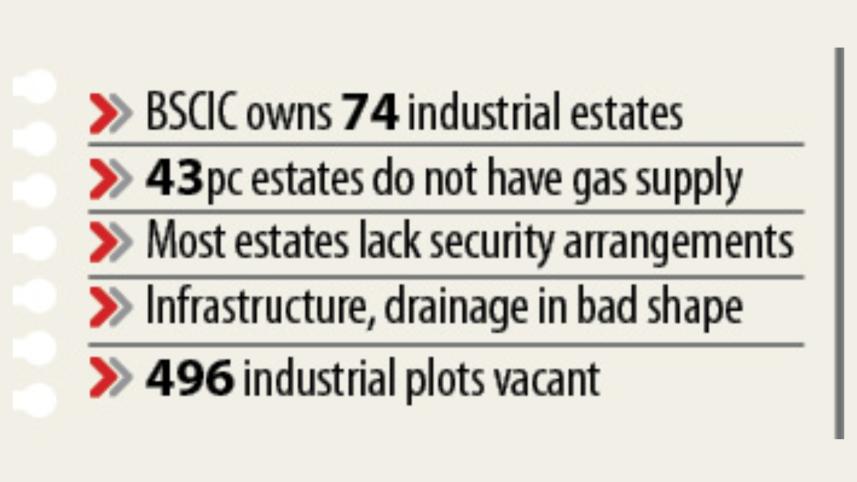
Most of the Bangladesh Small and Cottage Industries Corporation’s 74 industrial estates across the country are in dire straits, with dilapidated roads and drainage, and unreliable or no gas and power supply plaguing them.
The Meherpur BSCIC estate, for instance, has allotted 64 of its 70 plots to entrepreneurs. During a recent visit however, The Daily Star correspondent saw no more than 11 operational industrial units. These units included printing and packaging, rice mills, and handicrafts.
 For all latest news, follow The Daily Star's Google News channel.
 Established in 2002, the estate is failing to thrive mainly due to poor road network leading to the units, and no gas connection and drainage system, said the caretaker of a factory still running there.
Since the whole estate is without boundary walls, it has turned into a pasture for cattle to graze and more disturbingly, a safe den for drug addicts, he added.
Our correspondents in Barishal, Kushtia, and Jhenidah gave similar depictions of the BSCIC estates in their areas.
The Dinajpur BSCIC industrial area is however more vibrant with 90 percent units operating as rice mills. But large potholes and piles of ash riddle the roads leading to the 35-acre estate. Even inside the estate, almost all the roads are in bad condition
and ash is piled up here and there.
Industry owners said the roads were so bad that truckers do not want to come inside the estate.
Visiting the area, this correspondent found that the drainage system was poor and did not cover the entire BSCIC area. Where there was drainage system, the drains were clogged.
They alleged that the government did not take sufficient care of the infrastructure there.
“There is no good road inside the BSCIC estate, no drainage system. So, when there is a small amount of rain, the whole area is submerged. The estate should also have its own water supply system but it doesn’t,” Mohan Patwari, owner of Patwari Business Ltd, told The Daily Star.
Patwari added that in the rainy season the situation gets worse as factories get flooded and their operations suspended.
Dinajpur BSCIC officials also acknowledged the problem and said the situation was similar in other BSCIC estates.
A report by the Bangladesh Institute of Development Studies (BIDS), released earlier this year, sheds light on the challenges the BSCIC estates have been facing over the years.
The BIDS study, conducted between September 2017 and March 2018, is the first such study to identify problems since BSCIC started its journey in 1957.
The report said that except for a few BSCIC estates, all face severe waterlogging due to poor maintenance of the existing drainage system.
It also stated that none of the BSCIC estates has boundary walls, a major concern for industry owners and employees who need to protect their equipment and goods. Street lights too are not available in most of the estates, deteriorating security.
The report also said the absence of a dedicated gas and electricity supply connection and red tape hamper proper functioning of the industrial units.
“Almost all of the estates have an electricity connection while only 57 percent of the estates have a gas supply connection. About 80 percent of the estates have water supply facilities and one estate has CETP [Savar tannery]. In about 37 estates, ETPs [effluent treatment plants] have been established by individual enterprises,” the report stated.
It also said around 22 percent of BSCIC industrial plots have remained unutilised years after years. Weaknesses in rules and regulations, problems in the selection process, infrastructure bottlenecks (such as poor gas/electricity connections) were the key reasons behind the plots not being used.
The study also found that around 34 percent stakeholders argued that plots in the estates were allocated based on political and other influence.
Other factors included a weak selection process of entrepreneurs for the plots and corruption of BSCIC officials. Some entrepreneurs applied for plots only to resell for profit.
Monsur Hossain, senior research fellow and study director of BIDS, said if the site selection process was better, the BSCIC estates could have been more effective.
“The low utilisation of BSCIC plots is alarming. The government’s decision to set up BSCIC in all the districts is not logical and this type of initiative was not successful even in India and China,” he said.
For example, Khagrachari BSCIC is almost empty, so special incentives could be given to the entrepreneurs to encourage them to utilise those BSCIC plots, he added.
The BIDS report said the plot utilisation rate is the lowest in Barishal division (50 percent) and the highest in Rajshahi division (95 percent).
BSCIC Chairman Mostaque Hassan said there were 496 vacant plots but those would be filled as soon as advertisements had been published to allot the plots.
“In Jhalakathi, Panchagarh, Sunamganj, Kurigram, Srimangal and some other places there is a crisis of potential entrepreneurs. For example, in Srimangal, there are 80 plots but we got only 10 applications. On the other hand, in Mirsarai, we have got more application than the number of plots,” said Mostaque Hassan.
Regarding the poor facilities, the BSCIC chairman said: “Yes, it is true that in some cases the infrastructure of BSCICs is not good but we are trying to improve the situation.”
He also said most of the times plots were allotted fairly.
“But in reality, we found that some industries suffered as they started with bank loans [which they could not repay]. When we take the initiative to cancel the plot allotment, the bank concerned files a case. In that case, we can’t do anything until the issue is settled,” said Hassan about ailing entrepreneurs whose units are “sick” or have shut down completely.
The BSCIC estates were established in six phases since 1960, the latest phase being completed in 2010.
A total of 1,969 acres were used for establishing 74 estates -- of which 3.6 percent was for administrative and other purposes (mosques/banks/green spaces etc.) and 19 percent was used for roads and drainage system, the study report said.
A total of 10,389 plots were developed and 96.8 percent of them were allotted to entrepreneurs.
Our correspondents in Barishal, Kushtia, and Jhenidah contributed to this report.
Comments