


Farmers all smiles as bitter gourd yield high

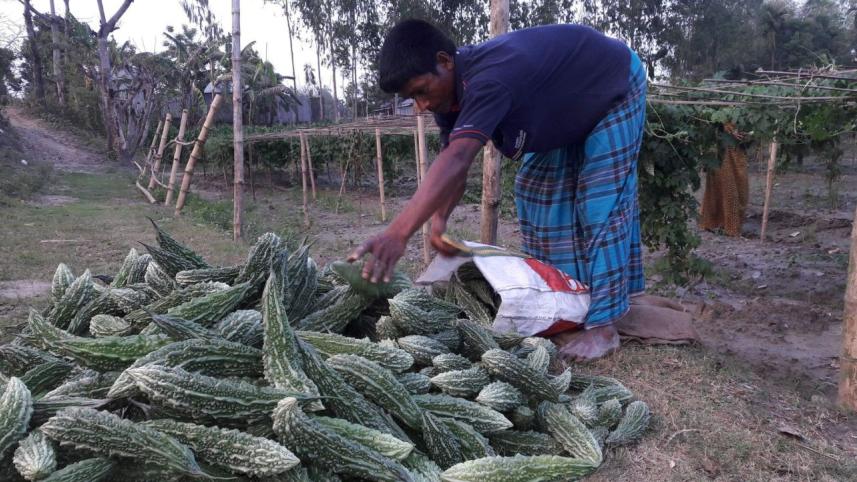
Cultivation of bitter gourd in Lalmonirhat has increased from last year as farmers are earning good profits from selling high-yield variety of bitter gourd.
Belal Hossain, 48, a farmer at Karnapur village in Lalmonirhat Sadar, is now busy harvesting his crop. He sells around 15 maunds of bitter gourd at up to Tk 800 per maund per week, he says, adding that he invested Tk 40,000 in farming bitter gourd on three bighas of land. "I will sell my crop until July," he added.
 For all latest news, follow The Daily Star's Google News channel.
 Nuru Miah, 42, another farmer of the same village, says he takes care of his bitter gourd field as he earns good profit from the vegetable. "We spend a handsome figure for buying pesticides and insecticides," he says.
Manowar Hossain, 56, a farmer at Bara Kamlabari village of Aditmari upazila, says they earned unexpected profit from selling bitter gourd last year when it fetched Tk 1,100 per maund. "Production is higher this year than last year," he said, adding that he cultivated bitter gourd on five bighas. "I also cultivated a local variety of bitter gourd on two bighas, but the production of local variety bitter gourd is less than that of the high yield variety," he adds. He says he sells local variety of bitter gourd at Tk 1,500 per maund.
Haripad Chandra Sen, 62, of Hajiganj village of Aditmari upazila, says it takes about Tk 400 for producing one maund of high yield bitter gourd, while it takes Tk 900 to produce the same quantity of the local variety. "We can get up to 40 maunds of high yield bitter gourd per bigha, but only 7-8 maunds of the local variety from the same land," he says.
"All my family members work in the bitter gourd and other vegetable fields, so I never hire labourers," says farmer Taherul Islam, 48, of Chaparhat village in Kaliganj upazila. "Bitter gourd is a profitable crop, and we are highly interested in farming it," he said.
Officials of the Department of Agriculture Extension (DAE) report that bitter gourd was cultivated on 180 hectares this year, as compared to 160 hectares last year, with 130 hectares being used for high yield and 50 hectares for local varieties.
Safayet Hossain, deputy director of Lalmonirhat DAE, says many villages in the district are known for vegetable farming, and farmers cultivate vegetables round the year. "Vegetables produced in the district are sent to the capital and other parts of the country after fulfilling local demand," he says.
Comments