


Sanctity lost

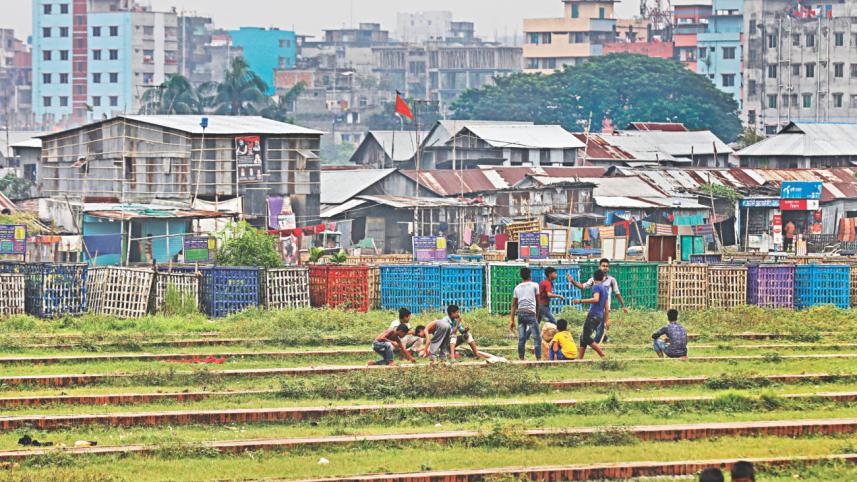
Graveyards are meant to be a calm place where one could grieve quietly for their loved ones or pray for the eternal peace of the deceased. And every visitor to a graveyard expects the personal space to pay respect to their loved ones.
But such has not been the case for Mirpur Martyred Intellectuals' Graveyard. Here, most mourners would not get the silence they need because of a residential colony inside the graveyard, with houses lining the row of graves.
 For all latest news, follow The Daily Star's Google News channel.
 Around 1,000 people have been living in this occupied portion of the graveyard for the last 15 years, disrupting its sanctity and shrinking the space.
Most of these residents are families of class-IV employees of Dhaka North City Corporation (DNCC). They have already constructed around 400 houses, the din of which is enough to break the tranquillity of the graveyard.
DNCC, the custodian of the graveyard, however has turned a blind eye to the situation.
Seeking anonymity, an official of DNCC said, “Though officially the number of houses is 155, the actual number will be around 400. These employees have also set up additional quarters to rent those out to outsiders.”
Sanowar Hossain, senior Mohorar (supervisory staffer) of the graveyard, said a residential area for the class-IV employees, called “City Colony”, was first set up on the western portion of the graveyard around 2003- 2004 when Sadeque Hossain Khoka was the mayor of undivided Dhaka City Corporation.
The residents were shifted to the existing place during the army-backed caretaker government in 2007-2008, he said.
Sanowar said the total area of the graveyard is around 67 acres, of which around 5-7 acres have been occupied by the employees. Earlier, around 23 acres land of the graveyard had been occupied by “different quarters”, but the caretaker government recovered most of it, he said.
The official also said DNCC has constructed a boundary wall around the graveyard, but the colony lies inside the boundary, giving unrestricted access to its residents.
Rafeza, a resident of neighbouring Jahurabad, who used to take her daughter to school in the area, said the reverence of the graveyard has been harmed due to colony residents, as they often quarrel here and use abusive and swear words.
The inhabitants of the colony also hold different kinds of programmes and play loud music; the volume is too loud even when they watch TV at home, she said. “It's not acceptable at all.”
Oishi, an eighth grader of a local school, said because of this colony, the graveyard is frequented by outsiders. “Sometimes we see colony residents and outsiders taking drugs here,” she said.
Meanwhile, the space of the graveyard is shrinking day by day with a growing population of Dhaka city.
Mohorar Sanowar said mostly general people are buried here, and only a portion is reserved for freedom fighters. Around five burials take place here every day, which adds up to around 140 to 150 a month, he said.
Mokhlesur Rahman, vice-president of Dhaka North City Corporation Scavenger and Workers Union, said initially the number of approved houses was 151, but later 146 more employees got “verbal” approval.
He said apart from the “approved” houses, 30 to 35 more were built by outsiders using the influence of local ruling party leaders.
Mokhles said some city corporation staff also expanded their houses in addition to their approved ones for their family members.
He said DNCC is constructing four multi-storey buildings at Gabtoli where garbage management workers will be shifted; city corporation employees from here will also be relocated there.
Md Sharif Uddin, project director of the Gabtoli city colony project, said they are constructing four 15-storey buildings on four acres of land for 783 waste management workers.
The design was completed, and the construction work will start within four or five months, he said.
Jamal Mostofa, panel mayor of DNCC, said, “We have a plan to shift them to Gabtoli but it will take time. We are working on it.”
Dhaka North City Corporation also plans to modernise the graveyard, he said.
Comments