


The perils of plastic laminated posters

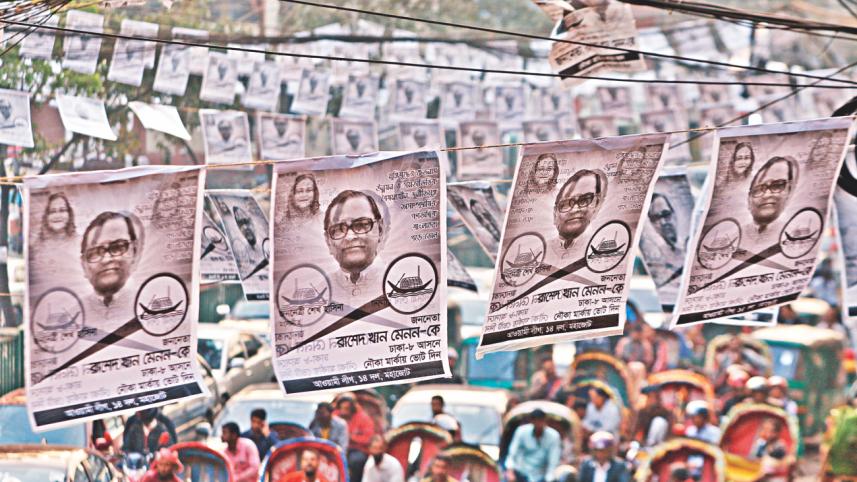
Contestants for the 11th parliamentary polls have been using laminated posters in the campaign, which are harmful for the environment.
Such posters can be seen across Dhaka city and the country, displaying faces and electoral symbols of candidates, mostly of the Awami League grand alliance, Left Democratic Alliance, and Islami Andolon Bangladesh. They are also using PVC sheets, which are equally harmful.
 For all latest news, follow The Daily Star's Google News channel.
 Candidates said they were laminating posters with plastic to protect those from the elements, and that it was not a violation of electoral rules.
However, Abdul Matin, general secretary of Bangladesh Poribesh Andolon (Bapa), said, “This is bad news. These plastics will eventually block the drainage system in urban areas, and canals in rural areas.”
Politicians usually do nothing to protect the environment, he said. “Now, it appears that they are acting against the environment. This is reprehensible.”
As many as 15 crore posters could be printed for the upcoming election, Shahid Serneabat, chairman of Printing Industries Association of Bangladesh (PIAB), told The Daily Star.
During the 2008 election, six crore posters were printed, according to PIAB estimates.
Mohammad Aslam, owner of New Bangladesh Laminator at Fakirapool, Dhaka, said several candidates used laminated posters during the union parishad and city corporation elections. “But that was on a limited scale,”he said.
This election, some candidates are laminating two to three lakh posters, he claimed.
With the increased demand for lamination, the cost of plastic film has gone up since the beginning of the month, said Md Mustafizur, proprietor of Popular Lamination at Fakirapool, a printing hub in the capital. He has already laminated 50,000 posters and is expecting more orders.
Bapa's Matin demanded that the Election Commission ban the use of laminated posters.
Information Minister Hasanul Haq Inu, who is contesting in Kushtia-2, said he is using laminated posters to protect them from dew, and it saves cost. “Otherwise, I would have to print posters daily.”
Inu also said it is legal.
Asked about the harm to the environment, he said he had no idea about the matter.
“Environmental experts can answer that. If so, we will not use it,” he said, adding that polythene with certain thickness is allowed, and Bapa should make the matter clear.
Formal complaints should be lodged with the EC in this regard, he said. “We will comply with their decision.”
The EC has not made it clear whether laminated posters are allowed in campaign. In its notification on the electoral code of conduct, the EC defines posters as paper, rexine, digital display boards, electronic means or any other campaigning materials.
Prof Ahmad Kamruzzaman Majumder, chairman of Department of Environmental Science at Stamford University Bangladesh, said unlike paper, plastic is not degradable.
“Plastic of any thickness is harmful for earth, and it takes 200 years for plastic of any thickness to degrade,” he said. “Panaflex rexine or PVC fabric is even more dangerous.”
The department recently collected 30 laminated posters of 10 candidates and found that nine grammes of polyethylene was used to laminate each of them, he added.
“Plastic is hazardous for the environment as it's not degradable. It is likely that the posters will remain scattered on the streets after election and later clog the drains.” The use of plastic is against several laws and rules related to environment and solid waste management, he said.
Grand alliance candidate Rashed Khan Menon, also the social welfare minister, said plastic lamination is not prohibited. “One has to be practical in using paper posters that will otherwise be ruined by dew,” said the president of Workers' Party of Bangladesh.
On environmental concerns, he said environmentalists could not stop the use of polythene bags. “I don't understand why they are suddenly interested in posters. Environmentalists cannot be a master of everything.”
Comments