


River training all too crucial
The future of the Padma bridge will depend largely on how river training is done to keep such a meandering river under control during and after its construction.
River training is the most challenging job for building the country's largest bridge because of the Padma's unpredictable characteristics, riverbank erosion, riverbed scouring and flash flood, say experts.

A meandering river, like the mighty Padma, flows in a zigzag, continuously eroding its banks and changing its course.
Local and foreign experts have conducted a lengthy and strenuous research on the river's past as well as its nature for designing river training, which mainly includes riverbank protection and checking scouring of the riverbed.
Planning and implementing river training for the Padma bridge would be more difficult than that in previous bridge projects in Bangladesh, reads a design-phase document of the Bridges Division.
Initially it was thought that a small-scale river training would be required for the Padma bridge construction and that too only on the south bank (Janjira end). But after research, experts decided to conduct a massive river training along a 12.4km stretch at Janjira point and 1.6km at Mawa.
According to a study, about half-a-km stretch of the south bank has eroded since 2005.
The protection of riverbank is the most crucial part in river training, especially in the case of Padma bridge, said Prof Md Sabbir Mostafa Khan of water resources engineering at Bangladesh University of Engineering and Technology (Buet).
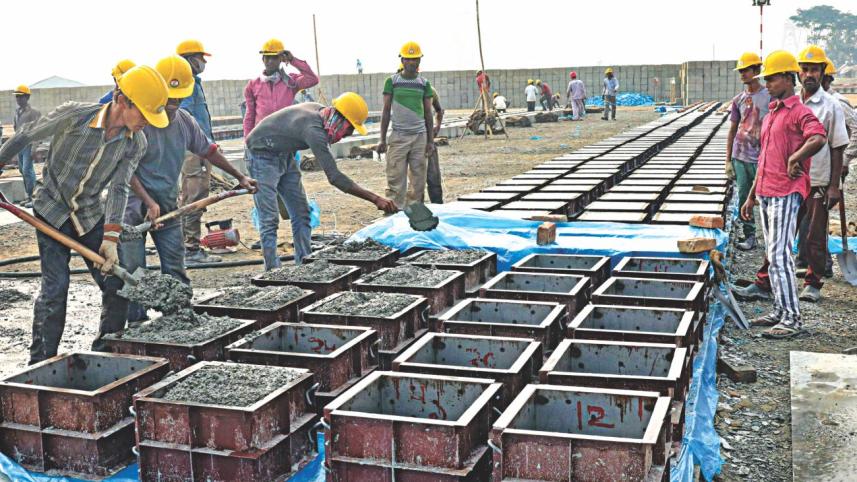
Under the ongoing river training, concrete blocks and boulders (large-size stones) are being put on the riverbanks to protect them from erosion.
"If the bank protection fails, the river course will change, threatening the bridge," said Prof Sabbir, a hydrologist with knowledge on the nature of the Jamuna and Padma.
He said the width of the Jamuna was reduced to 4.6km from 10km for construction of the Bangabandhu bridge. However, the same could not be done in case of Padma bridge, as experts believe reducing the river's width will increase the risk of riverbank damage.
Dr Maminul Haque Sarker, deputy executive director of the Centre for Environment and Geographic Information Service, who was involved in designing phase, said, "No problem will arise if the quality of river training work is ensured."
He said extensive work is required at the Janjira end since the site is more vulnerable than Mawa.
Both the experts said controlling the riverbed scouring is also crucial for safety of the bridge.
"There should be no compromise on river training. If the job is not done properly, the riverbank will be shifted and the bridge will be at risk," said Prof Sabbir.
As a precautionary measure, extra viaducts will be placed on both ends of the bridge considering that the bridge would be safe even if there is erosion and damage of riverbanks in future.
China's Sinohydro Cooperation Ltd is doing the river training at a cost Tk 8,707 crore.
During a recent visit to the bridge sites, workers were seen building around 80 lakh concrete blocks, which would be placed on the riverbed and banks to control scouring, erosion and flood in the area.
A Bridges Division engineer said river erosion and change of course are frequent at Janjira site. So, a vast area at this end has been bought under river training job.
"The Janjira end is vulnerable to erosion and this is why we are extra cautious while doing the river training job," he told The Daily Star at Janjira site.
 For all latest news, follow The Daily Star's Google News channel.
 Shafiqul Islam, director of Padma bridge project, too identified river training as one of the major challenges because of the river's unpredictable behaviour.
Local and foreign consultants studied the river and helped design the river training.
"We are working on the approved design. The unpredictable nature of the river is always in our consideration and we will take alternative measures if any crisis emerges," he told this newspaper.
Comments