


RMG’s automation and green growth have a gender problem— Don’t ignore it
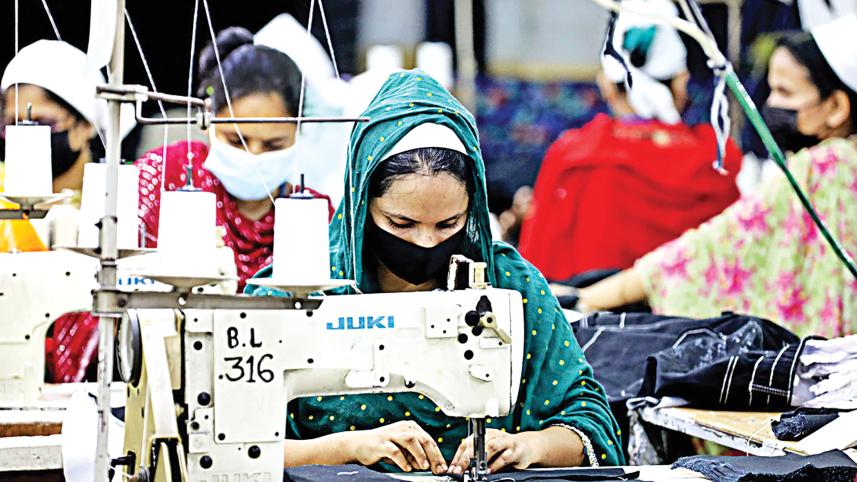
Fatema (pseudonym), a 27-year-old line operator in a garment factory outside Dhaka, has spent nearly a decade behind a sewing machine. Her hands move with mechanical precision, her daily output closely tracked by production targets. But last year, her factory introduced semi-automated sewing lines. Productivity improved. Jobs did not. Several of Fatema's colleagues—mostly women—were quietly laid off. "I didn't understand the new machine," she said. "No one asked if I wanted to learn."
Her story offers a glimpse into the deeper transformation sweeping across Bangladesh's ready-made garments (RMG) sector—one that is becoming more efficient and environmentally conscious, but risks becoming less inclusive if women are not actively supported in this transition.

The RMG sector has long been central to women's employment in Bangladesh. In the 1990s, over 80 percent of garment workers were women, many from rural areas with few other options for formal work. These jobs offered not just wages but a pathway to visibility, mobility, and social agency. Today, women make up around 56 percent of the RMG workforce. While demographic shifts contribute to this trend, much of it reflects structural challenges—most notably, automation and changing workplace dynamics.
This is not unique to Bangladesh. In Vietnam, women still constitute about 75–80 percent of the garment workforce and remain a dominant part of the industry, with limited evidence so far of a gendered decline due to automation (International Labour Organization 2025; World Bank 2021). In Cambodia, women have historically accounted for over 80 percent of garment workers and continue to dominate the sector, though longitudinal data on automation's gender impact remain limited (Heintz 2007; ASEAN 2024). In India, by contrast, women comprise a smaller share—around 35–40 percent of garment workers—and their participation has shown modest growth rather than decline, suggesting different structural dynamics at play (International Labour Organization 2021; International Labour Organization 2022). Across all contexts, women remain concentrated in low-paid, repetitive tasks that are among the first to be mechanised.
Buyers should be required to review gender-disaggregated labour data, insist on gender parity in training access, and incentivise suppliers who build inclusive cultures. National policy must also respond to this need.
In Bangladesh, the impact of automation is already evident. A 2024 study by the Business & Human Rights Resource Centre found that technological upgrades have triggered a 30.58 percent reduction in overall employment in several factories, with women hit hardest due to their predominance in easily mechanised roles such as sewing and trimming. The Business Standard also reported that sweater production lines saw a 37.03 percent labour drop, cutting by 48.34 percent, and sewing declined by 26.57 percent—all heavily affecting women workers. According to Kaler Kantho (2025), over 300 factories across Dhaka, Gazipur, and Narayanganj have closed or suspended operations—either temporarily or permanently—resulting in an estimated 200,000 job losses. The report attributes this downturn to automation, high production costs, and declining international orders, noting that women constitute the majority of those displaced. These combined factors demonstrate that while automation boosts productivity, it is also accelerating labour contraction and deepening gender vulnerability in the sector.
The green transition introduces another layer. With increasing pressure from global buyers to meet Environmental, Social and Governance (ESG) benchmarks, factories are installing solar panels, upgrading wastewater treatment systems, and embedding sustainability reporting into operations. These efforts are creating new roles in sustainability, but these too are largely inaccessible to women. An ILO survey (2025) found that only 18 percent of workers in sustainability roles were women, with most of them confined to supplementary tasks such as waste sorting.
Despite their experience, women are rarely considered for technical upskilling. However, targeted training in areas such as energy efficiency, textile-waste management, and compliance roles has shown that women can effectively transition into new green jobs. These findings are supported by research from LightCastle Partners (2025), which emphasises that women, when supported by inclusive training environments, contribute meaningfully to sustainable factory operations.
There are promising examples worth building upon. In several pilot initiatives, women operators trained in green practices—such as safe chemical handling and recycling-process management—were subsequently promoted to roles supporting environmental compliance. While these efforts have been limited in scale, they clearly demonstrate that gender-responsive upskilling is both viable and effective. The next step is not innovation, but commitment—to scale and institutionalise these practices across the sector. Yet persistent barriers continue to hold women back.
Despite comprising the majority of line workers, women represent only about 9 percent of production supervisors. A GIZ study (2024) found that promotion decisions were often shaped by gendered assumptions around leadership, assertiveness, and flexibility—qualities still too frequently attributed to men. Even when women exceed performance expectations, they are routinely passed over due to perceived limitations tied to family responsibilities or emotional disposition.
Other challenges—such as lack of childcare, safe transportation, and unequal domestic responsibilities—continue to limit women's full participation and progression in the sector. Many factories lack grievance mechanisms to address harassment or bias. As a result, promising women talent often drops out of the workforce, leaving the sector poorer in skills, diversity, and resilience.
Some global brands have started to address this imbalance, embedding gender equity into responsible sourcing codes. But most still treat gender as a peripheral issue, separate from core metrics like environmental compliance and productivity. If the RMG sector is to remain competitive and socially responsible, gender must be integrated into every level of industrial and environmental policy. This includes mandating gender-inclusive training, tracking promotion pathways, and recognising suppliers who foster equity alongside compliance.
Buyers should be required to review gender-disaggregated labour data, insist on gender parity in training access, and incentivise suppliers who build inclusive cultures. National policy must also respond to this need. A truly just transition requires legal safeguards, budget allocations, and representation of women in dialogue platforms around technology and sustainability.

The role of sectoral organisations such as BGMEA and worker federations is crucial here. They can amplify women's voices and support initiatives that strengthen peer networks, mentorship, and factory-based leadership forums. Multilateral development partners also have a part to play in piloting inclusive business models and de-risking innovation that opens space for under-represented groups.
One often overlooked dimension of this transition is the interplay between automation, decent work, and the care economy. Many women in the RMG sector are also caregivers at home. Without policies that address unpaid care burdens—through subsidised childcare, flexible work arrangements, or support services—the automation-driven restructuring of labour risks intensifying economic insecurity for women. ILO research (2025) underscores that decent work must be understood holistically, ensuring access not only to jobs but to working conditions that reflect workers' realities.
Finally, the narrative itself must change. Stories like Fatema's are not about weakness; they are about exclusion. Women are not passive recipients of progress; they are capable contributors and leaders if the systems around them allow them to participate fully.
Fatema's voice captures what is at stake: "I don't want sympathy. I want skills. I want to work in the future too." A future that is more efficient and sustainable must also be more inclusive. Women like Fatema should not be sidelined by change—they should be helping to lead it.
Syeda Zeenat Karim is a development professional with 10+ years of experience in project management, gender advocacy and strategic communications.
Send your articles for Slow Reads to slowreads@thedailystar.net. Check out our submission guidelines for details.
 For all latest news, follow The Daily Star's Google News channel.
Comments