


Blind, physically challenged students pursue their dreams
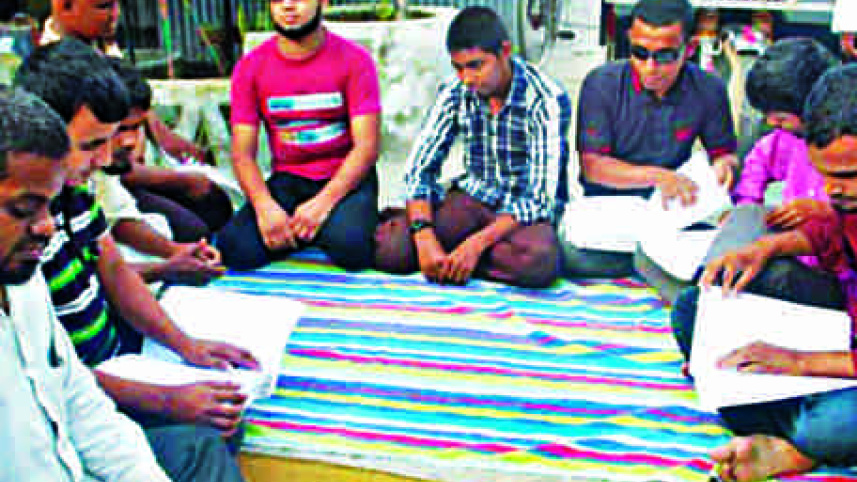
At first, Md. Abdul Jalil's story sounds sadly familiar. "Due to family poverty," says the student from Gazipur, "I couldn't pursue studies beyond my Higher School Certificate, completed in 2002." However, with the help of a humanitarian organisation in Pabna, the Manab Kalyan Trust, Jalil has subsequently been able to complete a master's degree in Islamic Studies and is currently preparing for the Bangladesh Civil Service exam.
What makes Jalil's experience more remarkable is that he has been blind since birth.

While the Manab Kalyan Trust has not strayed from its roots in assisting ultra-poor students and orphans, it specialises in helping the physically challenged and most notably, the visually impaired.
The trust is currently assisting 135 students in general and madrasa education, 60 of whom are visually impaired. For them, specialised education is imparted using Braille texts and recorded lectures rather than through the various local educational institutions where other trust recipients study.
The trust's aim is to serve as an educational gateway through which all its recipients can realise their life goals.
Trust chairman, Professor Md. Abul Hossain first established the trust as a self-funded organisation in 1994 while working at Pabna Edward College. Initially, he conducted classes for six ultra-poor students in a rented room in the Singa bypass area.
"Then I met an autistic worker at the college," he says, "who had little by way of support or opportunity. I realised I wanted to do something to help physically challenged people prove themselves in society."
For most of the next decade the trust remained small, but since Hossain's retirement in 2002 he has been able to pursue the trust's aims wholeheartedly.
"I completed my HSC from a specialised school in Rajshahi," says blind student Nobab Ali of Kazipur village in Rajshahi's Godagari upazila. "Since arriving at the trust in 2009 I have completed my BA. Now I am studying an MA in political science from Pabna Edward College." Ali has every expectation of pursuing a fruitful and satisfying career.
Visually impaired Md. Moniruzzaman from Brammanpara in Narsingdi meanwhile, arrived at the trust in 2010 and has since passed his HSC. He is now studying for a degree with similar hopes of achieving a secure income for his future.
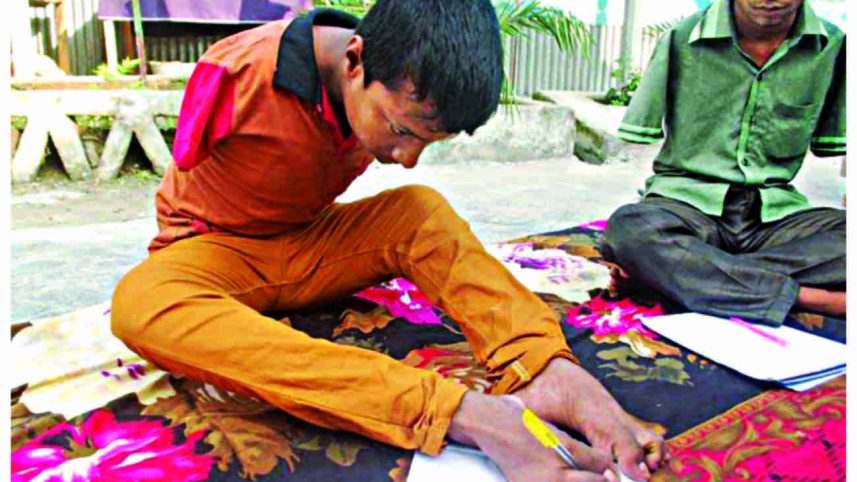
Md. Mirazul Islam of Zatrapur village in Pabna's Atghoria upazila is not blind. The fourteen-year-old lost both his hands early in life. "Everybody in my family and in society thinks I have nothing to do," he says, "but I want an academic career and ultimately a good job. I want to show people that a physical barrier is not a barrier at all."
The enthusiastic student has been with the trust for four years and studies in class seven. Writing with his feet, he has already passed his Primary School Certificate in which he achieved top marks.
Currently the Manab Kalyan Trust engages fifteen teachers and six other staff. It manages all academic expenditure and staff salaries from donors.
"Government support would help us to further develop," says Professor Hossain, adding that government officials have visited on several occasions to observe and express satisfaction.
From across Bangladesh ultra-poor, physically challenged and particularly blind students reach Pabna to study with the Manab Kalyan Trust. What all the students share is the dream of a self-sufficient and rewarding life.
 For all latest news, follow The Daily Star's Google News channel.
Comments