


Experts for more mitigation fund from developed countries
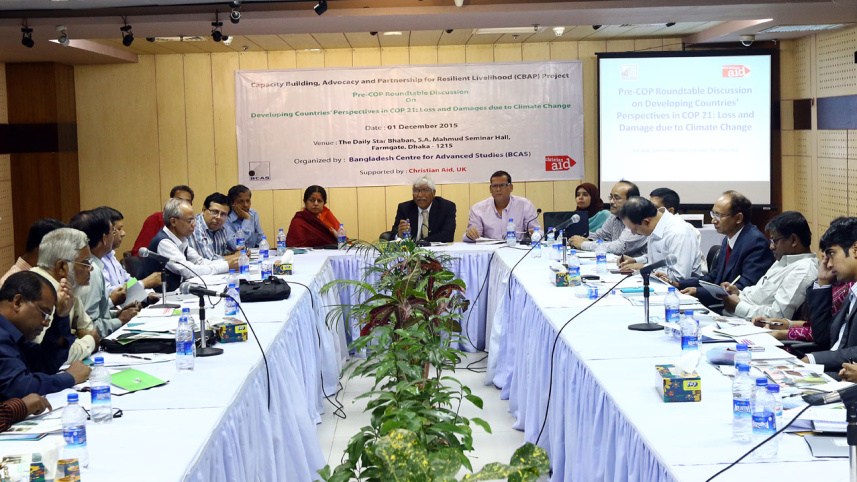
Climate experts at a discussion yesterday emphasised the importance of funding by the developed world to combat climate change impacts.
They said an estimated 20 million people in Bangladesh would be displaced if global temperatures rise by two degrees Celsius by the end of the current century.

A Atiq Rahman, executive director of the Bangladesh Centre for Advanced Studies (BCAS), said approximately 100 million people would be displaced globally by 2030 and 300 million by 2100, citing a report of the Intergovernmental Panel on Climate Change (IPCC).
In the event that the sea level rise by one metre, displacement coupled with massive migration movement across the world would put the entire civilisation under serious threat, he added.
Atiq, also a lead author at IPCC, said, "The conference has to forge the way for an assured as well as new and additional funding by the developed world for climate combat."
BCAS and Christian Aid UK organised the discussion on climate-induced loss and damages and expectations from the 21st Paris Conference of the Parties on climate change at The Daily Star Centre in the capital.
Shakeb Nabi, country director of Christian Aid UK, said along with legally-binding targets to mitigate carbon emission, targets for adaptation and compensation for loss and damages caused by carbon emission are now crucial in the climate negotiation process.
According to a BCAS assessment carried out in three cyclone-affected south-western villages in Satkhira, Khulna and Bagerhat districts, farmers, fishermen and day
labourers are the worst affected communities.
The 300 households surveyed in the assessment demanded grant from the developed world for resilience development with adaptation strategies, salinity tolerant agriculture, and affordable technology, conservation of wetlands, river embankment, forest conservation and rainwater harvesting.
Climate change impacts not only induce huge economic loss but also irreparable social, emotional and cultural loss with displacement and loss of livelihood, said Dwijen Mallik, a BCAS fellow.
 For all latest news, follow The Daily Star's Google News channel.
Comments