


The impact of AI on the legal profession in Bangladesh
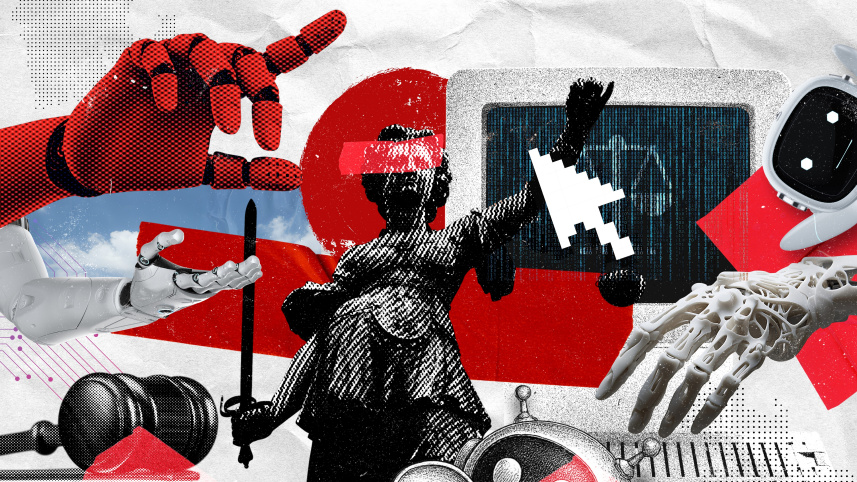
Richard Susskind, a prominent British author on legal technology, penned an article for The Times on March 27, 2025, whose title can only inspire existential dread in those of us who aspire to build careers in the legal profession: ‘Artificial intelligence could replace traditional lawyers by 2035’. In the view of many leading legal professionals globally, however, obsolescence is a distant – if not impossible – proposition. But even as debates rage, discussions flow, and applications become increasingly widespread, lawyers in our country are just as occupied in harnessing the opportunities presented by AI and gauging its potential.
“I find AI useful in my practice, and I personally know colleagues who do as well,” says Barrister Faran Md Aaraf, an Advocate of the Supreme Court of Bangladesh. “I use it to find applicable case law and to locate provisions within contracts. For instance, if it is a 200-page contract, and I need to find something specific, I’d use AI to guide me to that portion of it.”

Tahsin Noor Salim, an Advocate at the Supreme Court of Bangladesh and an Associate at The Law Counsel, takes a similar approach in usage: “At the law chamber, I use AI to proofread drafts or to refine the language in written submissions, though I make sure to never upload confidential or privileged documents. I also use it for summarising case judgments."
“The AI feature in Manupatra really helps by making things far less time-consuming,” says Sadia Afroz, Barrister-at-Law of Lincoln's Inn, Advocate, and District and Sessions Judge Court. “You previously had to read several cases all the way through, or at least skim them, to get what you wanted. But with the help of its AI feature, you can get single-paragraph summaries encapsulating entire judgements.”
Manupatra is an Indian online platform used extensively by lawyers and Law students in Bangladesh for legal research. Barrister Sadia Afroz continues: “But even outside of that, if I want to research possible arguments or if I want to find some legal ground, AI such as ChatGPT can help by providing some common legal arguments or grounds, making research really expeditious.”

“AI is becoming a part and parcel of the practice itself,” says Margub Kabir, Barrister-at-Law and Head of Chamber of Margub Kabir & Associates. “You need to be well-versed in its uses to do your cases properly because your opponents might be using it as well.”
Nevertheless, all of the above legal practitioners acknowledge that AI is a tool best used with a great deal of caution. “An AI-generated legal draft of a contract is possible, but it still requires human supervision,” says Barrister Faran Md Aaraf. “So, whenever I use AI, I make sure to double-check everything.”
Advocate Tahsin Noor Salim elaborates as to why this is necessary: “One has to remain mindful of the limitations of general-purpose AI. The main risk is their generation of false or misleading information — especially fictitious case references.”
This problem is more pronounced in the Bangladeshi context because of the lack of legal resources online. Barrister Sadia Afroz shares her perspective on this: “AI does not have access to all our laws or bylaws. Because of this, it is even more prone to giving you the wrong conclusion. If a wrong conclusion is reached, the responsibility for that is on you as a legal practitioner.”
She continues: “It is undoubtedly a good help in the initial period, as it helps to narrow things down, but the matter stands that even for research, AI cannot be blindly trusted.”
Mahir Chowdhury Abir, an Associate at Avon Chambers, shares an example of the consequences of unqualified reliance on AI in legal research: “There was an intern at our law firm around a year ago who was assigned some legal research and given 15 days to conduct it. So, he came up with 15 cases, of which only two were real. The other 13 were AI-generated hallucinations that had never come before any court ever.”
The present unreliability of generative AI and the perception it has created is a key reason why ABM Imdadul Haque Khan, Advocate, Appellate Division, Supreme Court of Bangladesh, discourages its usage in his law firm in the making of legal documents: “For legal opinions and pleadings, if a client gets the impression that you are dependent on AI to generate them, it is bound to make them upset. They wouldn’t want to come to you ever again.”
While public perception makes it undesirable to use AI for generating legal documents, according to him, AI simply lacks applicability even when drafting legal notices. He says: “Legal notices under the Negotiable Instrument Act, 1881, or the Artha Rin Adalat Ain, 2003, have specific, commonly used templates that just have to be edited. The usage of AI would not have much of an impact in this area.”
Despite him maintaining a rule against direct AI usage in his law firm, Advocate ABM Imdadul Haque Khan encourages the usage of online legal platforms such as HeinOnline and Manupatra, which offer AI-powered tools to facilitate research.
However, it would be unfair to artificial intelligence and to our legal sector, which is in dire need of a spark of efficiency, if technology were judged based on what it is and not on what it could be.
Speaking on its potential and limitations, Barrister Sadia Afroz says, “Over time, AI will make fewer errors, and it will only facilitate fewer people to get more work done. But it won’t take over the legal industry.”
The sentiment is one that is shared by legal professionals globally.

“The future won’t be won by bots. It’ll be won by lawyers who obsess over their craft, sharpen their judgement, focus on areas others overlook, and use every tool available to raise the bar — not lower it,” says Matthew Leopold, the Head of Brand, PR, and Content Marketing at LexisNexis, at the end of his article ‘Legal AI won’t replace you. Poor judgement will’.
Taking note of the transformative potential of AI, developed nations such as the UK have already begun the work of embedding this technology into their justice systems. A July 2025 policy paper by the British Ministry of Justice, titled ‘AI action plan for justice’, outlines the path they wish to embark on, with the goal being to ‘drive the responsible adoption of AI to enable our people to deliver world-leading public services’.
 For all latest news, follow The Daily Star's Google News channel.
 Such benefits would no doubt be more than welcome in Bangladesh, whose courts have been struggling with a staggering 45,16,603 pending cases as of December 2024, according to a Supreme Court Report published in 2025. Considering the limitations of our court system at present, one is tempted to contemplate a radical idea: What if justice could be consolidated into dispassionate algorithms free from human errors?
Aminul Hoque Helal, an Advocate of the Supreme Court of Bangladesh, finds the idea to be amusing but impractical: “Even if the justice system were to be run by artificial intelligence, it would still have to judge and serve humans of flesh and blood. Of course, only flesh and blood can determine the guilt or innocence of flesh and blood.”
For this reason, he asserts that AI, despite its rapid advances, will never be an alternative to the present justice system, though it can play a role in developing and benefitting it.
Advocate ABM Imdadul Haque Khan, acknowledging the immense contribution AI could have in making our judiciary more efficient, proposes using comprehensive systems operable by judges to generate judgements on cases from a wide variety of topics. Yet, despite the obvious potential of such an innovation helping to decimate our daunting backlog of cases, he accepts that systems of such scale would take up over a decade to develop, even if the process were initiated today.
But outside of hypothetical uses and innovations, even the application of existing artificial intelligence tools is bound to face enormous technical challenges, given the fact that almost everything is done manually through offline paperwork in our lower courts.
Advocate ABM Imdadul Haque shares his assessment: “The infrastructure, knowledge, and training to apply AI in our courtrooms are simply not there at present.”
He also concludes that while lawyers and law firms may work to cultivate the required knowledge and develop the necessary infrastructure, for there to be a positive impact on our justice system and our burgeoning backlog, it is the court system that must responsibly incorporate the technology.
There remains, of course, the lingering question of AI’s potential and future role in advocacy. Advocate Tahsin Noor Salim shares her views: “Advocacy requires empathy, rational thinking, and the ability to think and respond on one’s feet – skills that are inherently human.”
“Human analytical skills can never be beaten by AI in this field because the person you are submitting to is a human,” opines Barrister Margub Kabir. “AI may well crack the bar exam, but to do a case, there are lots of other things you need to keep in mind. You need to understand what the judge would appreciate, and then focus on that.”
Advocate Tahsin Noor Salim continues: “As it cannot replace the understanding of human emotions, courtroom dynamics, and ethical considerations, in my opinion, AI can only serve as an assistant in advocacy.” In that vein, Barrister Faran M. Aaraf postulates that as a tool, AI may be of assistance for advocacy tasks such as cross-examination, finding contradictions in statements, and helping one summarise their own submissions.
But with the application of AI rapidly gaining traction, and with its latent potential to change the very dynamics of the legal profession, Advocate ABM Imdadul Haque Khan voices a pertinent concern: “If its usage is not ethical, AI may create big problems for us.”
Barrister Sadia Afroz elaborates on this: “If you tell everything about your client to the AI tool that you are using, that is a breach of confidentiality since AI tools store information. How much information they ultimately retain from users is a big concern that should affect their place in the legal industry.”
Mahir Chowdhury Abir suggests a way forward: “With AI education becoming more important with each passing day, we need uniform regulations as to what we can do with AI and what we cannot. Its usage must be regulated, monitored, and above all, taught with care and expertise.”
The takeaway seems to be that, as of now, the position likely to be occupied by AI in a law chamber is that of an almost all-knowing but error-prone intern. But this is nonetheless an ‘intern’ that possesses extraordinary potential and who must be nurtured with the greatest care.
References:
1. The Times (March 27, 2025). Artificial intelligence could replace traditional lawyers by 2035.
2. LexisNexis Future of Law blog (March 27, 2025). Legal AI won’t replace you — poor judgement will.
3. GOV.UK (July 31, 2025). AI Action Plan for Justice.
4. The Daily Star (July 6, 2025). Over 45 lakh cases pending in courts.
Nayeem is a final-year Law student. He can be contacted at nayeemhaider90@gmail.com
Comments