


Waterlogging plagues Kalurghat industrial area

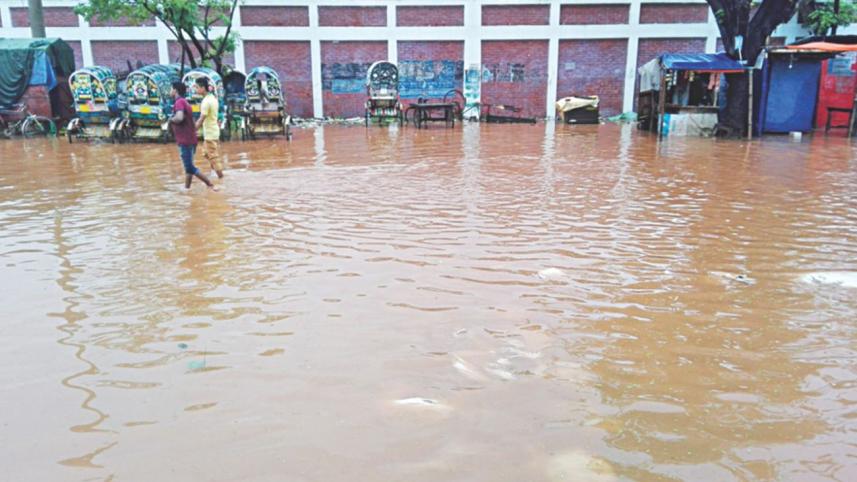
Exporters at the Kalurghat heavy industrial area in Chittagong have long been facing extreme difficulties in shipping goods on time due to seasonal waterlogging that hampers production and transportation.
“Sometimes, I have to even shut down my factory as workers have to come wading through knee-deep water,” said the owner of an export-oriented garment factory, asking not to be named.
 For all latest news, follow The Daily Star's Google News channel.
 “I am also facing difficulties in case of production shortfalls as the factory cannot run in full capacity because of the absence of workers,” said the owner, who employs 1,000 workers and supplies woven shirts to H&M, GAP and Tommy Hilfiger.
The exporter said the waterlogging in Kalurghat, where many multinational companies such as Unilever and Berger Paints, have operations, was nothing new as it has continued to surface for years with the onset of rainy season.
The area remains inundated with water even for two to three months at a time, in places for faulty drainage systems and in others for the absence of a proper one, the owner said.
He said even vehicles cannot enter factories to take goods to the Chittagong port for shipment.
“As a result, garment factory owners either face the harsh reality of cancelling work orders or using expensive air shipments to maintain strict lead-time.”
Syed Nurul Islam, chief executive officer of Well Group, one of the country's major industrial conglomerates, echoed the garment factory owner.
He said the situation is so bad that continuing business there has become a challenge. “I am disappointed with the sorrow state,” Islam said.
Kalurghat is one of Bangladesh's oldest industrial hubs where the journey of the country's garment industry began and nearly 100,000 workers are now employed.
Islam has the highest 18 units, including that for garment manufacturing, spinning, food processing, yarn dyeing and weaving, in the industrial hub, exporting goods worth more than $100 million from the factories every year.
He said all the factories in Kalurghat, including many consumer goods, food and beverage production and processing units, together export goods worth more than $500 million a year.
Islam said sometimes water enters one of his units, forcing him to stop production for many days until the water recedes.
Waterlogging occurs mainly for the absence of a canal to drain the water out, he said, adding that exporters and factory owners also face the challenge posed by dilapidated roads while transporting goods to the Chittagong port.
Mahbubul Alam, president of the Chittagong Chamber of Commerce and Industry, said Kalurghat is not the only area that has been affected by waterlogging. In fact, all types of business activities in Chittagong are being hampered by the waterlogging, caused by the incessant rain over the past two to three months.
Businesses in Khatunganj, Chaktai and Atanganj areas, where the country's largest wholesale commodity markets are located, have been hit by the waterlogging, he said.
Alam, however, acknowledged that waterlogging has been occurring for a long time in Kalurghat where nearly 400 small, medium and heavy industrial units are located.
Heavy industrial units are located at the BSCIC (Bangladesh Small and Cottage Industries Corporation) in Kalurghat. But there are many small and medium-sized industries that are located outside of it.
“The factories both inside and outside of the BSCIC deserve protection from the waterlogging as they have created jobs for thousands of workers and earn millions of dollars every year in exports,” Alam said.
Comments