


Subsidy for fertiliser to decline

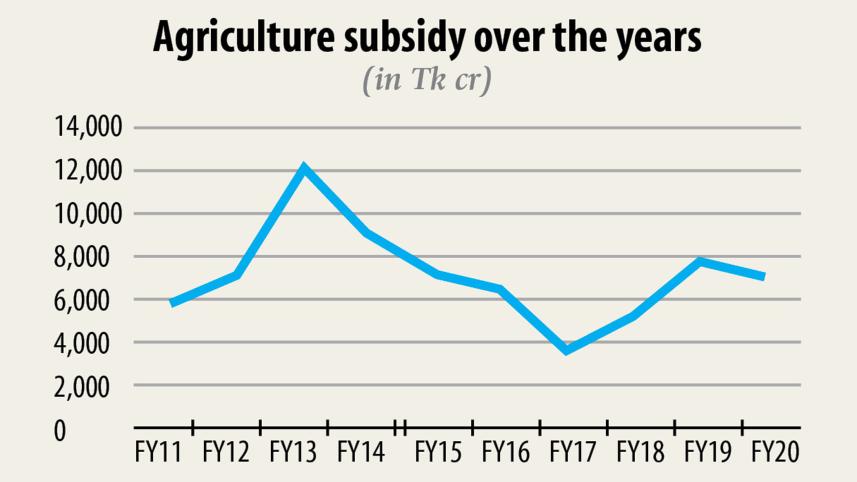
Subsidies on fertiliser products are likely to decline to around Tk 7,000 crore in the outgoing fiscal year as falling prices for the key farming ingredient and cheaper transport costs will ultimately enable the government to increase spending on other purposes, said numerous private importers and officials of the agriculture ministry.
The amount is just 9 per cent less than the previous fiscal year's subsidy of Tk 7,700 crore.
 For all latest news, follow The Daily Star's Google News channel.
 "We are reaping the benefits of the low oil prices brought on by the pandemic," said a senior official of the ministry of agriculture (MoA).
Besides, the price for fertilisers in the upcoming fiscal year will decline by about $40 per tonne, he added.
The Bangladesh Fertiliser Association (BFA), formed by private importers and fertiliser dealers, said that its members are already buying the product at lower prices than that of the previous year.
The BFA could import Diammonium phosphate (DAP) for the government's use in the next fiscal year at $309-$315 per tonne, down from $358-$364 a year earlier, according to BFA Executive Secretary Riaz Uddin Ahmed.
On the other hand, the price per tonne for Muriate of Potash (MOP) rose by $80 this year, he said.
To produce a variety of crops, Bangladesh uses roughly 50 lakh tonnes of chemical fertilisers annually, three-fourths of which is imported from countries such as Morocco, Tunisia, China, Saudi Arabia, Belarus, Russia, the UAE and Canada.
The remaining demand is met by local manufacturers.
It costs about Tk 15,000 crore each year to import such a large amount of fertiliser and the government bears a large part of this expense to supply the ingredient to farmers at fixed prices.
Farmers purchase urea at Tk 16 per kilogram and MoP at Tk 15 per kilogram. Meanwhile, DAP and Triple Super Phosphate (TSP) can be bought at Tk 16 and Tk 22 respectively.
If the import or production cost exceeds the fixed rates, the government pays the difference through the taxpayers' money.
At present, the government provides a Tk 10 to Tk 20 subsidy for each kilogram of fertiliser so that farmers can buy the material at reduced prices and keep their production costs low, said an official of the agriculture ministry.
The government had allocated Tk 9,000 crore as subsidy for Bangladesh's agriculture sector in the outgoing fiscal year. The same amount is expected to be earmarked for fiscal 2020-21 to help the country meet its 51 lakh-tonne demand for fertilisers.
The projection for next year's fertiliser requirement is 16 per cent higher than the provisional estimate, which was 44 lakh tonnes during the outgoing fiscal year, the official said.
However, since the use of fertilisers is likely to increase, subsidies on the product might not decrease despite the fall in prices in the global market, he added.
The World Bank (WB) Commodities Prices data in June showed that the average price for DAP, TSP and urea slumped in the first quarter of 2020.
Except for TSP, the prices for all the products dropped in May, according to the WB data.
For example, the global market price for DAP decreased from $358 tonne per tonne in March to $263 per tonne in May.
Earlier this month, the Agricultural Market Information System (AMIS) said that although fertiliser production has resumed in many parts of the world as restrictions are now being lifted, most fertiliser prices showed downward trends due to a global downturn in demand and uncertainty around interruptions in the food supply chain worldwide.
AIMS, an inter-agency platform composed of G20 members, Spain and several major exporting and importing countries of agricultural commodities, was formed following the global food price hikes in 2007-08 and 2010.
"We also get $10-$15 benefits for freight transport now," said Md Sayedul Islam, chairman of the state-run Bangladesh Agricultural Development Corporation (BADC), a key importer of non-urea fertilizer for the government.
"It gives a lot of hope," he added.
The BADC already imported more than 12 lakh tonnes of TSP, MOP and DAP in fiscal 2019-20 while the BFA imported 10 lakh tonnes of non-urea fertilisers during the same period.
Private importers will account for six lakh tonnes of DAP and two lakh tonnes of MOP in the next fiscal year, said BFA Chairman Kamrul Ashraf Khan Poton.
However, the government have yet to fix the amount of non-urea fertilisers to be imported by BADC next fiscal year, he added.
While the BADC and private importers import non-urea fertilisers, the state-owned Bangladesh Chemical Industries Corporation imports urea as domestic production for the product falls short of the country's annual requirement.
Comments