


Soybean imports from US surge 310% in Sept-Dec

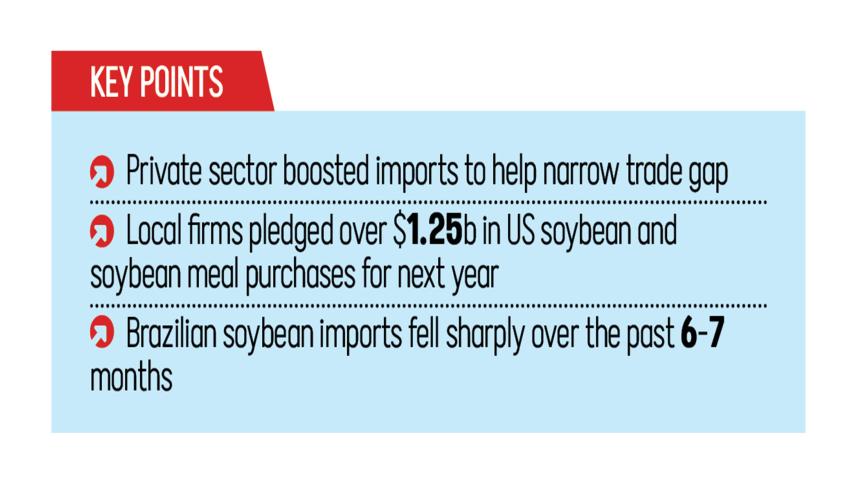
Bangladesh has massively increased soybean imports from the United States over the past four months, thanks to attractive prices and private sector efforts to narrow the trade gap with Washington.
Between September and the first week of December, the country imported 754,681 tonnes of American soybeans, a rise of 310 percent compared with the same period last year, according to the US Soybean Export Council (USSEC).

The increase occurred during the first 11 weeks of the new marketing year, which runs from September to August.
The price advantage followed a temporary halt in American soybean purchases by China earlier this year, in protest against higher reciprocal tariffs on Chinese goods.
The pause left US farmers with surplus stock and depressed prices. By the time Beijing resumed buying in October under a new trade agreement, Bangladeshi importers had already seized the opportunity.
Bangladesh's private sector has also stepped up imports of US cotton, wheat and liquefied natural gas under commitments to reduce the bilateral trade gap.
Following intense negotiations, the Trump administration in August cut reciprocal tariffs on Bangladeshi goods to 20 percent from 37 percent imposed in April 2025.
The US-Bangladesh trade relationship has grown considerably over recent decades, although the balance remains heavily in Dhaka's favour. In 2024, US exports to Bangladesh totalled $2.3 billion, while imports from Bangladesh reached $8.4 billion.
Jim Sutter, chief executive of USSEC, said in November that US soybeans and soybean meal are the largest American agricultural exports to Bangladesh.
He added that Bangladesh's leading soy-processing firms and meal importers recently signed a Letter of Intent worth $1.25 billion to purchase US soybeans and soybean meal over the coming year.
Sutter described the agreement as "a landmark" that highlights sustainability and supply chain resilience.
"Participants are collaborating with USSEC to advance sourcing standards, technical engagement, and growth of the protein-feed ecosystem in Bangladesh," he said.
Bangladesh produces only about 7 percent of its annual soybean demand, relying on imports for the remainder.
Sutter said the country now has a large and modern crushing industry that supplies most of its soybean meal and oil needs. Bangladesh maintains a zero percent import tariff on soybeans and soybean meal, providing a stable trade environment.
In the 2023-24 marketing year, the US accounted for 32 percent of Bangladesh's soybean imports and 3 percent of its soybean meal imports. Industry leaders expect these shares to rise sharply under recent agreements.
Md Taslim Shahriar, deputy general manager of Meghna Group of Industries, said Bangladesh has reduced soybean imports from Brazil over the past six to seven months in favour of US supplies.

He said American soybeans are currently priced at $485-$490 per tonne, about $10 cheaper than Brazilian beans, although transport costs are $15 higher.
Amirul Haque, managing director of Delta Agrofood, one of the country's largest crushers, said competitive pricing is the main driver of the shift.
 For all latest news, follow The Daily Star's Google News channel.
 He added that the private sector is committed to reducing the trade gap with the US.
"We want policy support from the government so we can contribute more to the nation," Haque said. "We are trying to reduce the trade gap further so that our trade with America keeps growing."
Comments