


Aus acreage falls as low prices frustrate farmers

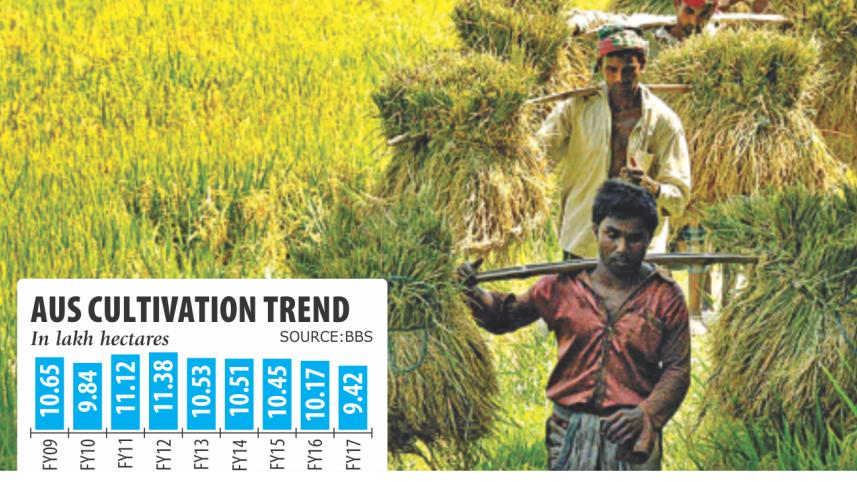
Aus acreage fell to a five-year low at 9.42 lakh hectares this fiscal year as many farmers switched to other crops, mainly jute, frustrated by low prices of the paddy, agriculture officials said.
Production declined 7 percent year-on-year to 21.34 lakh tonnes, according to provisional estimates by Bangladesh Bureau of Statistics.
 For all latest news, follow The Daily Star's Google News channel.
 “Many growers switched to jute cultivation because of the low prices of boro paddy last year,” said Md Hamidur Rahman, the immediate past director general of the Department of Agricultural Extension.
BBS found that jute acreage rose 9 percent year-on-year to 7.38 lakh hectares in the last sowing season because of its higher prices than paddy.
The aus paddy is grown during March-August while jute is cultivated in March-September.
The government now offers incentives to boost aus cultivation in a bid to cut dependency on the underground water that is used in boro irrigation.
Aus needs less irrigation as it is grown during the monsoon, according to agriculture officials.
The government took a Tk 33 crore incentive scheme last year to inspire farmers to cultivate aus, officials of the agriculture ministry said.
The UN's Food and Agriculture Organisation earlier said farmers in Bangladesh brought down boro plantation last year in response to low domestic prices.
The US Department of Agriculture (USDA) in October last year said floods during the monsoon affected both aus and aman, vegetables and other crops.
It said several districts in the north, northeastern and central areas were partially affected by floods during July-August.
“Farmers managed to recover the aman rice crop by replanting later in the season,” the USDA said in its October 2016 issue of Bangladesh Grain and Feed Update.
Despite the fall in acreage and output, the impact on total rice area and production would be minimal since aus rice constituted only 9.4 percent of total area and 6.78 percent of total rice production, the US agency said, predicting a good aman harvest.
“We have recorded a bumper aman harvest. Both acreage and yield have increased during the aman season. Increased aman production will make up for the loss in aus yield,” said Chaitanya Kumar Das, director of the field services wing of the DAE.
Aus had been the second biggest crop after rain-fed aman until mid-1980s. The crop began to lose appeal as farmers slowly started shifting to boro encouraged by its higher yields.
Aus acreage has shrunk below 10 lakh hectares now, from 30 lakh hectares in early 1980s.
Comments