


Digital ambitions take centre stage
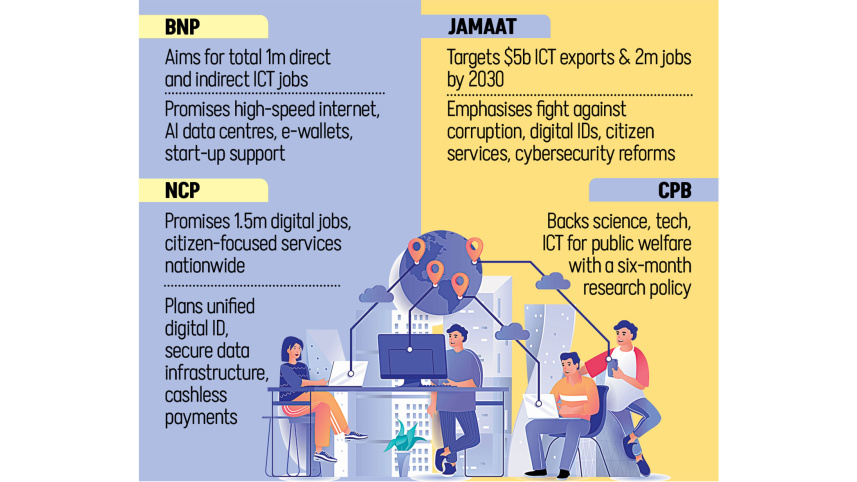
With Bangladesh striving to build a digital future, information and communications technology (ICT) and telecom have moved from specialised policy areas to key issues in the electoral debate.
In their manifestos for the upcoming general election, the Bangladesh Nationalist Party (BNP), Bangladesh Jamaat-e-Islami, the National Citizen Party (NCP), and the Communist Party of Bangladesh (CPB) have outlined broad plans for the sector, including ambitious job creation targets, digital infrastructure goals, and promises of transparency, innovation, and inclusion.

While the parties present forward-looking visions, implementing them will require systemic reforms, stronger institutions, and investment in human capital.
Bangladesh’s ICT and telecom sector has seen rapid growth, with mobile use surging and internet penetration increasing. Yet service quality often remains poor, and digital public infrastructure has frequently failed to deliver efficient, citizen-centred services. Rural broadband reliability is uneven, power outages disrupt networks, and licensing complexity adds costs without improving services.
Against this backdrop, political parties are seeking to persuade voters they can build on past progress and tackle these challenges.
BNP AIMS TO MAKE ICT AN ECONOMIC DRIVER
BNP designates ICT as a “special priority sector” and a potential “driving force of the country’s economic growth.” It pledges to create a “future-oriented, dynamic and technologically inclusive Bangladesh,” benefiting citizens, students, freelancers, entrepreneurs, and businesses.
Job creation is central. BNP plans to directly generate 200,000 ICT jobs in cybersecurity, BPO (business process outsourcing), AI-data, semiconductors, and Industry 4.0, and indirectly create 800,000 more through freelancing and content creation.
The manifesto sets ambitious infrastructure targets, including reliable high-speed internet for all and “99.999 percent network reliability” through a new Connectivity Masterplan developed with public and private sectors.
Additional pledges include introducing PayPal and a national e-wallet, building an AI-driven data centre campus, expanding start-up funds, and creating a national crowdfunding platform.
While the manifesto’s focus on AI, semiconductors, and digital skills aligns with Bangladesh’s goal to diversify exports and move up the value chain, many targets remain highly aspirational.
Currently, Bangladesh has around 300,000-400,000 ICT workers, far below the over one million tech-related jobs promised. Rural broadband is uneven, and infrastructure essential for advanced data centres and near-constant uptime is still developing.
AKM Wahiduzzaman, BNP’s information and technology affairs secretary, said the party plans a phased ICT transformation with entry- to high-skill job creation, curriculum modernisation, and scalable infrastructure backed by measurable KPIs. Semiconductor and hardware development will begin with achievable clusters and phased, performance-linked investments.
JAMAAT FOCUSES ON GOVERNANCE AND ANTI-CORRUPTION
Jamaat places ICT at the centre of its economic and governance agenda, aiming for $5 billion in exports and 2 million ICT jobs by 2030, rising to $10 billion by 2035.
These targets mirror those of the previous Awami League government, which fell short due to skill gaps, limited high-value product development, and weak global market integration.
The manifesto offers little detail on addressing long-standing structural issues, including access to global clients, quality standards, intellectual property protection, and advanced talent development, raising questions about whether these goals represent a real departure from past failures.
Jamaat prioritises anti-corruption and citizen services. Its manifesto pledges to “completely eliminate corruption” using ICT, introduce a complaint redress system within three months, implement a single digital ID for all services, and support local tech firms under a “Bangladesh First” approach similar to BNP’s.
Cybersecurity plans include a national policy, strengthening CIRT (cyber incident response team), forming an ethical hacking team, and enacting international-standard laws for information confidentiality and digital rights. Telecom reforms aim to improve efficiency, reduce corruption, and ensure fair competition among operators.
Despite these initiatives, implementation challenges remain. The party’s export and job targets appear overly optimistic given the current capacity limitations, including underdeveloped inter-ministerial coordination, legal frameworks, and secure databases.
 For all latest news, follow The Daily Star's Google News channel.
 Fahim Mashroor, former president of Bangladesh Association of Software and Information Services (BASIS), criticised both BNP and Jamaat for focusing heavily on creating over one million jobs “mainly through freelancing,” calling it “a repeat of past government failures.”
He added, “There is no clear plan for employing the thousands of computer science graduates entering the job market, even as the tech sector faces job cuts. Both parties mention AI, but neither addresses the risks it brings.”
NCP & CPB PROPOSE CITIZEN-CENTRIC APPROACHES
The NCP envisions a citizen-centric digital state, creating 1.5 million digital economy jobs in BPO, freelancing, remote work, data services, cybersecurity, and customer support, supported by digital hubs in all 64 districts.
A unified NID-based digital ID will act as a single gateway to all public services, while government services will be fully digitised, paperless, and trackable. The party also plans a secure national data infrastructure, cashless payments, a central bank digital currency (CBDC), fair digital taxation, and data-driven social protection to underpin an accountable and inclusive digital Bangladesh.
The CPB prioritises science, technology, and ICT for national development, emphasising public welfare over corporate profit and surveillance.
Within six months, it will launch a National Science, Technology, and Research Policy linking education, research, and industry, with public research funding allocated transparently through peer review.
ICT and AI will follow human-centred ethical guidelines, supporting reskilling, strengthening data protection, and building digital infrastructure that safeguards citizens’ rights.
Comments