


Rising food prices squeeze households ahead of Ramadan

With Ramadan beginning in just over a week, a period when demand for essentials typically surges, households are facing mounting pressure from rising prices.
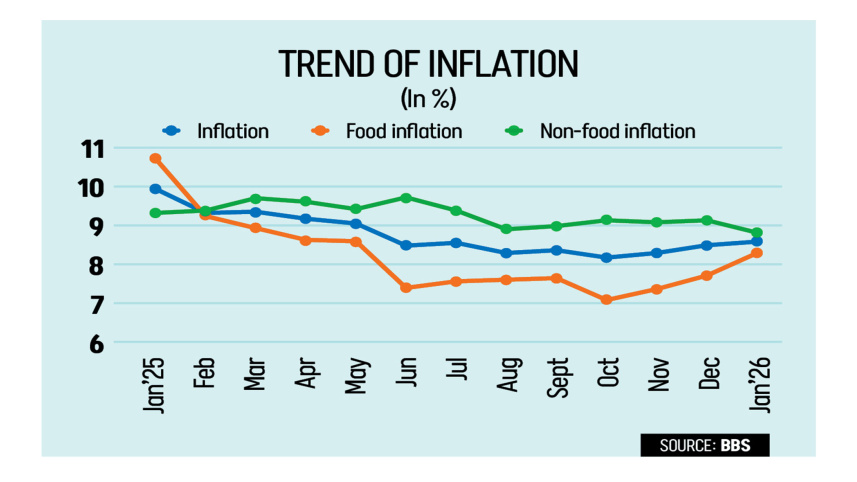
Food inflation, which matters most to ordinary Bangladeshis, climbed to 8.29 percent in January, up nearly 0.6 percentage points from December, according to the Bangladesh Bureau of Statistics (BBS).

Prices of essential food items have been rising steadily in recent months, emerging as the main driver of overall inflation. After easing to 7.08 percent in October from 7.64 percent in September, food inflation rose in each of the following three months.
Overall inflation followed a similar trajectory. After registering a 0.19 percentage points decline in October, headline inflation resumed its upward trend, reaching 8.58 percent in January, BBS data show.
Non-food inflation, by contrast, eased by 0.32 percentage points in January to 8.81 percent, reflecting lower price pressures in areas such as clothing, transport, housing and other services.
Yet this silver lining offers little comfort to lower and middle-income groups when the food on the plate gets costlier, especially at a time when income has remained stagnant. BBS data shows that wage growth increased by only 0.1 percentage points to reach 8.08 percent in January.
Wages remained consistently behind the inflation rate for nearly four years.
ELECTION FEVER
Economists and policy experts attribute the recent surge in food prices to a combination of election-related spending and seasonal demand ahead of Ramadan.
Zahid Hussain, former lead economist for the World Bank in Dhaka, pointed to an unusual confluence of demand- and supply-side pressures in January. “There were significant factors from both sides.”
On the demand side, private spending linked to the election peaked as preparations intensified. “That created a demand pull, and it mostly affected the food category,” Hussain said.
On the supply side, he cited a crisis in liquefied petroleum gas (LPG), used by a large swathe of Bangladeshi households for cooking, in January.
“Everyone who relies on it was affected,” he said. “This has a direct impact on the housing, water and gas category under non-food inflation, but it also creates ripple effects across other sectors of the economy.”
Hussain noted that the recent uptick in overall inflation was driven almost entirely by food prices, while non-food inflation declined on aggregate, a pattern visible in both rural and urban areas.
The data also point to a stubbornly entrenched inflationary psychology. The 12-month average inflation rate now stands at 8.66 percent, well above the central bank’s target, challenging the optimism expressed by Bangladesh Bank (BB) Governor Ahsan H Mansur, who has forecast inflation falling below 5 percent by June 2026.
Hussain cautioned, however, that non-food inflation has not eased uniformly across categories.
Price pressures remain particularly high in housing-related and discretionary segments. Inflation in miscellaneous items stands at around 21 percent, he said. Even as some non-food categories cool, others remain worryingly elevated.
NO BREATHING ROOM
For the central bank, the latest figures leave little room for manoeuvre, Hussain said.
“The BB was expected to announce its monetary policy last week and was waiting for the inflation data to see whether there was any scope to lower the policy rate,” he said. “But the message from the data is clear: the time for change hasn’t come yet.”
 For all latest news, follow The Daily Star's Google News channel.
 “The policy rate should stay where it is, and the exchange rate needs to be kept stable,” he added. “There isn’t much else for the BB to do at this moment.”
Fahmida Khatun, executive director of local think tank the Centre for Policy Dialogue, agreed. “There is no room for reducing the policy rate.”
Echoing Hussain, she also noted that electoral and Ramadan spending pushed the food inflation, which drove the overall inflation. “This is a matter of concern.”
Maintaining tight monetary conditions, however, offers only a holding action.
“Monetary policy does work in this context,” said Hussain. “If things aren’t kept tight during high inflation, the situation will get even worse.”
But tightening alone cannot fully address the problem, he cautioned.
“This is more like a temporary hold. The fire won’t be completely extinguished unless the supply-side problems are fixed.”
Comments