


Over 76% of voters equate development with roads, bridges
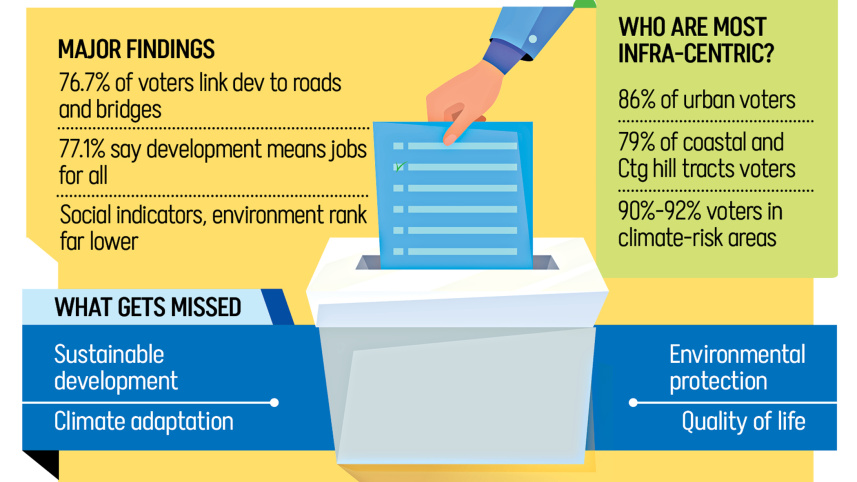
More than 76 percent of voters see development as building new roads, bridges and culverts, according to a survey, even as major political parties increasingly speak of sustainable development.
Researchers say this dominant, one-dimensional understanding leaves little room for improvements in social indicators, environmental outcomes or overall quality of life.

“But this is not their [voters’] fault,” said Khondaker Golam Moazzem, research director at local think tank Centre for Policy Dialogue (CPD).
“Ordinary people will always prioritise their basic, immediate problems, as they still define development in traditional terms,” he said at a programme in Dhaka yesterday to share the survey findings.
The survey, conducted among 1,200 voters and 450 political candidates nationwide, found that 76.7 percent of respondents primarily associate development with building roads and bridges, while 77.1 percent say it means ensuring employment for all.
Perceptions among political party respondents broadly mirrored those of voters.
In some cases, party representatives showed a somewhat broader understanding of development, but infrastructure-led thinking was dominant, according to the survey.
The emphasis on physical infrastructure was particularly strong in urban and climate-vulnerable areas.
About 86 percent of urban voters equated development with roads and bridges, while the figure stands at 79 percent in the Chittagong Hill Tracts and coastal areas. In climate-risk-prone regions, including Barind areas, the share rises to 90-92 percent.
Helen Mashiyat Preoty, senior research associate at the CPD, said both voters and political parties claim to favour sustainable economic growth over traditional growth, but their understanding of development is largely tied to conventional infrastructure-focused models.
She said that such a narrow perception could, over time, overshadow critical issues such as sustainable development, environmental protection and climate adaptation.
Despite the dominance of infrastructure in how development is defined, voters identified the environment, education and health as their top three aspirations for the next decade.
Education ranked as the highest priority across all age groups, according to the survey.
Among social indicators, health and quality education emerged as the most pressing concerns for Bangladesh in the years ahead. Many of these challenges, however, are closely linked to environmental degradation, said CPD.
The survey also found that voters have yet to fully grasp the role of energy transition in environmental protection and restoration.
Most respondents focused on immediate and visible environmental problems, while struggling to link renewable energy or the phase-out of fossil fuels with day-to-day environmental challenges.
When asked about environmental problems, voters cited air pollution, rising temperatures and health hazards as the top three sources of public suffering. Yet the solutions they proposed largely remained traditional, such as planting trees or reducing plastic use.
“This shows that they are not really thinking about why these problems are occurring,” Moazzem said, pointing to a lack of attention to industrial emissions, brick kilns, unregulated chemical industries, river filling and sand extraction.
He said this could reflect limited awareness, fear of challenging powerful interests, or political reluctance to confront the root causes of pollution.
If meaningful change is to occur, Moazzem said, authorities must rein in groups responsible for environmental degradation, including those involved in illegal industrial units, brick and sand businesses and river encroachment.
 For all latest news, follow The Daily Star's Google News channel.
 While political parties have issued national-level election manifestos, he said similar commitments are needed at the local government level, backed by concrete action.
He said area-based employment is important, but it should not come at the cost of environmental damage through brick kilns, sand mining or real estate development on reclaimed land.
Moazzem said members of parliament, local institutions and the government must work together to promote environmentally sustainable, green jobs, alongside investments in health and education.
He also stressed third-party monitoring to assess whether manifesto promises are realistic and implemented, calling for stronger involvement of civil society and respected community members at the local level.
Comments