


Development spending plunges to 16-year low

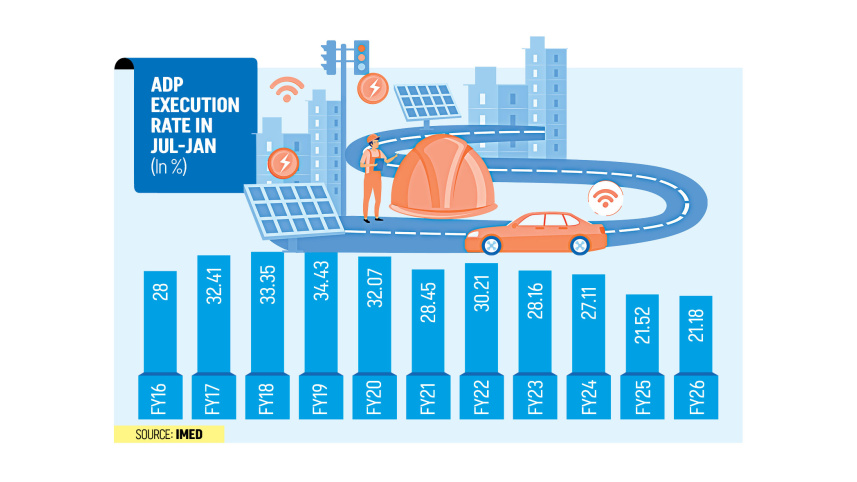
The government’s development expenditure in the first seven months of the current fiscal year 2025-26 (FY26) has slumped to its lowest level in at least 16 years amid fiscal restraints and political disruptions.
Ministries and divisions spent just Tk 50,556 crore – a mere 21.18 percent of the total Annual Development Programme (ADP) outlay – during the period, shows Implementation Monitoring and Evaluation Division (IMED) data published yesterday.

During the same period in FY25, when operations were disrupted by a mass uprising and administrative instability, the ADP implementation rate stood at 21.52 percent. The rates were 27.11 percent and 28.16 percent in FY24 and FY23, respectively.
The slowdown is particularly acute in the health sector, which has recorded dismal implementation rates despite growing concerns about healthcare accessibility.
The Medical Education and Family Welfare Division has utilised only 2.98 percent of its allocation, while the Health Services Division has managed just 6.59 percent, according to the IMED.
Md Deen Islam, research director at Research and Policy Integration for Development (RAPID), blamed lackings in “institutional capacity” for the slow spending.
“The underperformance in the health sector reflects deeper governance challenges. In many cases, those in charge hesitate to take bold decisions, particularly when procurement-related scrutiny creates a climate of fear. That affects implementation,” he added.
The underperformance comes as Bangladesh continues to grapple with one of the world’s highest rates of out-of-pocket health expenditure.
This has led to a “structural vulnerability that demands urgent policy attention,” Islam said.
“A single chronic or terminal illness can push a non-poor family into poverty,” he warned, citing data from the Multiple Indicator Cluster Survey showing stagnation in key health indicators.
He emphasised that without immediate increases in health investment and execution, Bangladesh risks falling further behind on crucial development metrics.
The broader spending slump reflects multiple headwinds. For the current fiscal year, the government allocated Tk 238,695 crore for the ADP, including funds from autonomous bodies.
However, during the July-January period, utilisation of both state funds and foreign loans has declined sharply.
Foreign fund spending fell to approximately Tk 18,668 crore, while government funds amounted to Tk 28,052 crore, down from Tk 30,096 crore in FY25.
This deceleration comes as the interim government implemented a reduced, austerity-focused ADP that slowed or postponed certain projects initiated by the previous administration.
Planning ministry officials note that several contractors fled the country before completing their work following the mid-2024 political changeover, further hampering implementation.
RAPID’s Islam largely agreed, noting that smaller projects may have received less attention as larger initiatives were prioritised.
Infrastructure sectors have fared considerably better than social services.
Among the top 15 recipients of allocations, the Ministry of Water Resources achieved the highest implementation rate at 41.10 percent, followed by the Energy and Mineral Resources Division with 40.66 percent, and the Local Government Division with 36.91 percent.
For Islam, the health shortfall is particularly worrying given Bangladesh’s demographic outlook.
 For all latest news, follow The Daily Star's Google News channel.
 He warned, “Within 15 to 20 years, Bangladesh will gradually transition into an ageing society. Without adequate investment in health infrastructure and human resources, fiscal pressure will intensify.”
He urged authorities to view health spending through an economic lens, noting that Bangladesh maintains a low ratio of nurses and support staff compared to doctors.
“Expanding this workforce would improve service delivery while generating jobs. Health investment is not just social spending, it is also an economic strategy,” he said.
However, Islam said ADP implementation may accelerate under the newly elected political government.
A modest uptick in January offered limited encouragement. The month recorded 3.64 percent implementation of the revised ADP, marginally up from 3.55 percent in January 2024.
“As an elected party, the BNP will have to deliver on its pledges, including job creation, expanding health services, and reducing out-of-pocket costs,” Islam said.
Ashikur Rahman, principal economist at the Policy Research Institute of Bangladesh, concurred that a full-fledged political government could help strengthen ADP spending by accelerating countrywide development activities.
Comments