


Aman cultivation brings cheer to haor farmers

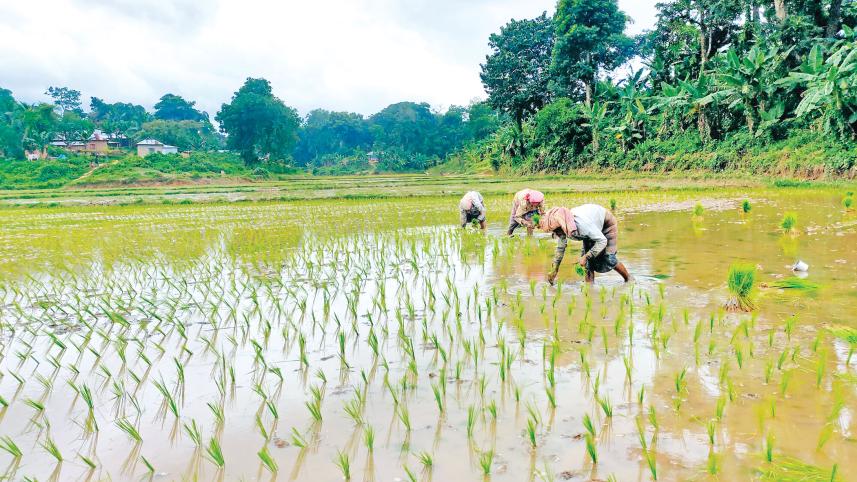
Haor areas of Sylhet division usually remain inundated for most of the year but there are high grounds where Boro paddy can be grown.
In this year's monsoon, thanks to low rainfall, a lot of areas have been saved from inundation, enabling the cultivation of Aman paddy.

According to the Department of Agricultural Extension (DAE), a record amount of Aman paddy is being cultivated by haor farmers in Sylhet this season.
During a visit to various areas in the division, this correspondent found that most farmers were busy planting the crop.
Amar Talukder, a meteorological assistant at Sylhet Meteorological Office, said the total recorded rainfall in July was 647.9 millimetres (mm).
However, 968.5 mm of rainfall was recorded in July last year, he added.
The DAE officials said the department set a target to bring about four lakh hectares of land in Sylhet under Aman paddy cultivation this year, of which 52 per cent has already been attained.
Taking advantage of the favourable climate condition, farmers cultivated Aman on 750 hectares of haor land in Kawadighi and Hakaluki haors, said Kazi Lutful Bari, deputy director of the DAE office in Moulvibazar.
Abdul Momin, agriculture officer of Kulaura upazila, said Aman paddy was a kind of savings deposit for farmers.
Amidst high temperatures in April, farmers in Sylhet did not opt for cultivating Aus paddy.
"But due to the currently favourable weather conditions, farmers are now busy planting Aman paddy using traditional methods," Momin said.
Aman paddy has been cultivated on about 500 hectares of land in Moulvibazar sadar upazila, Rajnagar upazila, and Panchgaon Munshi Bazar Union this season, as per the DAE data.
Besides, about 100 hectares of land in the Hail haor and Barahaor areas of sadar upazila, 100 hectares in Barlekha upazila, and 50 hectares in Juri upazila have come under aman cultivation.
As such, Aman paddy has been planted on a total of 750 hectares of land this season.
Milad Hossain, a farmer from Mirpur area of Moulvibazar sadar upazila, told The Daily Star that farmers like him were totally dependent on paddy production.
"Therefore, due to low rainfall in July…we have planted four to five varieties of Aman paddy in the Boro cultivation area," he said.
"I have planted Brie paddy 7, 85, 95 and Bina paddy 18.
We are continuing the planting work with local workers in the lockdown," Hossain added.
Samsu Mia, a farmer in Shewaijuri area, said times have changed as the region was once inundated with water.
"But since there is less water around Kawadighi this year, I had the courage to start cultivating Aman paddy," he added.
 For all latest news, follow The Daily Star's Google News channel.
 Babar Jaigidar, a farmer in Majlishpur, said the work of planting paddy saplings was going on in time as the weather was favourable and there was timely rainfall. So far, he has planted Aman paddy on 20 bighas of land.
With regard to Boro, bumper yields of the paddy as well as higher prices have led to higher profits.
"So, we have cultivated Aman on 6 more bighas of land in the current season compared to last year," he added. Jaigidar hopes that if the price of Aman paddy, like Boro paddy, was high, he would benefit.
Lechu Mia, a farmer from Sarampur village in Rajnagar upazila, said planting four or five varieties of paddy means that if one of them gives less yield, the other can make up for it.
Muhibur Rahman, a farmer from Rasulpur village in Rajnagar upazila, said for the past 15 years, he had not been able to cultivate any rice on 15 bighas of land at Kawadighi due to waterlogging.
He is happy this year though as the water has receded and he now hopes to harvest a substantial amount of Aman.
In this regard, DAE Deputy Director Bari said some 720 hectares of land has been planted with paddy so far.
"We always encourage farmers to plant high yielding varieties of rice. Most high yielding varieties have been planted in haors, where they had never been cultivated before. There was only Boro paddy," Bari said.
"This time though, the planting of aman paddy has doubled compared to last year," he added.
Dilip Kumar Adhikari, additional director of the DAE in Sylhet, inspected the planting of Aman in sadar upazila. He said agricultural land was decreasing day by day with the increase in population.
"Therefore, in order to meet the food needs of a growing population, planting and production of paddy has to be increased. In this case Aman cultivation gives hopes in the haor areas," he added.
Comments